
Your credit card minimum payment went up this month, and nothing obvious explains it. You opened the statement expecting the usual number, and it isn’t the usual number. Last month the card asked for $120. This month it wants $146. You didn’t miss anything, nobody called, and as far as you know nothing changed.
Something did change, and the statement in front of you almost certainly says what. The trouble is that it says it in small print, spread across three different boxes, in language nobody explains.
Here’s what’s actually going on, how to work out which reason applies to you, and what a rising minimum is really telling you about the account.
How Your Credit Card Minimum Payment Is Calculated
Most people assume the minimum is a fixed amount the bank decided once. It usually isn’t. It’s recalculated every single month, and the formula is the reason the number moves.
Issuers use one of three approaches, and many combine them.
| Method | How It Works | What Makes It Move |
|---|---|---|
| Percentage of balance | Typically 1% to 3% of what you owe | Your balance |
| Fixed amount | A set floor, commonly $25 to $35, regardless of balance | Nothing, until your balance grows past it |
| Combination method | 1% of balance, plus the interest and any fees from that cycle | Your balance, your rate, and any fees |

That third one is the formula that catches people out, and it’s extremely common. A fairly typical rule reads something like this: if your balance is under $35, you pay the balance; otherwise you pay whichever is greater, $35 or 1% of your balance plus the new interest and late fees.
Read that again with a rising rate in mind. If the interest charged this cycle goes up, the minimum goes up with it, even if you didn’t spend a dollar.
Your exact formula is in your cardmember agreement, usually under a heading like “Making Payments” or “How We Calculate Your Minimum Payment.” It’s worth finding once. Ten minutes now saves you guessing every month afterward.
The Seven Reasons a Credit Card Minimum Payment Goes Up
In rough order of how often they’re the culprit.
1. Your Balance Is Higher Than It Was
This is the most common answer by a wide margin, and it’s the one people overlook because the spending happened weeks ago.
Say your balance went from $4,200 to $5,100 over the holidays. On a card charging 22.36% with that 1%-plus-interest formula, the minimum moves from about $120 to about $146. Nothing unusual happened. The formula just did what it does.
Purchases aren’t the only thing that lifts a balance. A balance transfer fee, a cash advance, an annual fee posting, or a buy-now-pay-later style installment plan on the card can all push it up without feeling like spending.
2. Interest Is Being Folded Into the Minimum
If you carry a balance, interest gets charged every cycle. On the common formula, that interest becomes part of next month’s minimum.
This creates a slow upward drift that’s easy to miss month to month and obvious over a year. The balance grows a little, so the interest grows a little, so the minimum grows a little, and around it goes.
3. Your Interest Rate Went Up
Most US credit cards carry a variable APR tied to the prime rate. When prime moves, your rate moves with it, usually within a billing cycle or two, and the issuer doesn’t need your agreement to do it.
The effect is bigger than people expect. On a flat $5,000 balance, going from 19.99% to 24.99% lifts the minimum from roughly $133 to roughly $154. Same balance, same spending, twenty-one dollars more per month.
This is the reason worth checking first in the current climate, because card rates have been sitting near a twelve-month high.
4. A Promotional Rate Ended
Zero-percent offers have an expiry date, and the month it passes is often the month the minimum jumps.
Two things can happen when a promo ends. On a standard 0% APR offer, interest simply starts accruing from that point forward. On a deferred interest offer, which is common with store cards and furniture or electronics financing, any balance left when the promo ends can have the entire period’s interest added retroactively. That second version is brutal and catches a lot of people.
Check your statement for a line about promotional balances and expiry dates. If one just lapsed, you’ve found your answer.
5. You Missed a Payment
An unpaid minimum doesn’t vanish. It’s normally added to the next month’s minimum, so a single miss roughly doubles what’s being asked, and a second miss compounds it.
A late fee usually posts alongside, which increases the balance, which feeds the formula again. Miss enough payments and a penalty APR can apply, which pushes the rate up sharply.
If a payment has already slipped and others are close behind, the order you pay things in matters more than the budget does. Our guide for when you are behind on every bill covers which bills to protect first.
6. A Fee Posted to the Account
Annual fees, late fees, over-limit fees, foreign transaction fees, returned payment fees. Any of these lands on the balance, and some get added into the minimum directly until they’re cleared.
An annual fee is the sneaky one, because it posts on the card’s anniversary rather than at any point you’d be watching for.
7. Your Issuer Changed the Terms
Card issuers can change how they calculate minimums. It happens less often than the other six reasons, but it does happen, and the notice usually arrives as a dense change-in-terms letter that looks like junk mail.
If none of the other explanations fit, dig out any mail from the issuer in the last couple of months.
Working Out Which One Applies to You
You can usually settle this in about ten minutes with two statements side by side. Pull up last month’s and this month’s.
- Compare the closing balances. If this month’s is higher, start there. That’s your answer most of the time.
- Find the interest charged this cycle and compare it to last cycle. A jump with a similar balance means your rate moved.
- Check the APR printed on the statement against last month’s. Cards list it, usually near the interest charge breakdown.
- Look for a fees section. Anything new there went into the balance.
- Check for a promotional balance line and whether an expiry date has passed.
- Confirm last month’s payment actually posted, and posted in full.
Every US card statement also carries a box, required by federal law, showing how long it would take to clear the balance paying only the minimum, and what that would cost. People skim past it. Don’t. It’s the most useful thing on the page.
What a Rising Credit Card Minimum Payment Is Telling You
Here’s the part that matters more than the arithmetic.
A credit card minimum payment is not designed to get you out of debt. It’s designed to keep the account current while the balance earns interest. On most cards it covers the interest plus a sliver of principal, which is why balances can sit almost still for years while you pay faithfully every month.
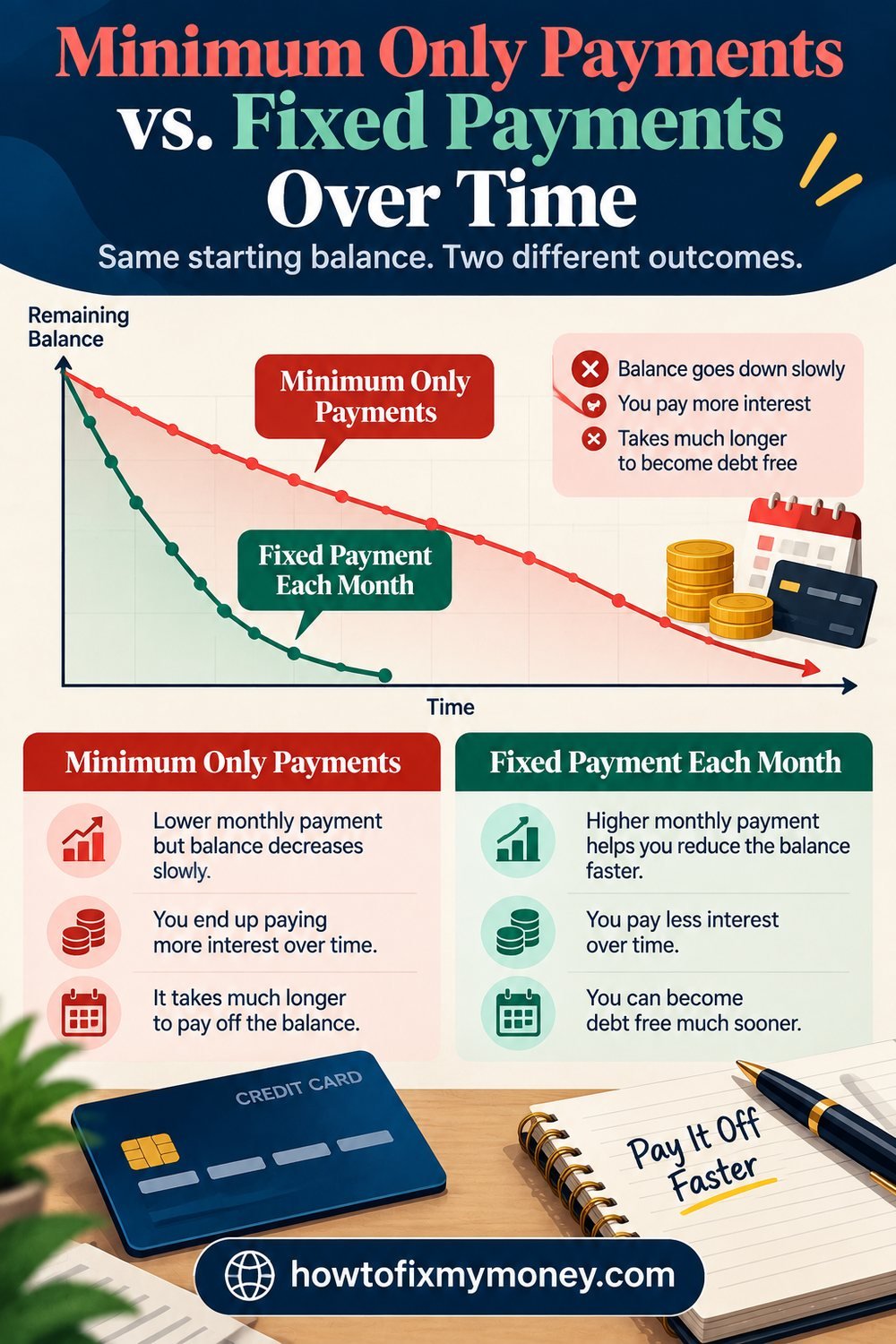
Take a $6,000 balance at 22.36%. The starting minimum under that common formula is about $172.
| What You Pay | Time to Clear | Interest Paid | Total |
|---|---|---|---|
| Minimum only, every month | 18 years | $9,674 | $15,674 |
| Minimum plus $25 | 9 years 1 month | $5,404 | $11,404 |
| Minimum plus $50 | 6 years 2 months | $3,835 | $9,835 |
| Minimum plus $100 | 3 years 10 months | $2,456 | $8,456 |
| $172 held flat every month | 4 years 9 months | $3,789 | $9,789 |
Look hard at the first row against the last row. Both start at the same payment. The only difference is that in the top row you let the payment shrink as the balance falls, and in the bottom row you kept sending $172 regardless.
Same money out the door in month one. Thirteen years and roughly $5,900 apart at the finish.
That’s the single most useful thing on this page. If you do nothing else, pick an amount and stop letting it shrink.
Your own numbers will be different. Put your balance, rate and payment into the free Debt Payoff Calculator and you’ll see your real dates rather than an illustration.
What to Do About It
If You Can Afford the New Minimum
Pay it, then do the one thing in the table above. Set a standing payment at the current amount and leave it there. Not the minimum, which falls as you pay down. A fixed number.
Set it up as an automatic transfer so it doesn’t depend on you remembering in a tight month. And if the increase came from spending, the card needs to stop being used while you clear it, or you’ll be reading this article again in March.
If the balance spans several cards, the order you attack them in changes what it costs you. Our comparison of the debt snowball and avalanche methods runs the numbers on both.
If You Cannot Afford the New Minimum
Call before the due date, not after. This matters more than almost anything else in this article. Issuers have far more room to help an account that’s current than one that’s already late, and the conversation is completely different once a payment has been missed.
Most major issuers run hardship programs they don’t advertise. Depending on the lender and your situation, these can include a temporarily reduced rate, a lower fixed payment for a set number of months, a waived late fee, or a short payment deferral.
What to say is simple. You’ve had a change in your financial situation, you want to stay current on the account, and you’d like to know what hardship options are available. Then stop talking and let them answer.
- Ask for the retention or hardship department specifically. The first person who answers often can’t approve anything.
- Get the terms in writing or by email before the due date passes.
- Never agree to a payment you can’t actually make. Breaking a hardship arrangement leaves you worse off than never having one.
- Ask directly how the arrangement will be reported to the credit bureaus, and get that answer in writing too.
If money is tight across the board, freeing up room elsewhere buys you the space to cover the higher minimum. Our guide on how to cut $300 a month without touching your rent goes through where that money usually hides.
Where to Get Free Help
You never need to pay anyone for reliable information about this.
- The Consumer Financial Protection Bureau explains how credit cards work, what issuers can and cannot change, and how to complain if something looks wrong.
- The Federal Trade Commission covers your options when debt is getting away from you, and how to recognize a scam.
- The Federal Reserve’s consumer credit release publishes average card rates, which is a useful sanity check on whether yours is unusually high.
Non-profit credit counseling agencies also offer free budget sessions and can sometimes negotiate a lower rate on your behalf. A legitimate one won’t charge you before doing any work.
Frequently Asked Questions
Can my credit card company raise my credit card minimum payment without telling me?
If the increase comes from your balance, your rate or a fee, no separate notice is needed. The formula was always in your agreement and it simply produced a bigger number. If the issuer changes the formula itself, that’s a change in terms and you should receive written notice.
Why did my minimum go up when I did not use the card?
Almost always interest, a rate increase, or a fee. Interest charged on a carried balance gets folded into the next minimum on most cards, so the number can climb for months without a single purchase.
Does paying only the minimum hurt my credit score?
Paying the minimum on time is reported as an on-time payment, so it doesn’t hurt your payment history. The indirect problem is that your balance stays high, and how much of your available credit you’re using is a major scoring factor.
Should I pay the minimum or as much as I can afford?
As much as you can afford, by a wide margin. The table above shows an $8,000 difference in total cost on a single $6,000 balance. If money is genuinely tight this month, paying the minimum on time is the right call and keeps the account in good standing.
Will my minimum payment go back down?
Yes, as the balance falls, if your minimum is calculated as a percentage. That’s exactly why holding your payment steady instead of letting it drop is so effective.
What happens if I just cannot pay the minimum at all?
Call the issuer before the due date and ask about hardship options. Skipping the call and missing the payment adds a late fee, can trigger a penalty rate, and starts a mark on your credit report after 30 days. The call is free and the worst answer is no.
Is a balance transfer a good way to deal with a rising minimum?
Sometimes, if your credit still qualifies you for a genuine 0% offer and you can clear the balance inside the promotional window. Watch the transfer fee, usually 3% to 5%, and be realistic about whether the balance will actually be gone before the promo ends. If it won’t, you may have moved the problem rather than solved it.
The Short Version
A credit card minimum payment that went up is a symptom, not the illness. Find the cause on your statement, which is usually a higher balance, a higher rate, or a fee that posted.
Then do the thing almost nobody does. Pick a payment amount, set it to repeat automatically, and don’t let it shrink as the balance falls. On a $6,000 card that one decision is worth around $5,900 and thirteen years.
And if the new number is out of reach, call this week rather than next. A phone call while the account is still current opens doors that close the moment a payment is missed.
For a structured way to clear what’s left, see our 12 months to debt free plan, or browse more guides in our Debt Relief section.

Bilal founded HowToFixMyMoney.com in 2026 to make US personal finance decisions easier to work through without a financial background. Every figure published here traces back to a primary source — the Bureau of Labor Statistics, the Federal Reserve, the IRS, the CFPB — and each article links to the data it relies on. He is not a licensed financial advisor, and nothing on this site is personalized advice.