Black Friday falls on November 27 this year. The days before it are not time to find more money. They are time to set a Black Friday budget, before a countdown timer sets one for you.
Most spending advice treats the number as the easy part and the willpower as the hard part. That has it backwards. A Black Friday budget written down in advance survives the weekend. A Black Friday budget you work out in the moment, surrounded by crossed-out prices, does not. Our Black Friday budget calculator lets you write it down now: add your list, and it shows the total with tax and whether it fits.
This article gives you the number, meaning how much Black Friday money you can safely spend, and then gives you the two things that decide whether it holds: what the discounts are genuinely worth, and how fast they stop being worth anything once you finance them. It ends with what the bill looks like in January, and how to clear it before interest takes over.
How Much Black Friday Money Should You Spend? The 40% Rule That Works on Any Paycheck
How much do other shoppers spend? In Deloitte’s 2025 survey, shoppers planned to spend an average of $622 from Black Friday through Cyber Monday, and 64% planned to use credit cards or buy now, pay later to cover it. That average is not your number. Your number comes from the money that actually exists.
Your Black Friday budget is not a separate pot. It is a slice of the money you have already set aside for the whole season, which means the first question is how much exists. If you’re hosting Thanksgiving the day before, price the dinner first with our Thanksgiving dinner cost calculator, because the grocery bill comes out of the same pot.
If you started a holiday sinking fund, roughly half of it has landed by now. Spending all of it this weekend leaves December empty, and December is when the costs nobody plans for arrive.
No Christmas Budget Yet? Find Your Number in Two Minutes
Take one month’s take-home pay and subtract everything you must pay before the next paycheck: rent or mortgage, utilities, phone, insurance, car costs, minimum payments on every card and loan, and groceries. What remains is the most that paycheck can give the whole season.
If that number is zero or negative, your Black Friday budget is $0 this year. Skip the sales and start with what to pay first when you’re behind on every bill.
Carrying Credit Card Debt? Cut Your Black Friday Share in Half
At the 22.36% average card rate, a balance you carry for a year costs about as much as a typical Black Friday discount saves. Drop your share from 40% to 20% and send the difference to the balance you already owe.
| Your Total Christmas Budget | Black Friday Share (40%) | If You Carry Card Debt (20%) | Keep for December (at 40%) | Why |
|---|---|---|---|---|
| $300 | Up to $120 | Up to $60 | $180 | Food, travel and last-minute gifts all land later |
| $500 | Up to $200 | Up to $100 | $300 | The gaps in your list appear in week three |
| $800 | Up to $320 | Up to $160 | $480 | Bigger lists leave more people unaccounted for |
| $1,200 | Up to $480 | Up to $240 | $720 | Travel and hosting costs scale with the budget |
Forty percent is a working guide rather than a rule. Shift it upward if your list is weighted toward electronics and toys, where the discounts genuinely run deepest. Shift it down if you are buying mostly food, travel or experiences, which barely discount at all.
Whatever share you choose, write the dollar figure down before November 27 and treat it as the whole of what exists. A Black Friday budget you can quietly extend is not a budget.
Why a Black Friday Budget Has to Exist Before the Sales Do
Adobe forecasts $275.1 billion in US online holiday spending between November 1 and December 31, up 6.7% on last year. Black Friday alone accounts for $12.9 billion of it online, and Cyber Monday on November 30 for $15.1 billion.
Those numbers exist because the weekend works, and it works by dismantling whatever Black Friday budget you brought to it. Retailers spend the year preparing four days designed to move you from browsing to buying, and the mechanism is not the discount itself. It is the deadline attached to it.
A deadline removes comparison, which is what a Black Friday budget depends on. You cannot check a price history, sleep on it, or ask whether you wanted the thing last week, because the timer says the decision expires. That pressure is the product.
So your Black Friday budget is not a spending limit. It is the one decision you make while you can still think clearly, and everything after it is just execution.
Set Your Black Friday Budget Against the Real Discount Ceiling
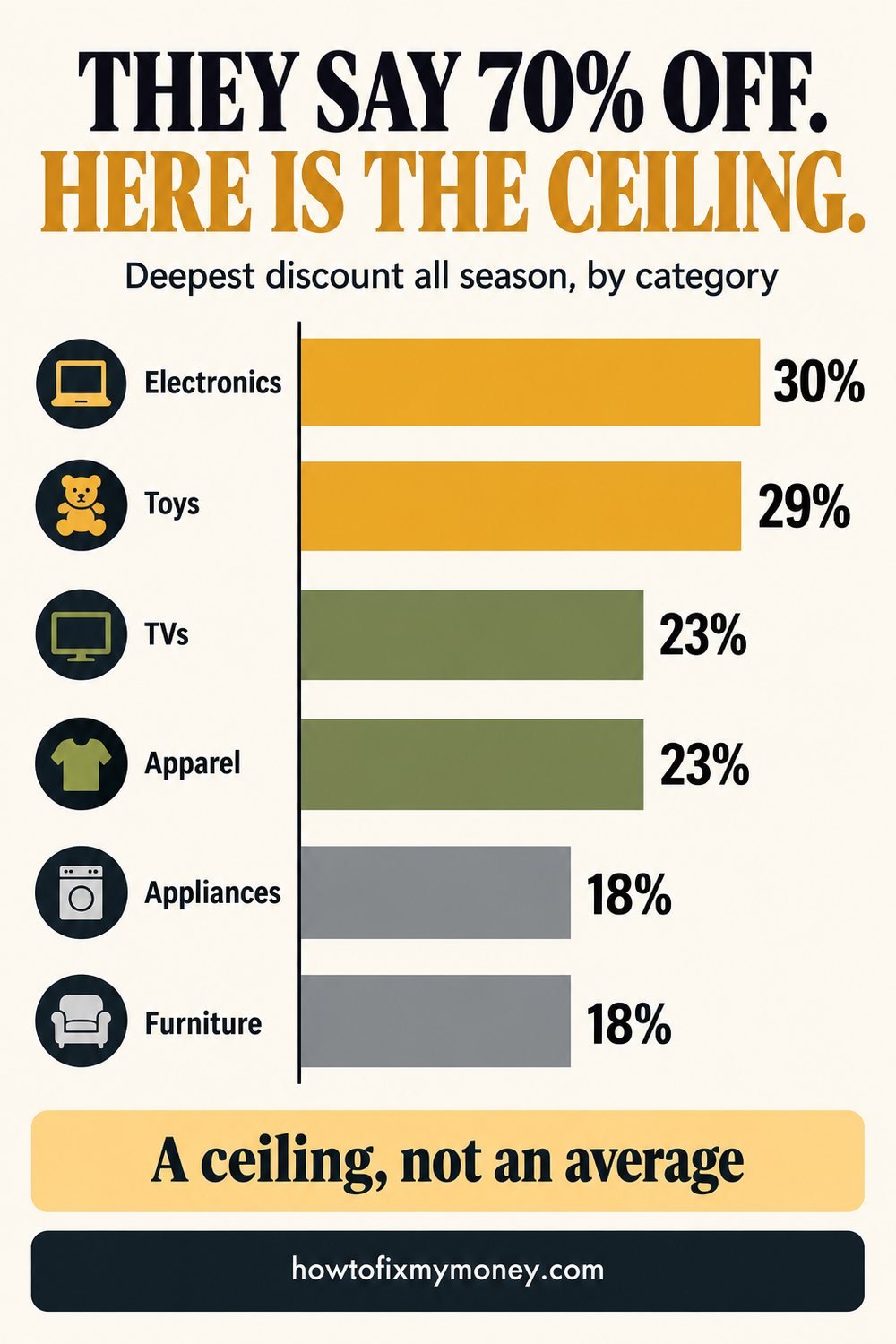
Build your Black Friday budget on what the discounts actually reach rather than on what the signs claim. Retailers advertise up to 70% off. Adobe tracks what the discounts really reach at their deepest point across the whole season, and the numbers are considerably smaller.
| Category | Peak Discount | What $400 of List Price Costs | You Keep |
|---|---|---|---|
| Electronics | 30% | $280 | $120 |
| Toys | 29% | $284 | $116 |
| TVs | 23% | $308 | $92 |
| Apparel | 23% | $308 | $92 |
| Appliances | 18% | $328 | $72 |
| Furniture | 18% | $328 | $72 |
Read that as a ceiling rather than a promise. Thirty percent off electronics is the deepest point of the entire season, reached on a handful of items, not the average you will find on a Friday morning.
The practical use for a Black Friday budget is simpler. If you want furniture, the best discount available all season runs around 18%. Waiting for half off furniture means waiting for something that is not coming, and the waiting itself costs you the chance to plan.
Set your Black Friday budget against these figures rather than against the signs in the window. A category with an 18% ceiling deserves less of your money than one with a 30% ceiling, because the same dollar does less work there.
Sixty Percent of Reference Prices Failed the Only Real Test Anyone Applied
A discount needs a before price, and that before price is where the trouble starts. Researchers at Oxylabs tracked 61,172 products across two major US marketplaces, checking prices every hour from August through Black Friday and collecting over 44 million data points.
They then applied California’s standard, which treats a former price as legitimate only if the item actually sold at that price for at least half the three months beforehand.
Of the products with enough price history to test, 60% failed. Their advertised reference prices did not reflect what the item had genuinely been selling for. Nearly 2,000 products had carried a discount tag continuously since August, which makes the sale price the normal price and the crossed-out number decoration.
On one of the two marketplaces, the Black Friday price was the lowest price of the preceding week in only 28% of cases. On the other, 59%. Either way, a large share of shoppers paid the same or more than they would have paid a week earlier, while believing they had caught a deal.
How to Check Any Discount in Thirty Seconds Flat
You do not need to trust the sign, and checking protects your Black Friday budget in less time than reading the product description.
- Screenshot the price now. Before the sale starts, record what the three or four things on your list actually cost today. This single habit beats every deal-hunting tool, because you are comparing against a price you personally observed.
- Check a price-history tool before you buy. Browser extensions and price-tracking sites show the last several months for most major retailers, and a flat line ending in a dip tells you the discount is real.
- Search the exact model number rather than the product name. Retailers create Black Friday variants with slightly different model numbers, which makes direct comparison harder and sometimes hides a lower specification.
- Ignore the percentage and read the dollar price. A 40% discount off an inflated figure costs more than 20% off an honest one, and only the dollar amount leaving your account is real.
- Check the return window before buying, not after. Many retailers extend holiday returns into January, and some explicitly exclude doorbuster items from that extension.
Four of those five cost nothing but a few minutes, and they convert your Black Friday budget from a guess into a measurement.
What a Discount Is Worth Once You Put It on a Card

Here is the arithmetic that decides whether a Black Friday budget survives January. The Federal Reserve puts the average rate on cards carrying a balance at 22.36% in its G.19 report for August 2026. Apply that to a $500 purchase and watch the discount evaporate.
| Advertised Discount | Cash Price | Paid Over 6 Months | Over 12 Months | Over 18 Months |
|---|---|---|---|---|
| 30% off electronics | $350 | 25.4% real | 21.2% real | 17.0% real |
| 23% off a TV | $385 | 17.9% real | 13.4% real | 8.7% real |
| 18% off furniture | $410 | 12.6% real | 7.7% real | 2.7% real |
An 18% furniture discount carried for eighteen months nets you 2.7%. You compared, you waited in line, you felt clever, and the interest took almost all of it back.
That table is the strongest argument for setting your Black Friday budget in cash terms rather than in credit-limit terms. A discount is only a discount if you pay for it once.
The same logic applies in reverse and is worth knowing. If you genuinely have the cash, a real 30% discount on something you had already planned to buy is an excellent use of money, considerably better than most things you could do with $120.
The Trap That Turns a Black Friday Budget Saving Into a Loss
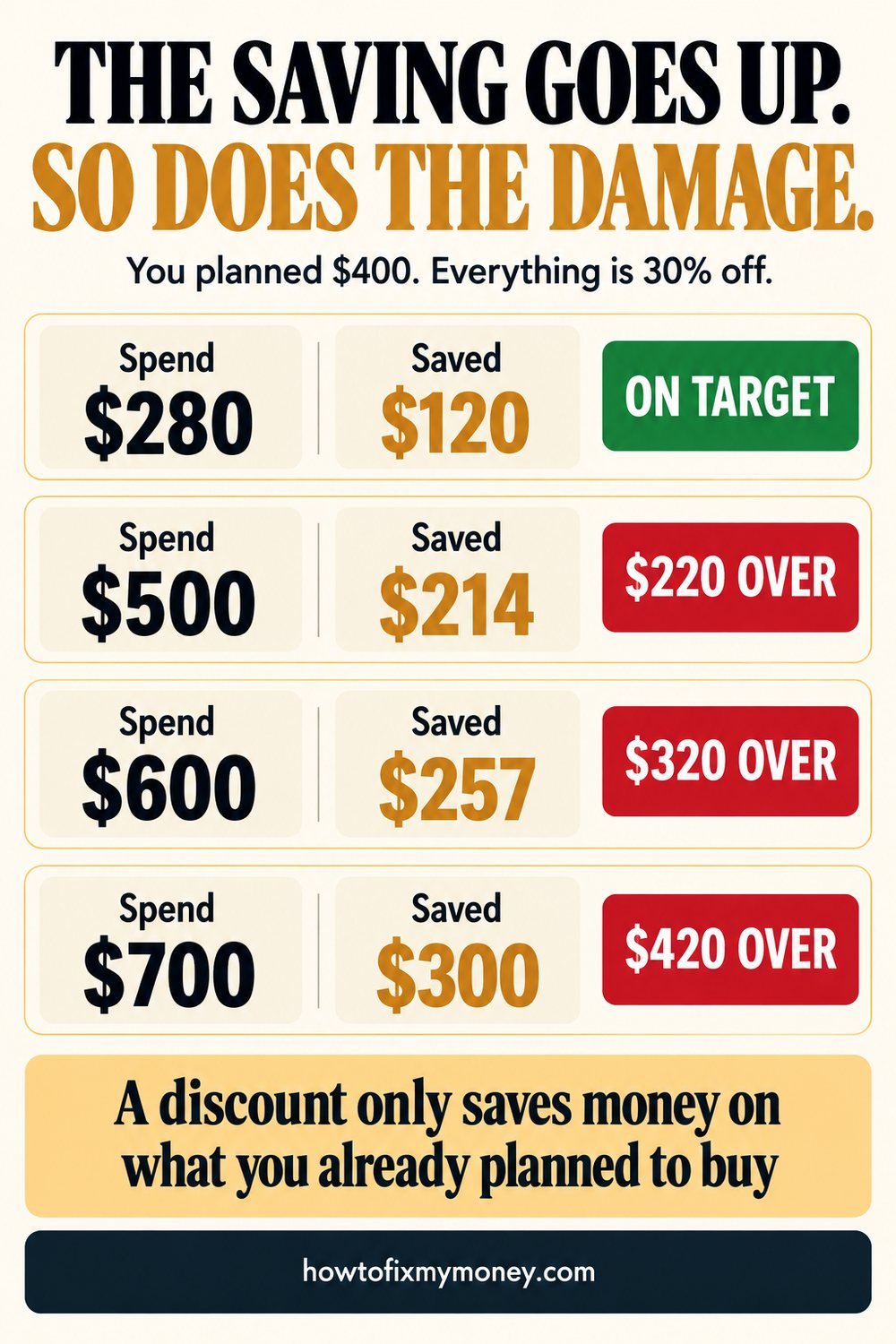
Suppose you planned to spend $400 and everything is 30% off. Buying exactly what you planned costs $280 and leaves $120 in your account. That is the entire point of the exercise.
| What You Actually Spend | List Value You Got | Paper Saving | Versus Your $280 Plan |
|---|---|---|---|
| $280, as planned | $400 | $120 | On target |
| $500 | $714 | $214 | $220 over |
| $600 | $857 | $257 | $320 over |
| $700 | $1,000 | $300 | $420 over |
Every row after the first shows a larger paper saving and a worse outcome against your Black Friday budget. The saving column grows because you bought more, which is precisely the behavior the discount exists to produce.
A discount only saves money on something you were already going to buy. On anything else it is a reduced price for an unplanned purchase, which is still a purchase, and your account cannot tell the difference.
The 17% That Comes Straight Back
Retailers expect 17% of holiday sales to come back, and research with the National Retail Federation found that 82% of shoppers return unwanted gifts within a month of receiving them.
Apply that to your own Black Friday budget. Spend $500 and roughly $85 of it statistically comes back, which means a chunk of what you lined up for never ends up under a tree at all.
Two practical consequences follow. Keep every receipt and gift receipt in one place from the moment you buy, because the January version of you will not remember which retailer had which item. And check whether doorbuster or clearance items sit outside the extended holiday return window, since those exclusions are common and rarely advertised.
Buy Now, Pay Later Is Not a Black Friday Budget
Adobe forecasts $21.3 billion of buy now, pay later spending across November and December, up 6.6% on last year. The weekend is where most of it starts, and it is where a Black Friday budget most often stops being one.
Split payments feel different from a card because the first installment is small and the plan charges no interest. The problem is not the cost of any single plan. It is that four purchases across four retailers create four payment schedules that never appear on one statement, so the combined monthly commitment is invisible until a payment misses and a late fee lands.
If you use these plans, add every installment together before the weekend ends and write the monthly total next to your Black Friday budget. A plan you cannot total is a plan you are not actually managing.
What Your Black Friday Bill Will Look Like in January, and How to Pay It Off Before Interest Hits
A card purchase on November 27 lands on the statement that closes in December, and card issuers must give you at least 21 days between the statement and the due date. So your Black Friday bill comes due in late December or January, right on top of your Christmas costs.
Pay the full statement balance by the due date and you pay no interest, as long as you started the month at $0. Already carrying a balance? Most cards then charge interest on new purchases from the day you buy, so the clock starts on Black Friday itself.
| How You Pay a $600 Black Friday Bill | Monthly Payment | Months to Clear | Interest Paid | Total Cost |
|---|---|---|---|---|
| Full statement balance by the due date | $600 once | 1 | $0 | $600 |
| Over 3 months | $207.50 | 3 | $22.50 | $622.50 |
| Over 6 months | $106.62 | 6 | $39.73 | $639.73 |
| Minimum payments only | $25 | 33 | $202.70 | $802.70 |
Estimates at 22.36% APR with interest charged monthly and no other balance on the card. Minimum payment assumed as the greater of $25 or 1% of the balance plus interest. Your card’s terms may differ.
Minimum payments turn a $600 weekend into an $802.70 bill that lasts almost three years. Three payments of $207.50 clear the same purchase by March for $22.50 in interest.
Split-pay plans add a second bill on their own schedule. Most pay-in-4 plans charge every two weeks, so a $400 order on November 27 means $100 on November 27, December 11, December 25 and January 8, the same weeks your card bill and Christmas costs arrive.
Three Moves That Stop a Black Friday Bill From Following You Into Spring
- Add up every card charge and every split-pay installment once Cyber Monday ends, and write one total next to your Black Friday budget.
- If you can’t clear the statement in one payment, set an automatic payment for the three-month amount instead of the minimum. Our credit card payoff calculator shows your exact figure.
- Already holding more than one balance? Pick a payoff order with debt snowball vs avalanche, and if Christmas adds more, follow the plan to pay off Christmas debt before it compounds.
What Genuinely Gets Cheaper in November, and What Does Not
Timing matters as much as the number in your Black Friday budget, because categories move on different schedules.
- Televisions and laptops reach their deepest discounts during the weekend itself, which is the one genuine reason to shop it rather than wait.
- Toys discount hard in late November and again in the final week before Christmas, so a toy you miss now will likely reappear cheaper in December.
- Apparel discounts continue past Christmas and into January clearance, which usually beats anything offered in November.
- Furniture and appliances follow their own calendar tied to new model releases, and Presidents Day and Memorial Day routinely beat Black Friday.
- Food, travel and event tickets barely discount at all in November and frequently cost more, so budget for them at full price.
Use that list to decide what belongs in this weekend’s share and what belongs in December’s. Moving a category to the right week costs nothing and often saves more than the discount would have.
Set the figure before the sales set it for you
Put your real income and bills into the free Budget Planner and find what this season can genuinely support. Take 40% of that for the weekend, write it down, and treat it as the whole of what exists.
Five Rules That Keep a Black Friday Budget Intact
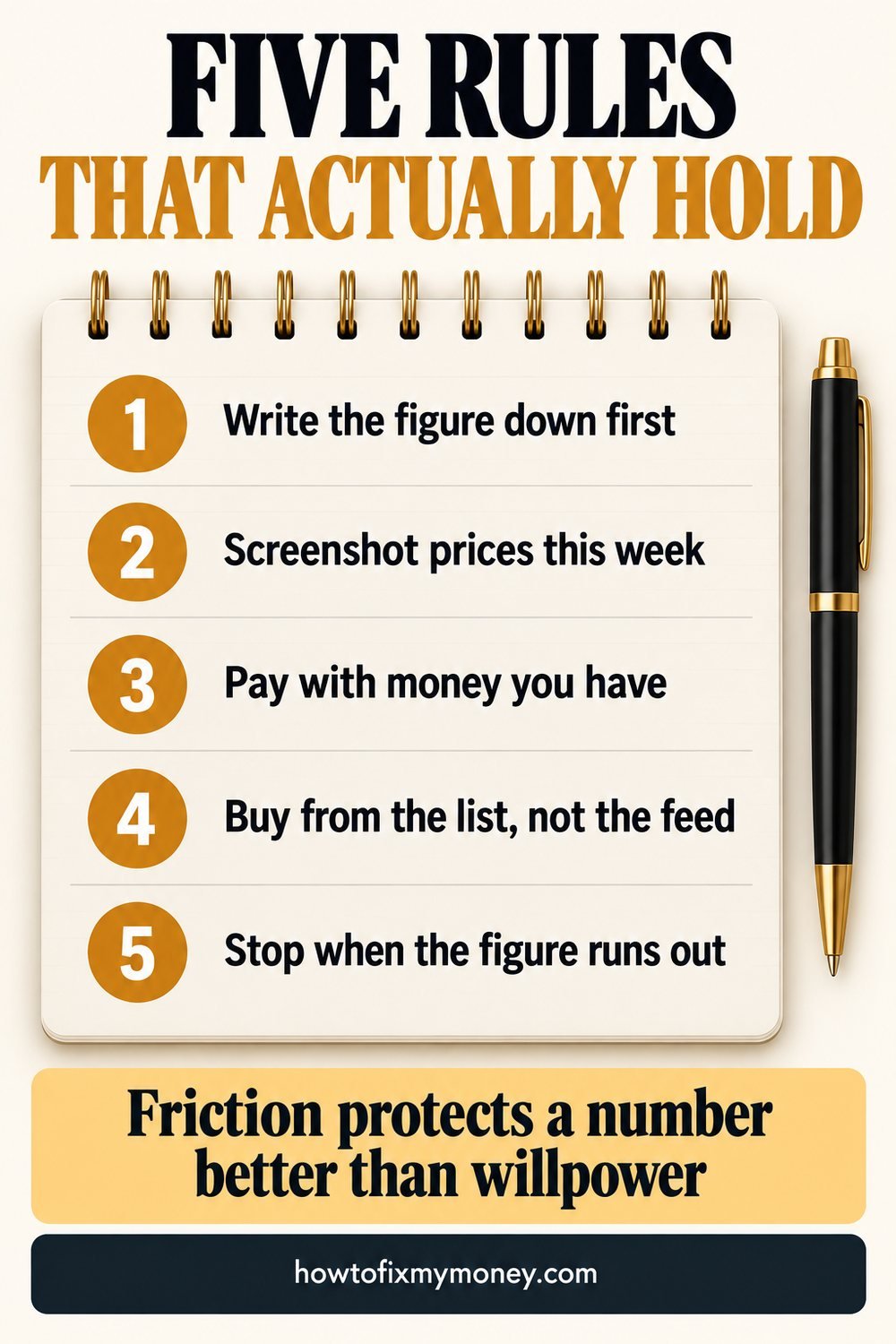
- Write the dollar figure down before November 27 and tell someone else what it is. A number nobody else knows is a number you can quietly revise.
- Screenshot the prices of everything on your list this week. You are building your own reference prices, which is the only kind that cannot be manipulated.
- Pay with money you already have. A discount financed over a year loses most of its value, and over eighteen months on a low-discount category it loses nearly all of it.
- Buy from the list, not from the feed. Decide the names and the items in advance, and treat anything that was not on the list as a full-price purchase regardless of the tag.
- Stop when the figure runs out, even on day one. The weekend lasts four days by design, and the pressure to keep going is manufactured.
Those five rules cost nothing, and a Black Friday budget needs them precisely because the weekend is built to break one.
Questions People Ask About Setting a Black Friday Budget
How much should a Black Friday budget actually be?
Work backward from your total Christmas budget rather than from the deals. Roughly 40% of what you have set aside is a sensible ceiling for the weekend, which leaves enough for the costs that arrive in December. Shift that share up if you are buying electronics or toys, and down if your list is mostly food, travel or experiences. If you carry credit card debt, cut that share to 20%.
Are Black Friday discounts actually real?
Some are, many are not, and the label never tells you which. In the Oxylabs study of over 61,000 products, 60% of those with enough price history carried reference prices that failed California’s regularly-offered test. Check a price-history tool or your own screenshot rather than trusting the crossed-out number.
Is it better to wait for Cyber Monday?
It depends entirely on the category. Online-only electronics and smaller tech often see their best prices on Cyber Monday, while televisions and large appliances tend to peak during the weekend itself. If an item appears in both events, the difference is usually small enough that certainty beats optimization.
Should I use buy now, pay later for Black Friday?
Only if you could have paid in full and are choosing the split for cash-flow reasons. The risk is not any single plan, it is running several at once across different retailers, where the combined monthly commitment never appears in one place. Total every installment before the weekend ends.
When will my Black Friday credit card bill be due?
A purchase on November 27 usually appears on the statement that closes in December, with the due date at least 21 days after that, so most Black Friday bills come due in late December or January. Pay the full statement balance by then and you avoid interest, unless you were already carrying a balance.
What if the thing I want is not discounted?
Then buy it later or not at all, because a full-price purchase made during a sale weekend is simply a full-price purchase with extra pressure attached. Many categories discount more deeply in December or January, and a few never meaningfully discount at all.
How do I stop myself blowing the Black Friday budget on the day?
Take the figure out of your main account before the weekend and leave the card at home, or use a separate account holding exactly your Black Friday budget. Friction protects a number better than willpower does, and a declined transaction is a decision you already made calmly.
Do price adjustments still exist?
Many retailers will refund the difference if an item drops in price within a set window after purchase, often seven to fourteen days. Ask about the policy at the point of sale and keep the receipt, because the refund is rarely automatic and almost always requires you to ask.
What is the single biggest mistake people make?
Treating the saving as income. A $120 discount is not $120 you now have available for something else, and spending it again is how a weekend that started with a plan ends with a January statement that does not match anyone’s memory of it.
Your Black Friday Budget Plan From Now Until November 27
Today, write the list that your Black Friday budget has to cover. Every name, every item, with a dollar figure beside each one. Add the total, then decide what share of your Christmas money becomes the Black Friday budget.
This week, screenshot the current price of everything on that list. You are collecting evidence, and on November 27 those screenshots will defend your Black Friday budget better than any advertised percentage.
In the final days before November 27, move your Black Friday budget into a separate account and leave the rest where it is. Then shop the list, check each price against your own screenshot, and stop when the figure runs out.
Work out what your season can actually support with our free Budget Planner. If you are still building the money, the holiday sinking fund plan sets your weekly number, and what to cut first when Christmas costs too much handles the gap if the list runs past the budget. More guides sit in our Saving Money section.
Sources
- Adobe Analytics, 2026 holiday shopping forecast, September 28, 2026 – $275.1 billion online spend, peak discount percentages by category, $21.3 billion buy now pay later.
- Oxylabs, research on fake discounts – 61,172 products tracked hourly across two US marketplaces, 44 million data points, 60% of testable reference prices failed California’s regularly-offered standard.
- Deloitte, 2025 Black Friday-Cyber Monday survey – $622 average planned spend, 64% planning to use credit cards or buy now pay later.
- National Retail Federation, winter holiday FAQs – 17% of holiday sales expected to be returned.
- Federal Reserve, G.19 Consumer Credit, August 2026 – 22.36% average rate on cards carrying a balance.
- Effective discount figures after interest, and the $600 bill payoff table, calculated by How To Fix My Money using standard amortization at 22.36%.

Bilal founded HowToFixMyMoney.com in 2026 to make US personal finance decisions easier to work through without a financial background. Every figure published here traces back to a primary source — the Bureau of Labor Statistics, the Federal Reserve, the IRS, the CFPB — and each article links to the data it relies on. He is not a licensed financial advisor, and nothing on this site is personalized advice.