One income pays the same rent two incomes pay. That sentence explains almost everything about why standard debt advice fails single mothers.
Cut your spending by 10% and a two-earner household still has a second paycheck behind it. Cut yours by 10% and you have cut into groceries, because the obvious savings disappeared years ago. A single mom budget is not loose. It is already tight.
So a single mom budget that actually clears debt has to find the money somewhere other than the grocery line. For most single mothers, the largest available sum sits in the tax code, and a worked example later in this article puts it above $6,000 a year.
Why a Single Mom Budget on One Income Breaks Differently From Everyone Else’s
Two-income households carry a hidden insurance policy. When one earner loses hours, the other absorbs the hit for a while. One income removes that cushion entirely.
The effect shows up in three specific ways, and a single mom budget has to answer all three rather than just trimming expenses.
- Fixed costs eat a bigger share. Rent, utilities, insurance and a car payment cost roughly the same regardless of how many adults live there, so they consume far more of one paycheck.
- Every emergency lands on credit. Without a buffer, a $600 car repair becomes a $600 balance at a double-digit rate, which then competes with the debt you were already paying.
- Childcare behaves like a second rent. It arrives monthly, it rises, and it does not flex when money gets tight, which rules out the advice that assumes a spare few hundred dollars.
None of that makes the debt unpayable. It means a single mom budget has to find the payment somewhere the usual advice never looks.
The Filing Status That Costs Single Moms Over $1,000 Every Year
Start here, because this single line on a tax return moves more money into a single mom budget than a year of coupon clipping.
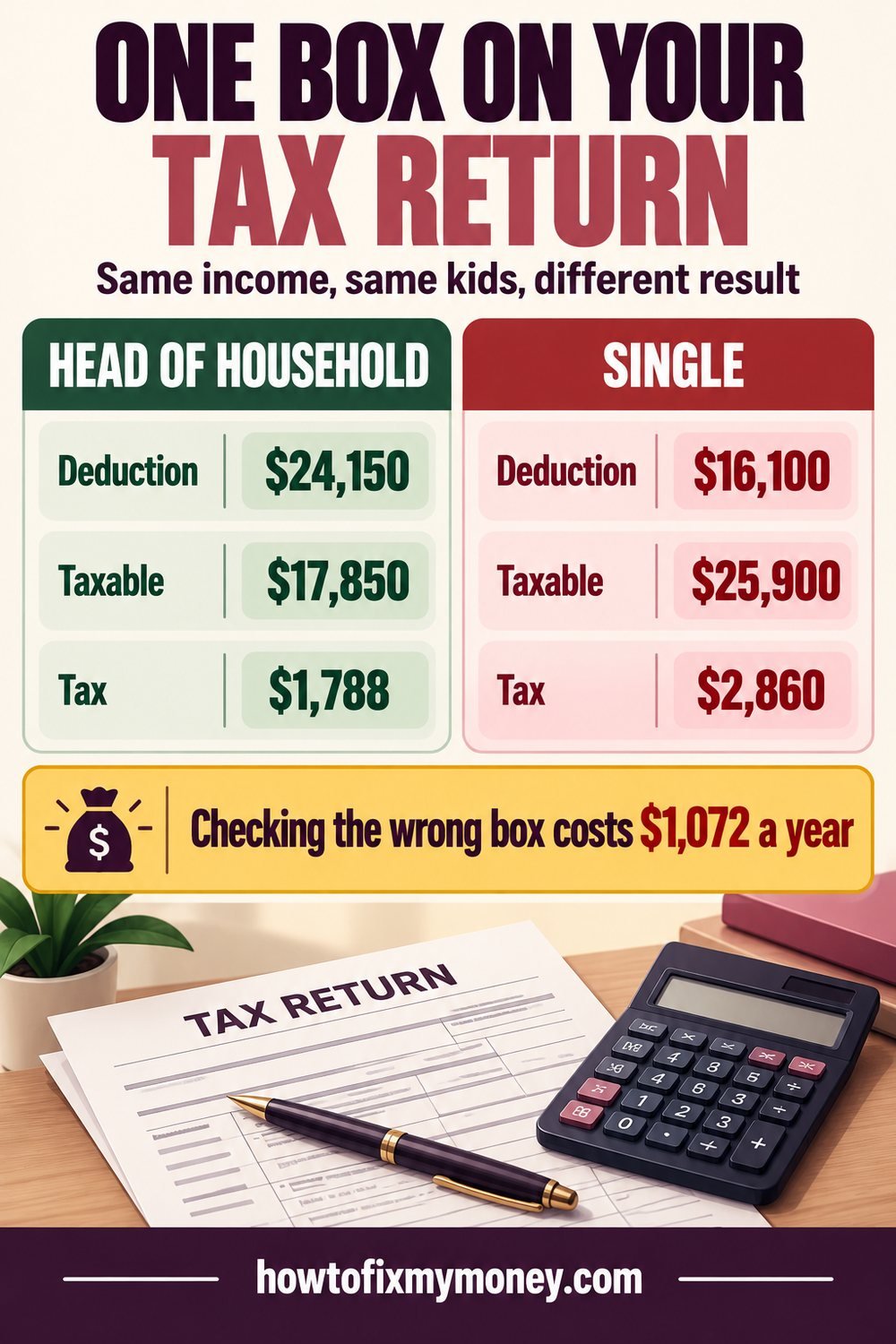
A single parent who pays more than half the cost of keeping up a home for a qualifying child can usually file as head of household rather than single. For 2026 the standard deduction runs $24,150 for head of household against $16,100 for single filers, and the tax brackets sit wider too.
Put a single mother earning $42,000 with two children through both versions:
| Filing Status | Standard Deduction | Taxable Income | Tax Before Credits |
|---|---|---|---|
| Head of household | $24,150 | $17,850 | $1,788 |
| Single | $16,100 | $25,900 | $2,860 |
| Difference | $8,050 | $8,050 | $1,072 |
The same income and the same children produce a $1,072 gap purely from the box she checks, and that gap lands straight in the single mom budget. Filing as single when head of household applies hands that money away every year, and plenty of single mothers do exactly that without knowing.
What the 2026 Credits Actually Pay a Single Mom on One Income
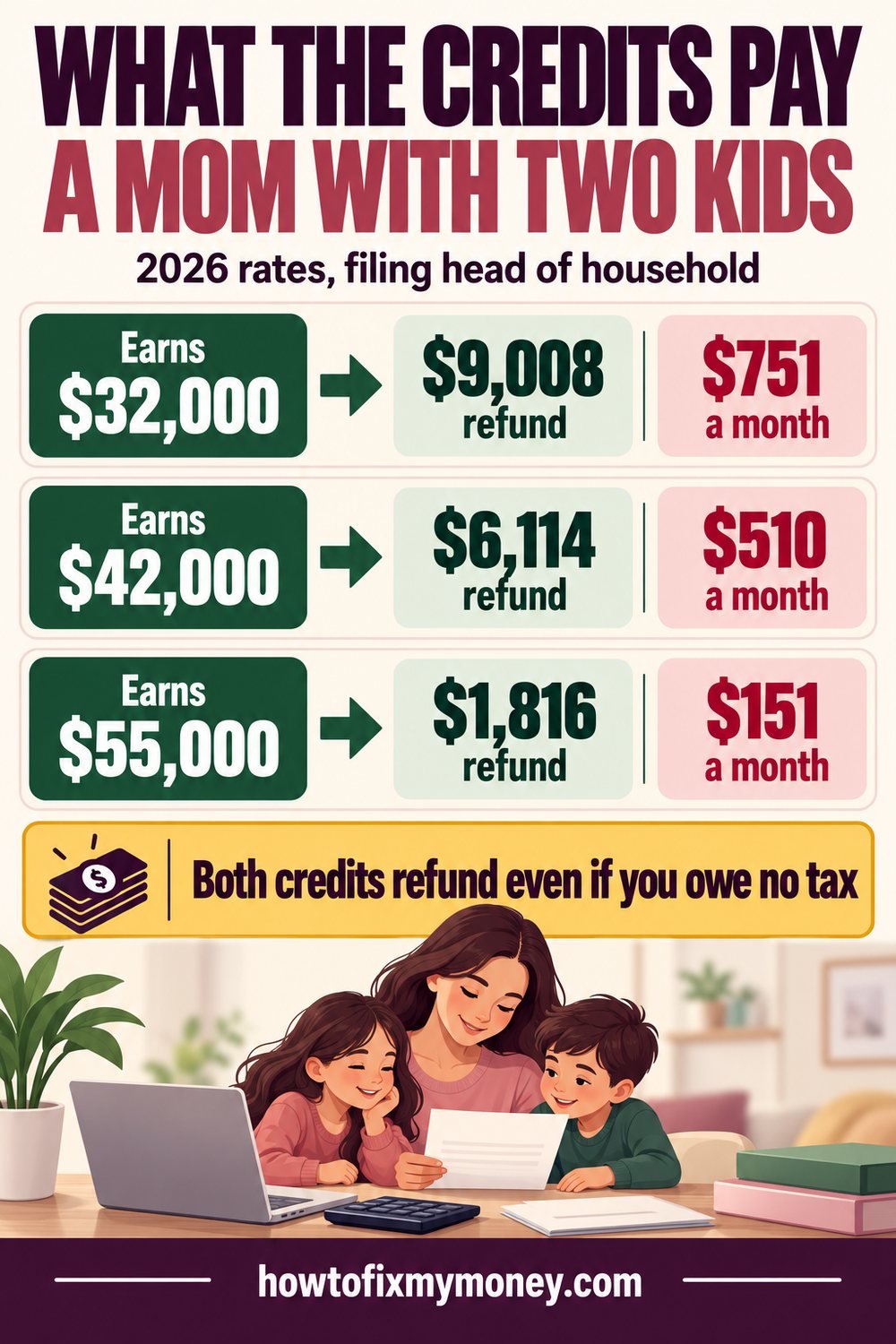
Two credits do the heavy lifting in a single mom budget, and both refund money even when you owe no tax at all.
The Child Tax Credit pays $2,200 per qualifying child for 2026, with up to $1,700 of that refundable. The Earned Income Tax Credit pays a maximum of $4,427 with one child, $7,316 with two, and $8,231 with three or more, then phases out as income rises.
Run one mother with two children across three income levels and the pattern becomes clear:
| Her Income | Tax Owed After Credits | Refund From Credits | Equivalent Monthly |
|---|---|---|---|
| $32,000 | $0 | About $9,008 | $751 a month |
| $42,000 | $0 | About $6,114 | $510 a month |
| $55,000 | $0 | About $1,816 | $151 a month |
Those figures feed a single mom budget directly. They combine the refundable Child Tax Credit with the Earned Income Tax Credit at 2026 rates, and they assume head of household filing with two qualifying children and no other complications. Your own result depends on your exact income, how many children qualify, and tests the IRS applies to each credit.
Read the last column again, because it reframes the whole problem. A mother earning $42,000 is sitting on roughly $510 a month of payment capacity that never appears in her monthly budget. No amount of trimming a single mom budget finds that much.
Claim it properly rather than paying someone a slice of it. IRS Free File offers guided tax software at no cost to anyone with an adjusted gross income of $89,000 or less, and IRS-funded volunteer sites prepare returns free in person for filers who qualify. Refund anticipation products take a cut of money you already earned.
What That Refund Does to Real Debt, With the Arithmetic
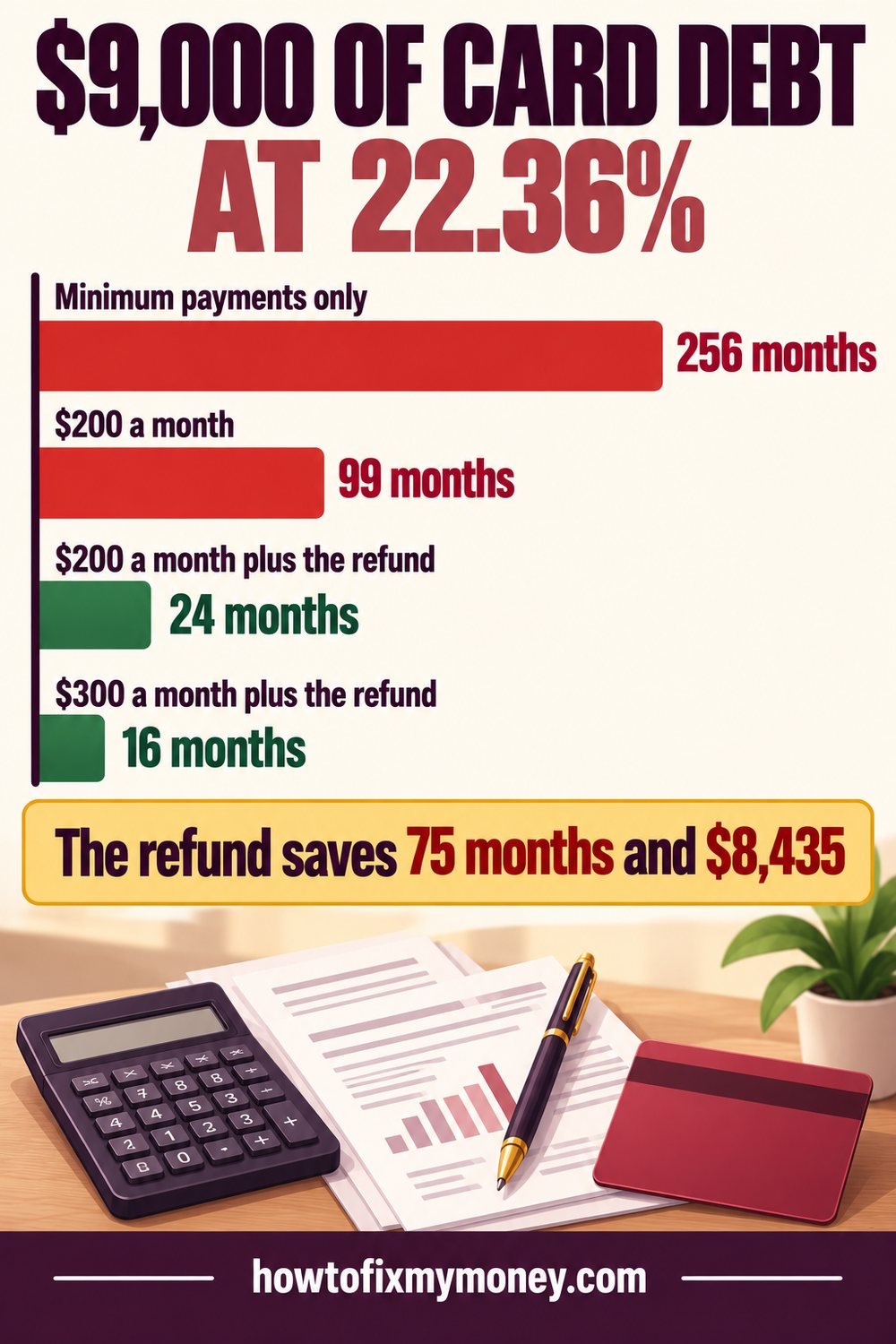
Take $9,000 of credit card debt at 22.36%, the average rate on cards carrying a balance in the Federal Reserve’s G.19 report for August 2026. Watch what the refund does.
| How You Pay It | Months to Clear | Interest Paid | Total Cost |
|---|---|---|---|
| Minimum payments only | 256 | $15,264 | $24,264 |
| $200 a month | 99 | $10,752 | $19,752 |
| $200 a month plus the refund | 24 | $2,317 | $11,317 |
| $300 a month plus the refund | 16 | $1,891 | $10,891 |
Adding one $6,114 refund a year to a $200 monthly payment clears the debt 75 months sooner and saves $8,435 in interest. The monthly payment never changed, and neither did the single mom budget around it. Only the refund did.
Minimum payments on that same balance run 256 months and cost more than the original debt. A single mom budget built on minimums is not a payoff plan; it is a subscription.
Splitting the refund still beats leaving it out of the single mom budget. Putting half at the debt and half into savings clears the balance in 31 months rather than 99, which many mothers prefer because it builds the buffer at the same time.
Six Steps to Build a Single Mom Budget That Clears Debt
Work through these in order. The sequence matters, because step two changes how much money the rest of the single mom budget has to work with.
- List every debt with its balance, rate and minimum payment. One page, real numbers, no estimates. You cannot aim at a target you have not written down.
- Fix your filing status and claim every credit you qualify for. Check head of household, confirm each child qualifies, and amend prior returns if you filed wrong. This step alone returns thousands to some households.
- Set the monthly payment at a level you can hit in a bad month, not a good one. A single mom budget that only works when nothing breaks will break, and a missed payment costs a fee plus a rate increase.
- Build a one-month buffer before you accelerate the debt. On one income this is not optional, because the buffer is the only thing standing between a flat tire and a new balance.
- Commit the refund in advance and in writing. Decide in January where it goes, because a lump sum that arrives without a plan disappears into ordinary spending by March.
- Automate the payment for the day after payday. Money that moves before you see it never enters the spending window, and automation removes the monthly decision entirely.
Most single mom budget plans fail at step four. Mothers skip the buffer to pay debt faster, hit an emergency in month three, and land back where they started with the added discouragement of having tried.
The Buffer That Stops One Income From Becoming No Income
Conventional advice says three to six months of expenses. On one income with children, that figure is correct and also useless, because no single mom budget reaches it while carrying debt at 22%.
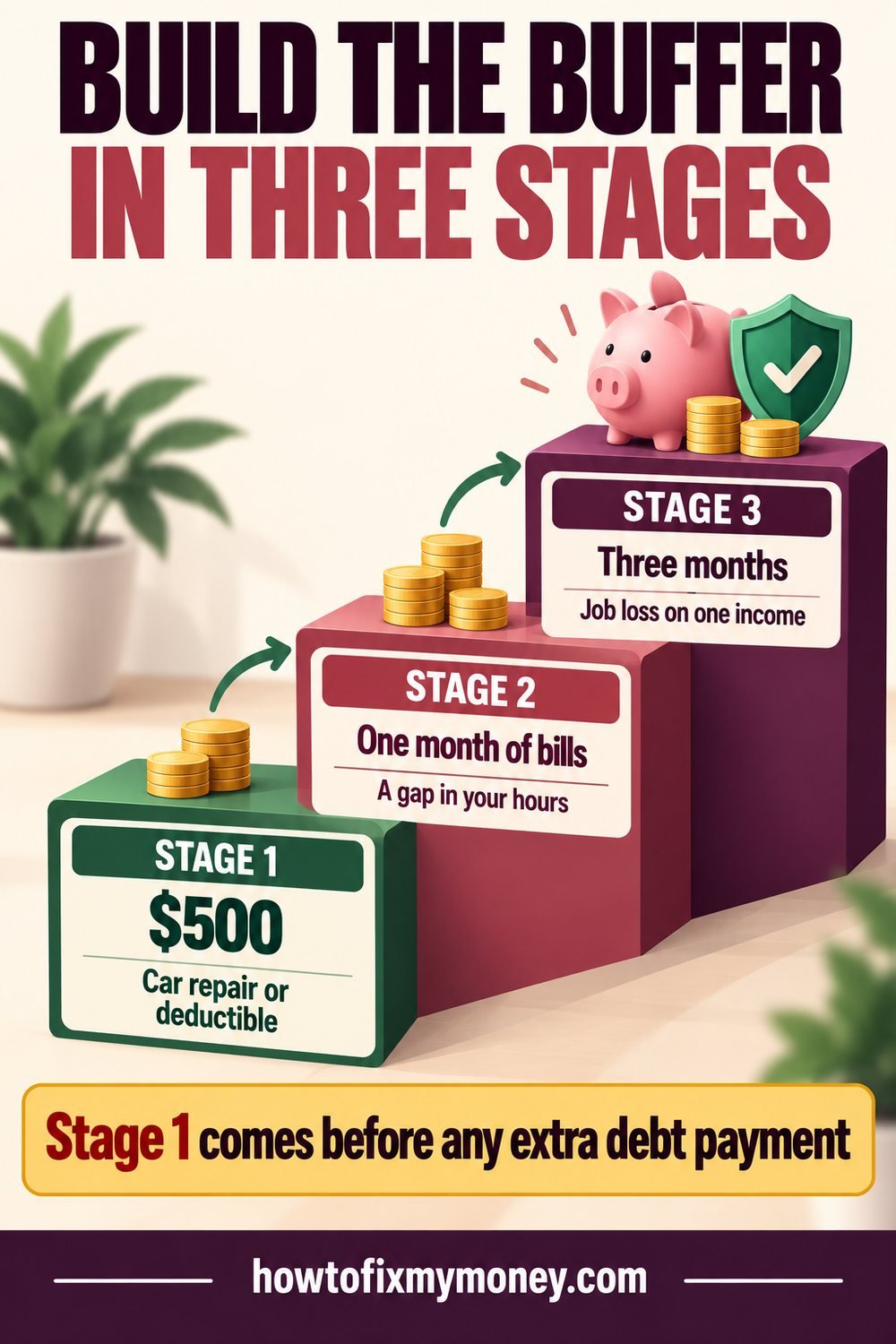
So build in stages instead. The first $500 stops most small emergencies from reaching a credit card, and it is reachable within a few months for almost everyone.
| Stage | Target | What It Covers | Priority |
|---|---|---|---|
| Stage 1 | $500 | Car repair, deductible, appliance | Before extra debt payments |
| Stage 2 | One month of expenses | A gap in hours or a late paycheck | Alongside debt payoff |
| Stage 3 | Three months | Job loss on a single income | After the debt clears |
Keep stage one in a separate savings account rather than checking, where it blends into the balance and leaks back into the single mom budget unnoticed. Many online banks allow named sub-accounts, and naming it stops casual spending better than willpower does.
A mother earning $42,000 takes home roughly $3,500 a month, which makes stage two a $3,500 target. Reaching it takes time, and the refund is the fastest route there if you split it rather than sending all of it at the debt.
Where to Find Payment Capacity When the Single Mom Budget Has No Room
Assume your single mom budget already lost the obvious cuts years ago. These release money that most lists never mention.
- Adjust your W-4 if you receive a large refund and need the cash monthly instead. Trading a $6,000 refund for $500 a month helps if the debt is accruing interest all year, though only do this if you will genuinely redirect it.
- Apply for childcare assistance through your state. Every state runs a subsidy program with income limits well above what parents expect, and many mothers who qualify never apply.
- Ask your utility provider about budget billing and hardship rates. Level billing removes the winter spike that pushes a tight month onto a credit card.
- Check eligibility for SNAP, WIC, LIHEAP and the school meal programs. A benefit that covers groceries frees the same dollars the debt needs, and eligibility rules surprise people.
- Request a lower rate on every card by phone. Issuers grant reductions more often than people expect, especially to customers with a clean payment history, and the call costs ten minutes.
- Review childcare and after-school options through employers, community centers and churches, which frequently run programs well below commercial rates.
Three of these together often give a single mom budget more monthly room than a year of aggressive grocery cutting, and none of them require your family to go without anything.
Which Debt to Attack First on a Single Income
Two methods compete, and the right answer for a single mom budget is not always the mathematically optimal one.
The avalanche method targets the highest rate first and costs the least overall. The snowball method clears the smallest balance first and produces a visible win sooner.
On a single income carrying real stress, the snowball frequently wins in practice, because a plan you stick to beats a cheaper plan you abandon in month four. Clearing one entire account also removes a minimum payment permanently, which hands the single mom budget breathing room in every future month.
One exception overrides both. Pay anything that threatens your housing, your car or your job before you optimize anything else. A rent arrears or a car loan in default costs you far more than interest.
Put your own numbers in before you choose a method
The free Budget Planner shows what your income genuinely supports each month. Set the payment from that figure rather than from an optimistic one, because the plan only works if it survives a bad month.
Single Mom Budget Mistakes That Cost Mothers the Most
- Filing as single when head of household applies. Worth over $1,000 a year in the example above, and repeated every year it goes unnoticed.
- Skipping the tax credits because last year produced no tax bill. Both the Child Tax Credit and the EITC refund money to people who owe nothing, so filing is how you collect.
- Paying for a refund advance. These products cost a slice of money you already earned, and free filing exists specifically for your income range.
- Emptying the buffer to make a big debt payment. The next emergency rebuilds the balance at 22% and undoes the progress.
- Borrowing from a retirement account to clear a card. You lose the growth, you may owe tax and a penalty, and the behavior that created the balance stays unaddressed.
- Treating a payday loan as a bridge. Rates on those run into the triple digits annually and trap borrowers in rollovers.
Questions People Ask About Building a Single Mom Budget
Do I qualify for head of household as a single mom?
Generally yes, if you paid more than half the cost of keeping up your home for the year and a qualifying child lived with you for more than half of it. You must also count as unmarried for tax purposes, which includes living apart from a spouse for the last six months of the year in some situations. Check the IRS rules or use free filing software, which asks the questions for you.
Can I claim the credits if I owe no tax?
Yes, and this surprises people every year. The Earned Income Tax Credit refunds fully even with no tax owed, and up to $1,700 per child of the Child Tax Credit refunds the same way for 2026. You have to file a return to receive either one, so skipping the filing because you earned little is the expensive choice.
Should a single mom budget pay debt or build savings first?
Build a small buffer into the single mom budget first, then run both together. Clear $500 into savings before you accelerate payments, because without it the next unexpected expense goes straight onto a card and cancels your progress. After that, split what you can between the two until the debt clears.
Is it worth amending an old tax return?
Often yes. You can generally amend a return for up to three years from the original filing deadline, and a wrong filing status or a missed credit adds up to several thousand dollars across three years. Free tax preparation programs help with amendments too.
What if my income changes month to month?
Set the automatic payment at your worst realistic month rather than your average, then make manual extra payments in the strong months. A single mom budget built on an average income fails in every below-average month, and missed payments cost fees and rate increases that outweigh the faster payoff.
Does child support count as income for the credits?
No. Child support is not taxable income to the person receiving it, and it does not count as earned income for the Earned Income Tax Credit, which requires earnings from work. It does count toward the cost of keeping up your home when you test head of household status.
Should I use the refund on debt or on the kids?
Decide the split in advance rather than in the moment, and write it down. Many mothers send 70% at the debt and keep 30% for the things the year squeezed out, which protects the plan and keeps it livable. A plan with no room for your family rarely survives the first year.
Where do I get free help with all of this?
IRS Free File gives you guided tax software at no cost with an adjusted gross income of $89,000 or less, and IRS-funded volunteer sites prepare returns in person free of charge for filers who qualify. For the debt side, a nonprofit credit counseling agency affiliated with the National Foundation for Credit Counseling gives a free initial review. Treat any service charging large upfront fees as a reason to walk away.
Three Moves That Start Your Single Mom Budget This Week
Write every debt on one page tonight with its balance, rate and minimum. The list takes twenty minutes and it is the only honest picture you will get.
Then pull last year’s tax return and check two boxes: your filing status, and whether you claimed the Child Tax Credit and the Earned Income Tax Credit. If either looks wrong, free tax help can amend it and the money comes back to you.
Finally, open a separate savings account and automate whatever you can toward the first $500, even if that figure is $15 a week. A single mom budget works because it runs without you, not because you find the discipline every month.
Build the numbers with our free Budget Planner, then read debt snowball vs avalanche to settle which balance to clear first. Our monthly budget template for low income gives you the layout to work from, and more plans sit in our Debt Relief section.
Sources
- Tax Foundation, 2026 tax brackets and inflation adjustments – standard deductions, EITC maximums and phaseouts, Child Tax Credit, head of household brackets.
- IRS, Earned Income Tax Credit – eligibility rules and how to claim.
- IRS, Free File – free guided tax software at an adjusted gross income of $89,000 or less.
- Federal Reserve, G.19 Consumer Credit, August 2026 – 22.36% average rate on cards carrying a balance.
- Tax, refund and debt payoff figures calculated by How To Fix My Money from the published 2026 rates, using standard amortization and a minimum payment of 1% of the balance plus interest.

Bilal founded HowToFixMyMoney.com in 2026 to make US personal finance decisions easier to work through without a financial background. Every figure published here traces back to a primary source — the Bureau of Labor Statistics, the Federal Reserve, the IRS, the CFPB — and each article links to the data it relies on. He is not a licensed financial advisor, and nothing on this site is personalized advice.