Most budget advice assumes you earn enough for the advice to work. Split your money 50/30/20, the rule says, and everything falls into place.
Run that arithmetic on a low income and it collapses before you reach the second category.
A monthly budget template built for a tight income has to do something different. It orders your spending by what happens if you skip it, not by what percentage a book recommends. This article gives you that template, a worked example you can copy, and real benchmarks from federal data to check your own numbers against.
Why the 50/30/20 Rule Breaks on a Low Income, and What a Monthly Budget Template Does Instead
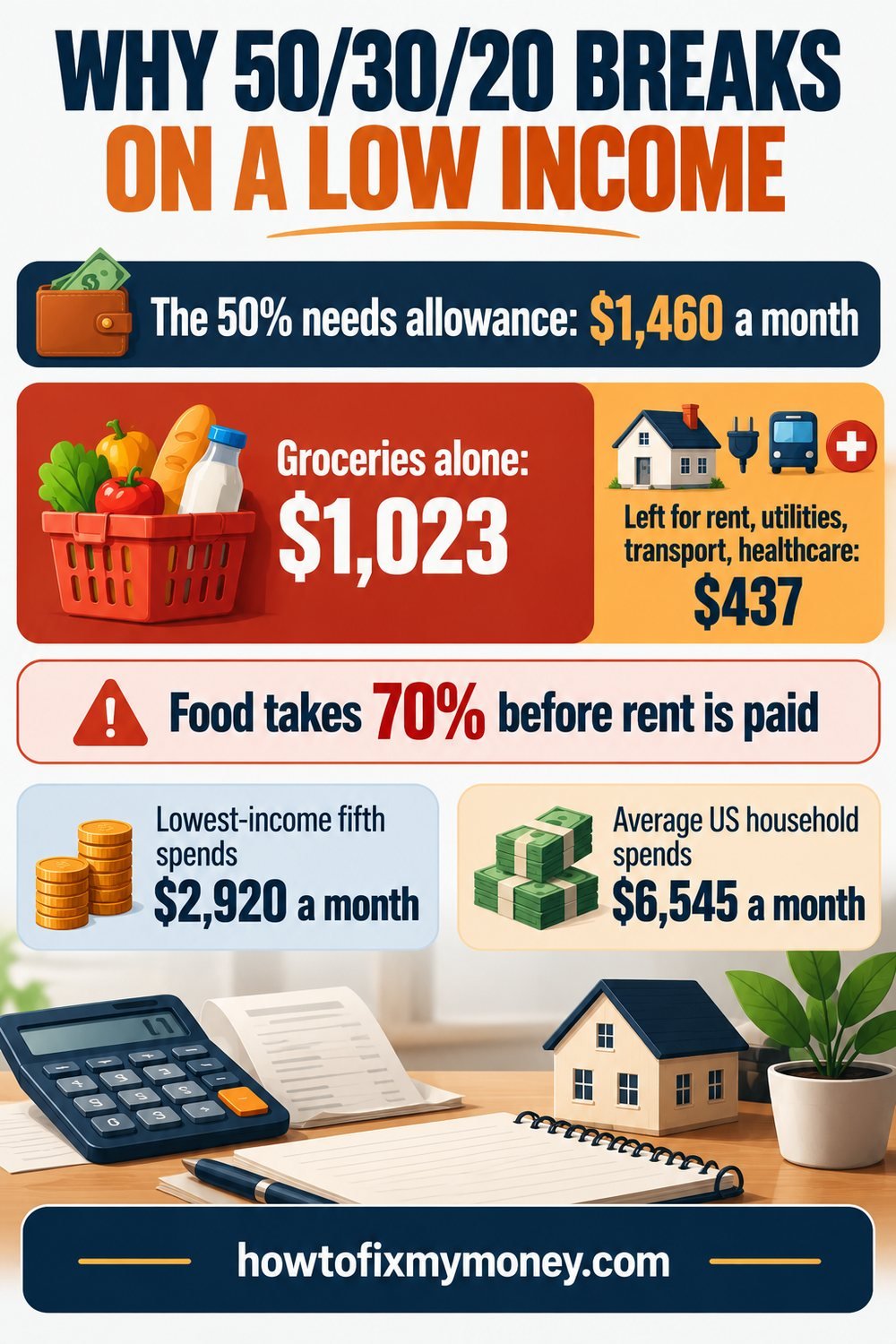
The Bureau of Labor Statistics Consumer Expenditure Survey tracks what American households actually spend. In 2024, households in the lowest income fifth spent $35,046 across the whole year. That works out at $2,920 a month for everything: rent, food, gas, insurance, the lot. The average US household spent $78,535, more than twice as much.
Now apply the rule. Fifty percent of $2,920 gives you $1,460 a month for needs.
USDA’s Thrifty Food Plan, its lowest-cost grocery budget, priced food for a family of four at $1,023.20 a month in June 2026. Groceries alone swallow 70% of that entire needs allowance and leave $437 for rent, utilities, transportation, and healthcare combined.
No household in America rents a home for $437 a month and drives to work on what’s left. The rule did not fail because you budgeted badly. It failed because somebody designed it for a household earning three times what you earn.
So drop the percentages. A monthly budget template for a low income works by priority instead, and the order never changes.
Start the Monthly Budget Template With the Number You Can Count On, Not the Number You Hope For
Before you fill in a single expense, settle on one income figure. This is where most low-income budgets go wrong, and it has nothing to do with discipline.
If your hours move week to week, or you work tips, gig shifts, or seasonal work, do not average the last six months. Averages hide the bad months inside the good ones, and the bad months are the ones that break a budget.
Take the lowest month you have had in the past year and build the monthly budget template on that figure. Every month that beats it hands you a surplus, and a surplus never causes a crisis.
Three more rules before the monthly budget template takes a single expense:
- Use take-home pay, after tax and after any deduction your employer makes. The gross figure on your contract has never paid a bill.
- Count benefits, child support, and SNAP separately rather than folding them into one number, because they arrive on different dates and some of them stop without warning.
- If you get paid every two weeks, remember that two months each year contain three paychecks. Budget on two, and treat the third as a bonus you have already decided how to spend.
The Four Tiers That Replace Percentages in a Low-Income Monthly Budget Template
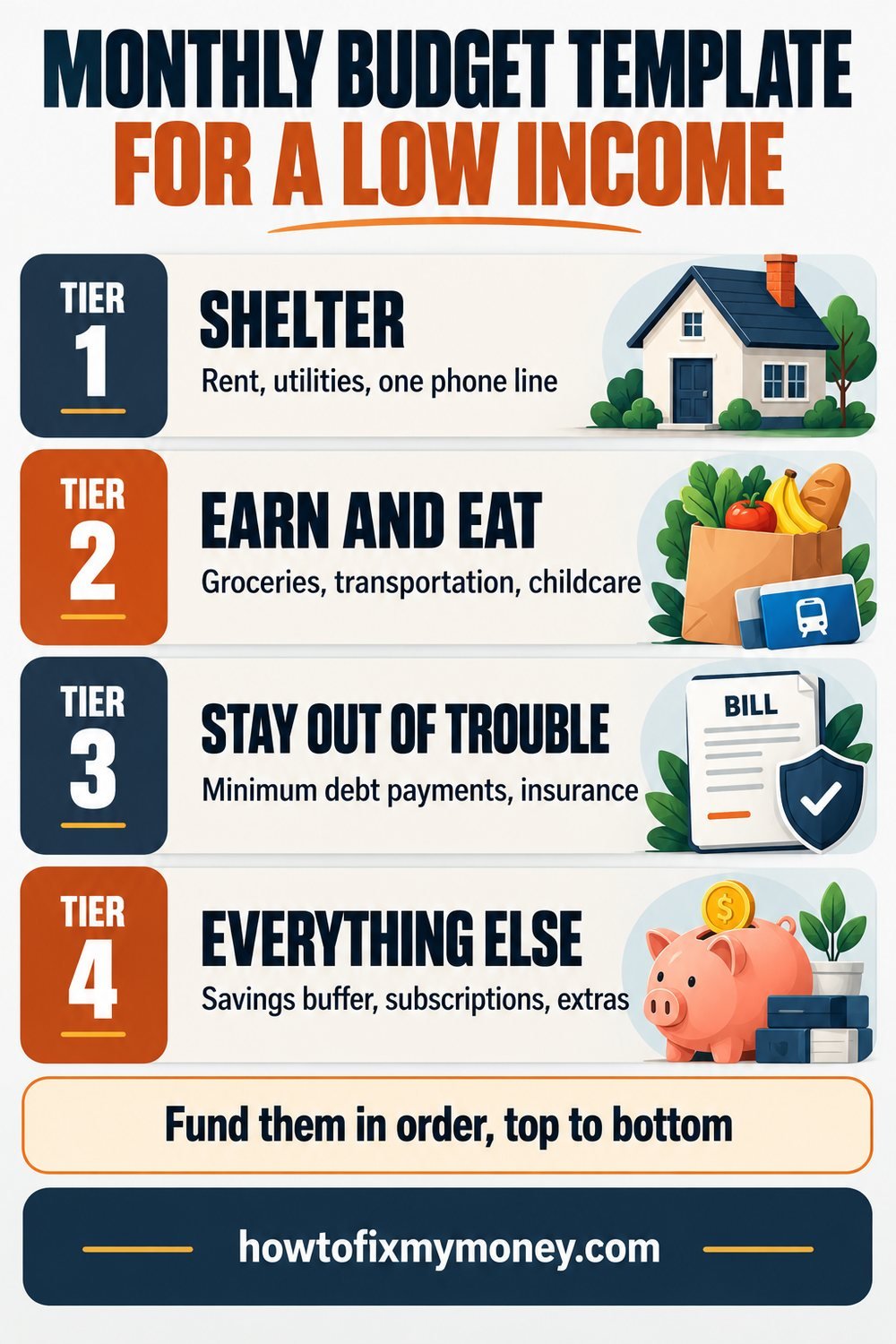
A monthly budget template for a low income ranks every expense by one question: what happens in thirty days if you don’t pay this?
That question produces four tiers, and you fund them strictly in order. Tier one takes what it needs before tier two gets anything.
| Tier | What Goes In It | If You Skip It | Fund It |
|---|---|---|---|
| Tier 1: Shelter | Rent or mortgage, electricity, gas, water, one basic phone line | You lose the home or the heat | First, in full, every month |
| Tier 2: Get to work and eat | Groceries, transportation, childcare, work clothing | You cannot earn next month | Second, with a written cap |
| Tier 3: Stay out of trouble | Minimum debt payments, car and health insurance, prescriptions | Fees, interest, and a damaged credit file | Third, at the minimum only |
| Tier 4: Everything else | Savings buffer, subscriptions, clothing, haircuts, gifts, eating out | Nothing immediate | Last, with whatever remains |
Two things about this order surprise people.
Insurance sits in tier three, below groceries. That feels wrong until you remember that a lapsed policy costs you money next month while an empty fridge costs you your job this week.
And savings sit in tier four alongside haircuts, which contradicts every pay-yourself-first article you have read. On a low income, saving before you have paid the rent simply moves the shortfall somewhere more expensive. Build the buffer from what genuinely remains, even when that figure starts at ten dollars.
Tier 1: Shelter, Power, and One Phone Line
Write these into the monthly budget template first and pay them first. Nothing in tiers two through four outranks a roof.
Keep one phone line in this tier rather than moving it down. Employers call, schools call, and benefits offices call; losing the number costs more than the plan does.
Tier 2: The Costs That Keep Next Month Possible
Groceries, the bus pass or the gas tank, childcare, and the clothes or boots your job requires. These protect your ability to earn, which makes them close to untouchable.
Give groceries a weekly cap rather than a monthly one. A monthly grocery figure disappears by the third week and people finish the month on a credit card.
Tier 3: The Payments That Punish You Later
Pay the minimum on every debt. Not more, not yet. Minimums protect your credit file and stop late fees, and until tiers one and two run comfortably, extra debt payments create the emergency that puts the balance back.
Keep insurance current if you possibly can. Dropping car insurance to save $90 risks a penalty, a license problem, and a bill you genuinely cannot pay.
Tier 4: What Is Left, and Where the Buffer Lives
Whatever survives the first three tiers belongs in tier four of the monthly budget template. Split it, and send the first share to a savings account at a different bank with no card attached.
Leave the rest for the things that keep a budget bearable. A month with zero spending money fails faster than a month with twenty dollars of it.
A Worked Example: The Monthly Budget Template on $2,000 a Month
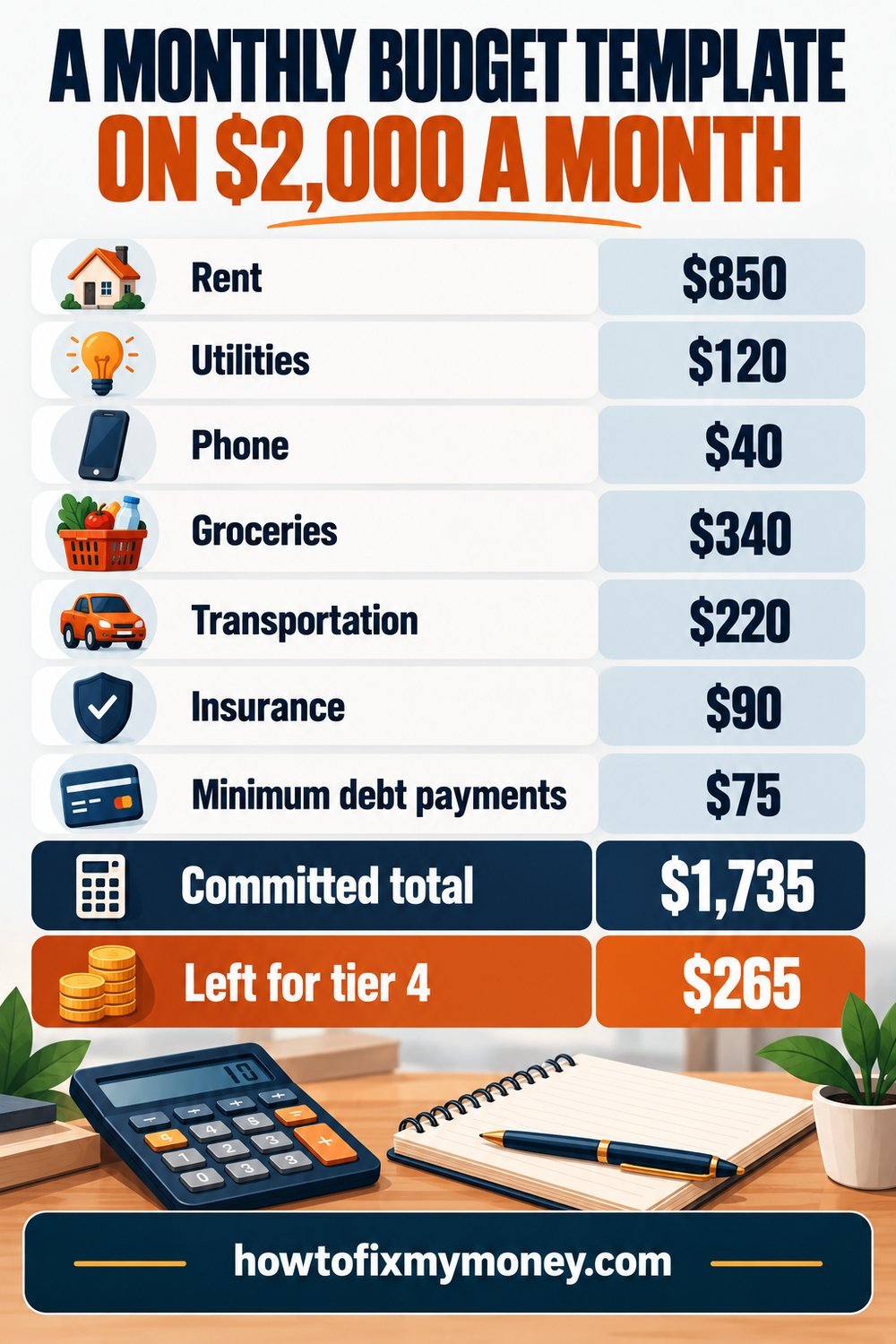
Numbers make this concrete. Here is a single adult bringing home $2,000 a month, a figure close to full-time work at $14 an hour after tax.
| Line | Amount | Share | Tier |
|---|---|---|---|
| Rent | $850 | 42.5% | Tier 1 |
| Utilities | $120 | 6.0% | Tier 1 |
| Phone | $40 | 2.0% | Tier 1 |
| Groceries | $340 | 17.0% | Tier 2 |
| Transportation | $220 | 11.0% | Tier 2 |
| Insurance | $90 | 4.5% | Tier 3 |
| Minimum debt payments | $75 | 3.8% | Tier 3 |
| Committed total | $1,735 | 86.8% | Tiers 1 to 3 |
| Left for tier 4 | $265 | 13.2% | Tier 4 |
Look at the committed total. Needs take 86.8% of this budget. The 50/30/20 rule would cap them at $1,000, which means the rule misses reality by $735 a month, or 37% of everything this person earns.
That $265 at the bottom does all the remaining work. Send $50 to savings, keep $100 for the things that break, and leave $115 for the month to actually contain something. Nobody sustains a budget that funds nothing enjoyable.
Your own numbers will differ. The order will not.
Benchmarks From Federal Data to Check Your Monthly Budget Template Against
People filling in a monthly budget template for the first time usually ask the same question: is my grocery number normal? Federal agencies publish the answer.
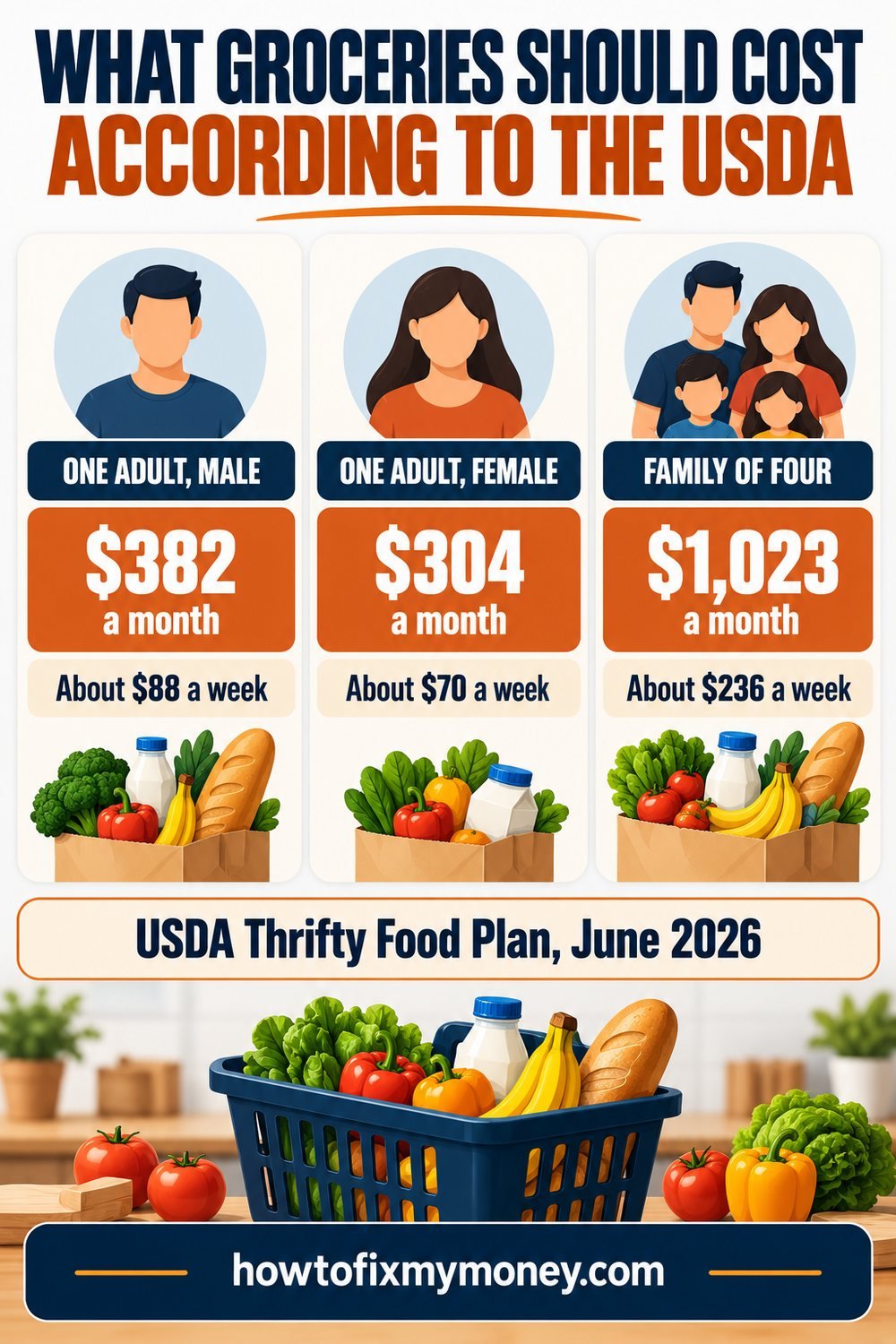
USDA’s Thrifty Food Plan sets the lowest-cost grocery budget the government considers adequate. These are the June 2026 figures.
| Household | Monthly Groceries | Weekly Equivalent |
|---|---|---|
| One adult, male, age 20 to 50 | $382.20 | About $88 |
| One adult, female, age 20 to 50 | $304.10 | About $70 |
| Family of four, two adults and two children | $1,023.20 | About $236 |
Compare your own figure to these before you decide you overspend. Many households land well under them, and plenty land over because they live somewhere expensive or buy food that stores longer.
Two other benchmarks help. Housing beyond roughly a third of take-home pay puts pressure on every other tier, though millions of American renters pay far more than that and have no realistic alternative. And transportation above 15% usually signals a car costing more than it returns.
What to Do When the Monthly Budget Template Does Not Balance
Sometimes you finish the monthly budget template and the bottom line reads below zero. That tells you something true, and it does not mean you failed.
Work through these in order, because the early steps cost you least.
- Cut tier four to nothing, temporarily. Subscriptions, eating out, the savings transfer. This buys you the fastest relief and costs nothing permanent.
- Shrink tier two before you touch tier one. Drop the grocery cap toward the USDA figure, cut one car trip a week, check whether your children qualify for free school meals.
- Call every tier three company before you miss a payment. Credit card issuers, insurers, and medical billers all run hardship programs, and every one of them treats a call before the due date differently from a call after it.
- Attack tier one last and hardest. A cheaper apartment, a roommate, or a move changes the arithmetic more than anything else on the page, and it also takes the longest to arrange.
- Check the assistance programs below. Many households qualify and never apply.
If the gap stays wide after all five, the problem is income rather than budgeting, and no monthly budget template fixes that on its own. Treat the template as the thing that keeps you stable while you work on the income side.
The Assistance Programs Worth Checking Before You Cut Anything Else
Plenty of households qualify for help and never claim it, usually because they assume they earn too much or the process looks daunting. Checking costs an hour.
Start with SNAP, the federal food benefit program. USDA runs it and each state handles applications through its own directory. Food benefits free up cash in tier two, which flows straight down to the tiers underneath.
Then check LIHEAP, which helps low-income households pay heating and cooling bills. States set eligibility using federal poverty guidelines, and the program exists precisely for the winter a utility bill doubles.
Dial 211 as well, or visit 211.org, for local rent assistance, utility funds, food pantries, and prescription help. Local programs rarely advertise and often hold money nobody claimed.
Put any benefit you receive on its own line in the monthly budget template rather than blending it into income. When a program ends, you then see exactly which line disappeared.
How to Run the Monthly Budget Template in Fifteen Minutes a Month
A monthly budget template you dread never survives past month two. Keep the routine short.
Set the Monthly Budget Template Up Once, on Paper or in a Free Spreadsheet
Write the four tiers down the left side, your income at the top, and leave a column for planned and a column for actual. Paper on the fridge beats an app you stop opening, and a free spreadsheet works if you prefer typing.
Check It Once a Week for Three Minutes
Open your banking app, compare the week’s spending against the grocery and transportation caps in the monthly budget template, and write the real figure next to the plan. Three minutes, once a week, catches an overspend while you can still fix it.
Reset It on Payday, Not on the First of the Month
Bills arrive on the first. Money arrives on payday. Align the monthly budget template with the day you actually get paid and the whole thing stops feeling like a race you start behind in.
Rewrite the Monthly Budget Template Whenever Your Income Changes
New job, lost hours, a benefit that ends, a rent increase. Redo the template that week rather than hoping the old numbers still hold. Fifteen minutes of rewriting prevents a month of surprises.
Holiday sales are where tight budgets break. Here’s how to set a Black Friday budget on a low income, including what to do if the number comes out to zero.
Questions People Actually Ask About a Monthly Budget Template for Low Income
What is the best monthly budget template for a low income?
The one that ranks expenses by consequence rather than by percentage. Fund shelter first, then the costs that let you earn next month, then minimum debt payments and insurance, then everything else. Percentage rules like 50/30/20 assume a level of income that makes the percentages possible.
How do I budget when my income changes every week?
Build the monthly budget template on your lowest month from the past year rather than an average. Averages bury the bad months inside the good ones. Every month above that floor gives you a surplus you can assign deliberately instead of a shortfall you have to absorb.
What percentage of income should rent take on a low income?
The standard guidance says roughly 30% of take-home pay, and the worked example above sits at 42.5% because that reflects what many renters actually face. Treat 30% as a target rather than a rule, and if you sit well above it, accept that tiers two through four will stay tight until housing changes.
Should I save money if I have credit card debt?
Build a small buffer first, then switch. A few hundred dollars stops the next emergency landing on the card and undoing the payments you just made. Once that buffer exists, send everything spare at the highest-interest balance.
How much should groceries cost for one person?
USDA’s Thrifty Food Plan priced it at $382.20 a month for a man aged 20 to 50 and $304.10 for a woman, as of June 2026. Those figures assume you cook at home and shop carefully, so treat them as a realistic floor rather than a target to beat.
Do I need an app, or will paper work?
Paper works, and for many people it works better. The point of a monthly budget template is that you see the numbers often, and you look at a sheet taped inside a cabinet door far more often than an app you installed once. Use whichever one you will still look at in week three.
What do I do when an unexpected bill wrecks the month?
Pay it, then rebuild the monthly budget template from where the balance lands rather than abandoning it. One bad month inside a working system costs you far less than a return to no system at all.
How long before a monthly budget template actually changes anything?
Most people see the first real change in month three. Month one tells you where the money goes, month two corrects the caps you set too low, and month three runs close to plan. Judging the template after four weeks underestimates it.
What Changes After Three Months of Running the Monthly Budget Template
The monthly budget template does not raise your income, and this article will not pretend otherwise.
What it changes is the number of decisions you make under pressure. You stop guessing whether the rent clears, you know which bill moves if the car breaks, and you spot a shortfall in week one instead of week four.
That shift is worth more than any percentage rule, and it starts the first time you write the four tiers down in order.
Once the monthly budget template runs, put the tier four money to work. The free Debt Payoff Calculator turns a fixed monthly amount into a real payoff date, and how to cut $300 a month works through the lines most households can still move. More guides sit in our Money Fixes section.

Bilal founded HowToFixMyMoney.com in 2026 to make US personal finance decisions easier to work through without a financial background. Every figure published here traces back to a primary source — the Bureau of Labor Statistics, the Federal Reserve, the IRS, the CFPB — and each article links to the data it relies on. He is not a licensed financial advisor, and nothing on this site is personalized advice.