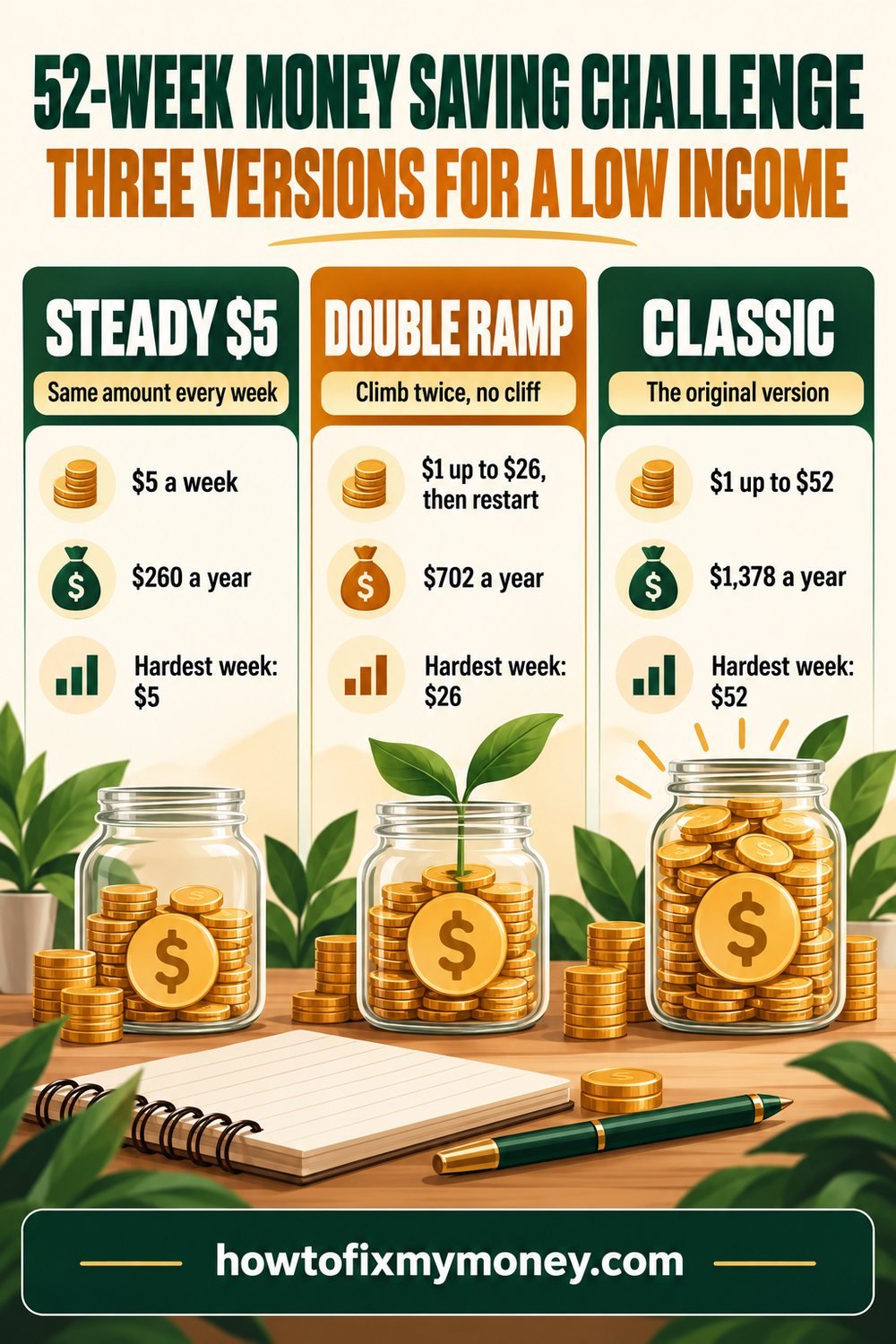
The 52-week money saving challenge is the most shared savings plan on the internet, and the version almost everyone shares is the one least suited to the people who need it most.
The original is simple. Save $1 in week one, $2 in week two, and keep adding a dollar until you put away $52 in the final week. Do that and you finish the year with $1,378.
The problem isn’t the total. It’s where the hard weeks land.
This is the same money saving challenge rebuilt for a tight income: what the standard version gets wrong, three schedules that work on a small budget, the full 52-week table free to print, and where the money comes from when there isn’t any spare.
Why the Standard 52-Week Money Saving Challenge Quietly Punishes a Low Income
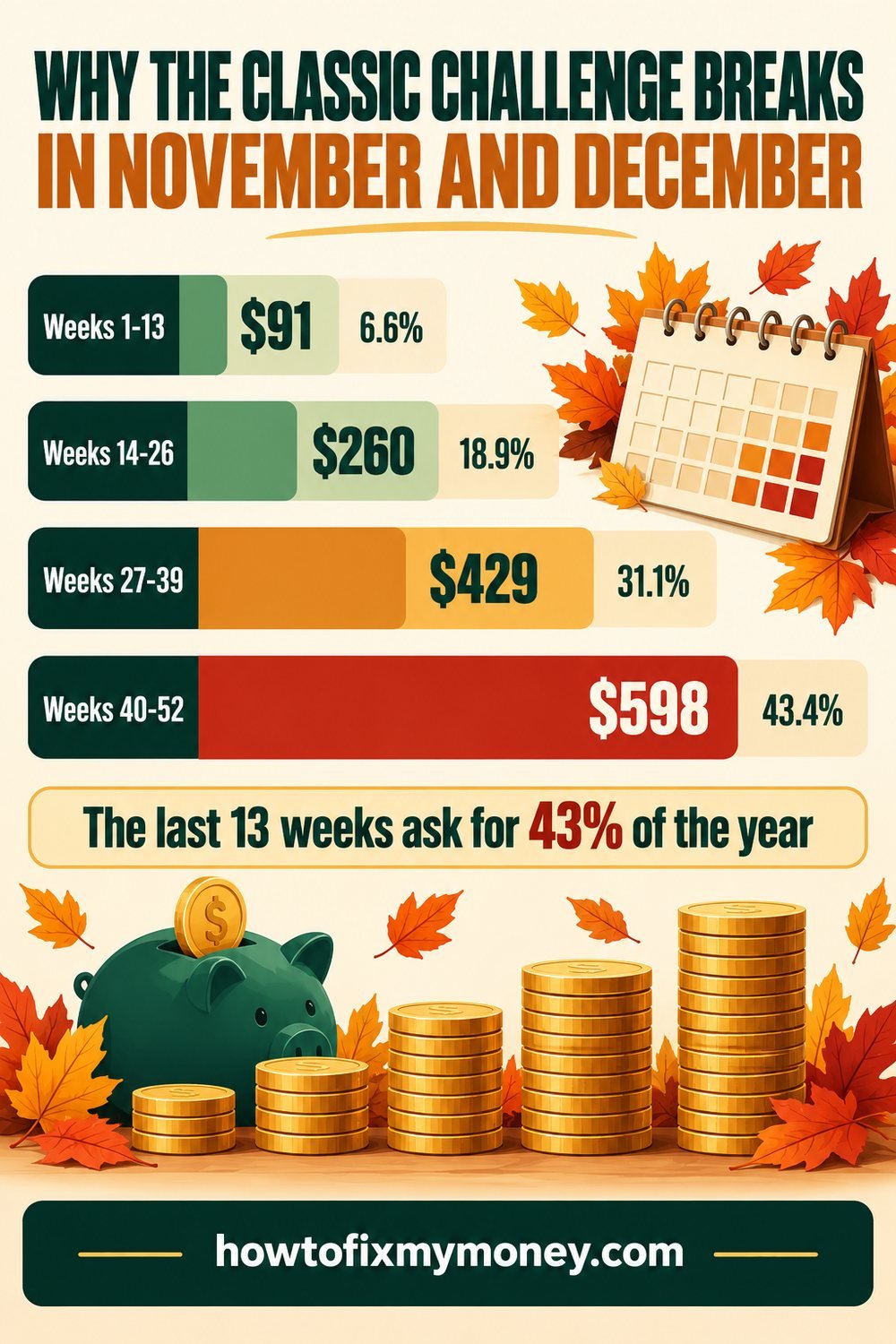
Start the classic version on January 1st and the weeks get harder as the year goes on. That sounds fine in theory. In practice it means the most expensive weeks of the challenge arrive in November and December, the two months everything else also costs more.
The $1,378 splits across the year like this.
| Quarter | Weeks | You Save | Share of the Year |
|---|---|---|---|
| First | Weeks 1 to 13 | $91 | 6.6% |
| Second | Weeks 14 to 26 | $260 | 18.9% |
| Third | Weeks 27 to 39 | $429 | 31.1% |
| Fourth | Weeks 40 to 52 | $598 | 43.4% |
Look at the bottom row. The last thirteen weeks ask for $598, which is 43% of the whole year, and they land square on top of Thanksgiving and Christmas. The final eight weeks alone want $388.
That is why so many people abandon a 52-week money saving challenge in October. They didn’t lose discipline. They signed up to a schedule that saves its hardest demand for the worst possible month, and a low income leaves no slack to absorb it.
One more thing worth correcting while we’re here. A lot of blogs put the classic total at $1,358. The real sum of $1 through $52 is $1,378. It’s a small error, but if you’re planning around the number, plan around the right one.
What the Numbers Say About Saving on a Low Income, and Why This Money Saving Challenge Still Matters
The Federal Reserve’s Economic Well-Being of U.S. Households report, published in May 2026, found that 63% of American adults could cover a surprise $400 expense with cash or its equivalent. Which means 37% could not, and 12% said they could not cover it by any means at all.
The gap by income is where this gets specific. Among households earning under $25,000, just 21% had enough set aside to cover three months of expenses. For households over $100,000 the figure is 75%.
And 30% of adults could not pay $500 from savings right now.
Put those together and the picture is clear: if you finish a 52-week money saving challenge with $520 in an account, you have moved past roughly a third of American adults on the one measure that matters most on a bad day. You don’t need $1,378 for this to be worth doing.
Three Versions of the 52-Week Money Saving Challenge, and How to Pick the One You Will Actually Finish
The best money saving challenge is not the one with the biggest total. It’s the one whose hardest week you can still pay in week 47. If you have a specific target in mind instead, our savings goal calculator turns it into a weekly or per-paycheck amount.
| Version | Weekly Amount | Year Total | Hardest Week | Who It Suits |
|---|---|---|---|---|
| Steady $5 | $5 every week | $260 | $5 | Very tight budgets, benefits income, anyone who has quit a challenge before |
| Double Ramp | $1 up to $26, then restart | $702 | $26 | Most low-income households, and anyone who wants the ramp without the December cliff |
| Classic | $1 up to $52 | $1,378 | $52 | Incomes that rise later in the year, or households with a December bonus |
The steady version is the one most people on a low income should pick, and it is the one almost nobody recommends because $260 doesn’t make an exciting headline. Five dollars a week is 71 cents a day. It does not get harder in week 40, which is the entire point.
The double ramp keeps the satisfying climb but cuts it in half. You go $1, $2, $3 up to $26 in week 26, then start again at $1 in week 27 and climb back to $26. Same rhythm, no cliff, $702 at the end.
The classic is worth attempting only if your income genuinely rises in the back half of the year. Seasonal work that peaks in the fall, overtime that appears before the holidays, a second job you pick up in September. If your income is flat, the classic is a trap dressed as a plan.
A fourth option deserves a mention: run the classic backwards. Save $52 in week one and work down to $1. The total is identical and December asks for almost nothing. It’s brutal in January, which is why few people finish it, but if you get a tax refund early in the year it can work.
The Full Money Saving Challenge Table You Can Print, With Running Totals for All Three Versions
Most sites put the money saving challenge table behind an email form or sell it as a printable. Here it is in full.
Pick one column pair and ignore the rest. Mixing versions halfway through is the fastest way to lose track of where you are.
| Week | Steady $5 | Running Total | Double Ramp | Running Total | Classic | Running Total |
|---|---|---|---|---|---|---|
| 1 | $5 | $5 | $1 | $1 | $1 | $1 |
| 2 | $5 | $10 | $2 | $3 | $2 | $3 |
| 3 | $5 | $15 | $3 | $6 | $3 | $6 |
| 4 | $5 | $20 | $4 | $10 | $4 | $10 |
| 5 | $5 | $25 | $5 | $15 | $5 | $15 |
| 6 | $5 | $30 | $6 | $21 | $6 | $21 |
| 7 | $5 | $35 | $7 | $28 | $7 | $28 |
| 8 | $5 | $40 | $8 | $36 | $8 | $36 |
| 9 | $5 | $45 | $9 | $45 | $9 | $45 |
| 10 | $5 | $50 | $10 | $55 | $10 | $55 |
| 11 | $5 | $55 | $11 | $66 | $11 | $66 |
| 12 | $5 | $60 | $12 | $78 | $12 | $78 |
| 13 | $5 | $65 | $13 | $91 | $13 | $91 |
| 14 | $5 | $70 | $14 | $105 | $14 | $105 |
| 15 | $5 | $75 | $15 | $120 | $15 | $120 |
| 16 | $5 | $80 | $16 | $136 | $16 | $136 |
| 17 | $5 | $85 | $17 | $153 | $17 | $153 |
| 18 | $5 | $90 | $18 | $171 | $18 | $171 |
| 19 | $5 | $95 | $19 | $190 | $19 | $190 |
| 20 | $5 | $100 | $20 | $210 | $20 | $210 |
| 21 | $5 | $105 | $21 | $231 | $21 | $231 |
| 22 | $5 | $110 | $22 | $253 | $22 | $253 |
| 23 | $5 | $115 | $23 | $276 | $23 | $276 |
| 24 | $5 | $120 | $24 | $300 | $24 | $300 |
| 25 | $5 | $125 | $25 | $325 | $25 | $325 |
| 26 | $5 | $130 | $26 | $351 | $26 | $351 |
| 27 | $5 | $135 | $1 | $352 | $27 | $378 |
| 28 | $5 | $140 | $2 | $354 | $28 | $406 |
| 29 | $5 | $145 | $3 | $357 | $29 | $435 |
| 30 | $5 | $150 | $4 | $361 | $30 | $465 |
| 31 | $5 | $155 | $5 | $366 | $31 | $496 |
| 32 | $5 | $160 | $6 | $372 | $32 | $528 |
| 33 | $5 | $165 | $7 | $379 | $33 | $561 |
| 34 | $5 | $170 | $8 | $387 | $34 | $595 |
| 35 | $5 | $175 | $9 | $396 | $35 | $630 |
| 36 | $5 | $180 | $10 | $406 | $36 | $666 |
| 37 | $5 | $185 | $11 | $417 | $37 | $703 |
| 38 | $5 | $190 | $12 | $429 | $38 | $741 |
| 39 | $5 | $195 | $13 | $442 | $39 | $780 |
| 40 | $5 | $200 | $14 | $456 | $40 | $820 |
| 41 | $5 | $205 | $15 | $471 | $41 | $861 |
| 42 | $5 | $210 | $16 | $487 | $42 | $903 |
| 43 | $5 | $215 | $17 | $504 | $43 | $946 |
| 44 | $5 | $220 | $18 | $522 | $44 | $990 |
| 45 | $5 | $225 | $19 | $541 | $45 | $1,035 |
| 46 | $5 | $230 | $20 | $561 | $46 | $1,081 |
| 47 | $5 | $235 | $21 | $582 | $47 | $1,128 |
| 48 | $5 | $240 | $22 | $604 | $48 | $1,176 |
| 49 | $5 | $245 | $23 | $627 | $49 | $1,225 |
| 50 | $5 | $250 | $24 | $651 | $50 | $1,275 |
| 51 | $5 | $255 | $25 | $676 | $51 | $1,326 |
| 52 | $5 | $260 | $26 | $702 | $52 | $1,378 |
Write it out by hand if you can. Crossing off a week on paper does something a banking app doesn’t, and the running total is the part that keeps people going through the middle of the year when nothing feels like it’s happening yet.
Where the $5 to $26 Actually Comes From When the Budget Is Already Bare
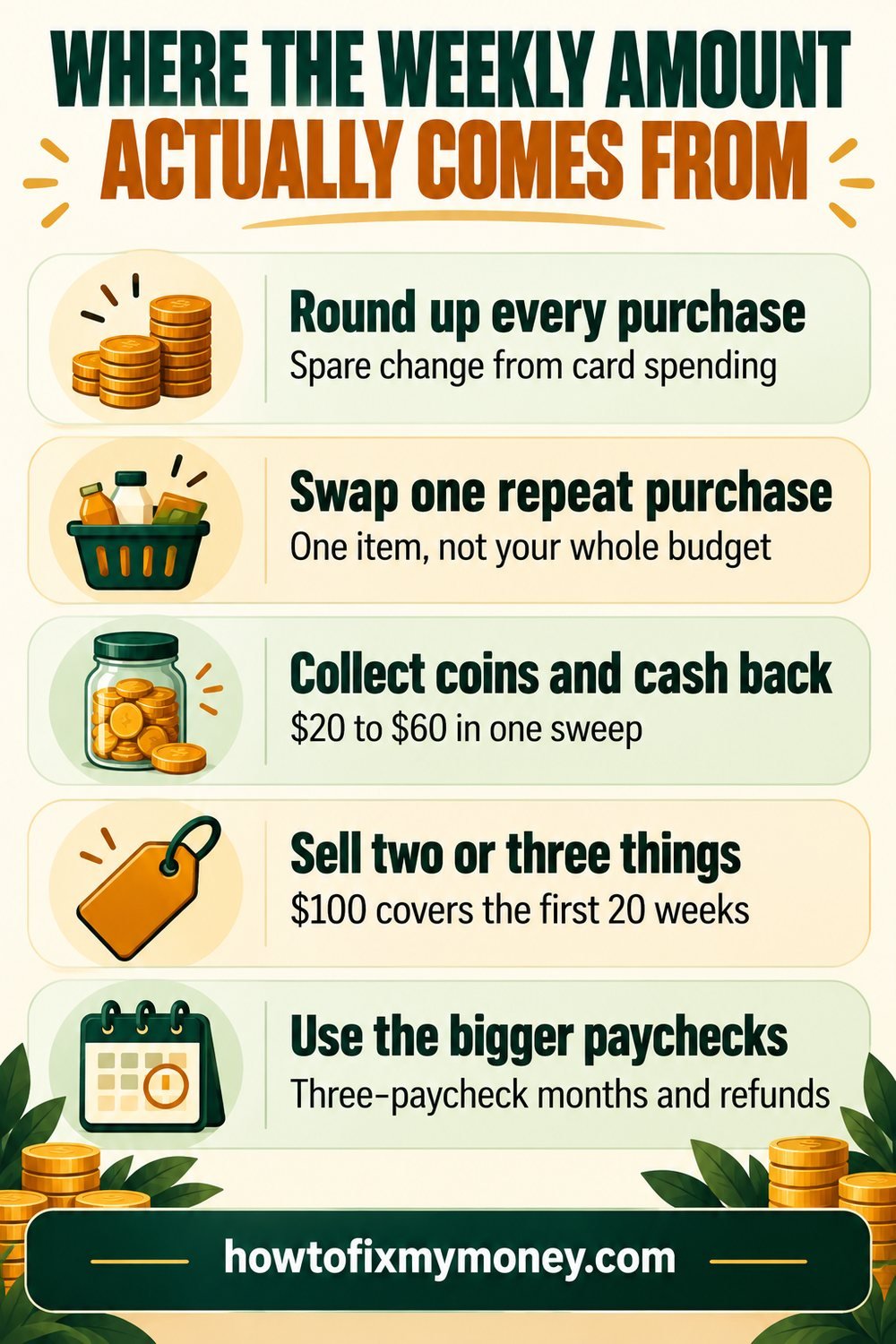
This is the question nearly every article on this topic skips, and it’s the only one that matters if your income is genuinely low.
Five dollars a week sounds trivial until you’ve already cut everything. Most households find it in these five places, and the least painful comes first.
Round Up Every Card Purchase and Move the Difference
Many banks and credit unions do this automatically: you spend $7.40, they round it to $8 and move the 60 cents to savings. Across a normal week of small purchases this alone often covers the $5 version without you noticing it at all.
If your bank doesn’t offer it, do it manually once a week. Look at the week’s spending, round the total up to the nearest ten dollars, and move the difference.
Swap One Repeat Purchase, Not Your Whole Life
Skip the budget overhaul. Change one thing, and pick it because you won’t miss it much. The store-brand version of something you buy weekly. One less drink bought out. The cheaper laundry detergent.
A single swap that saves $1.50 a week funds most of the steady version by itself, and unlike a full budget cut it survives past February.
Collect the Coins and Count the Cash Back
Physical change in the car, in a jar, in coat pockets. Cash-back app balances. Credit card rewards you’ve never redeemed. Loyalty points sitting at the grocery store.
None of this feels like real money, which is exactly why it’s still there. Most households find $20 to $60 in a single sweep, and that’s four to twelve weeks of a 52-week money saving challenge done in an afternoon.
Sell Two or Three Things in Week One to Build a Buffer
Skip the decluttering project. Pick two or three items you’ll never use again, list them locally, and price them to sell rather than to impress.
A hundred dollars up front covers the first twenty weeks of the steady version, which means the early weeks cost you nothing and you get to week 20 with the habit already formed.
Use the Weeks Your Income Is Bigger
If you’re paid every two weeks, two months a year contain three paychecks instead of two. If you get a tax refund, an energy credit, or a seasonal bonus, that’s a lump the money saving challenge can absorb.
Put a month’s worth of weeks in at once when the money is there, and the lean weeks ask for nothing. No rule says you must fund each week during that week.
What to Do in the Weeks of the Money Saving Challenge You Simply Cannot Pay
Every 52-week money saving challenge on a low income collects a few missed weeks. Planning for that in advance is the difference between a gap and an ending.
Mark the Week Zero and Carry On, Rather Than Doubling Up Next Week
Write $0, move to week 12, and you keep the chain intact. Trying to pay $22 next week to catch up is how people quit, because the catch-up week is always harder than the week they missed.
Finishing at $235 instead of $260 is a rounding error. Stopping in March is not.
Scale the Whole Money Saving Challenge Down Instead of Quitting It
If $5 is too much for more than two weeks running, the amount is wrong, not you. Drop to $3 a week, which finishes at $156, or $2, which finishes at $104.
A finished $104 money saving challenge beats an abandoned $702 by a distance, because the thing you’re actually building in year one is the habit of moving money on a fixed day. The amount is easy to raise later. Starting again is not.
Pause Properly If You Have To, With a Restart Date
A genuine crisis, a lost job, a car that died. Pause the money saving challenge and write a restart date on the sheet. An open-ended pause becomes an abandonment within about three weeks; a dated one usually doesn’t.
Where to Keep Your Money Saving Challenge Cash So It Is Still There in Week 52
You are about to leave money alone for a year, so put it somewhere you cannot reach in thirty seconds.
- Open a separate savings account, ideally at a different institution from your checking. The one or two day transfer delay is the feature, not the inconvenience.
- Don’t get a card for it. If there’s no card, there’s no two-in-the-morning decision in week 30.
- Automate the transfer for the day you’re paid. A fixed amount on a fixed day stops the money saving challenge from competing with everything else in your account.
Keep it somewhere federally insured. The FDIC covers $250,000 per depositor, per insured bank, for each ownership category, which is far more than this money saving challenge will ever need.
On interest, a straight answer. Because your balance climbs from zero, the average amount sitting there across the year is roughly half the final total. At around 4%, the classic version earns about $19 over the twelve months and the steady version about $5. Worth having. Not the reason to do it.
Should You Run a Money Saving Challenge at All If You Are Carrying High-Interest Debt?
Partly, and the order matters.
Paying 25% on a credit card while earning 4% in savings is a losing trade on paper, so the textbook answer is to clear the debt first. That same textbook answer also sends people with no savings straight back to the card: the next emergency has nowhere else to go.
Most people do better building a small buffer first. Run the steady $5 version until you have a few hundred dollars set aside, then send everything spare at the highest-interest balance, then come back and finish the year.
The Fed’s own numbers back the sequencing up. If 30% of adults can’t produce $500 from savings, having $500 is not a luxury that waits until the debt is gone. It’s the thing that stops the debt growing.
Questions People Actually Ask About the 52-Week Money Saving Challenge
Is the 52-week money saving challenge total $1,378 or $1,358?
$1,378. Adding $1 through $52 gives you 1,378, and you can check it quickly: 52 times 53, divided by 2. A lot of sites print $1,358, but that figure started as one typo and the rest of the niche copied it.
How much do I save in a 52-week money saving challenge for a low income?
Between $104 and $702, depending on which version you run. $2 a week finishes at $104, $5 a week at $260, $10 a week at $520, and the double ramp at $702. Any of these is a real result, and the right one is whichever amount you can still pay in a bad week.
What happens if I miss a week?
Write $0 next to that week and carry on with the following one. Don’t try to double up, because the catch-up week is always harder than the one you missed and it’s where most people quit. A challenge finished at 90% is a success.
Can I start the money saving challenge in the middle of the year?
Yes. January holds no special power, and starting in July simply puts week 52 in June. If anything, a mid-year start on the classic version is an improvement, because it moves the expensive weeks away from Christmas.
Is it better to run the money saving challenge backwards?
For some people, yes. Running $52 down to $1 gives the same $1,378 and leaves December asking for almost nothing. The catch is January, which demands $52, $51, and $50 in the first three weeks. It suits anyone expecting a tax refund early in the year and almost nobody else.
Where should I keep the money during the money saving challenge?
A savings account at a different bank from your checking, with no card attached and an automatic transfer on payday. The separation matters far more than the interest rate; at typical rates you’re looking at $5 to $19 across the whole year.
Is $5 a week really worth doing?
It’s $260 by the end of the year, which covers most of a $400 emergency, the exact figure the Federal Reserve uses to measure whether households can absorb a shock. It also puts you ahead of the 30% of adults who cannot find $500 in savings. Small and finished beats ambitious and abandoned.
What should I do with the money at the end of the 52 weeks?
Leave most of it exactly where it is, as the emergency buffer you didn’t have twelve months ago. If you want a target for year two, three months of essential expenses is the standard advice, though one month is a more realistic first step.
What Week 52 Actually Buys You
A money saving challenge does not buy a holiday or a transformed life. It buys a few hundred dollars in an account with your name on it.
What that money does is change the character of a bad week. The tire, the dentist, the week your boss cuts your hours: you pay for them and move on, instead of deciding which bill to skip.
And the second year of a money saving challenge is easier than the first, because you’ll already know what day the money moves and how little you miss it.
If a card balance is what’s making the weekly number hard, the free Debt Payoff Calculator will show you a real payoff date. If you want to find the weekly amount somewhere in your budget, start with how to cut $300 a month, or browse more guides in our Money Fixes section.

Bilal founded HowToFixMyMoney.com in 2026 to make US personal finance decisions easier to work through without a financial background. Every figure published here traces back to a primary source — the Bureau of Labor Statistics, the Federal Reserve, the IRS, the CFPB — and each article links to the data it relies on. He is not a licensed financial advisor, and nothing on this site is personalized advice.