Most people don’t overspend at Christmas because they’re careless with money. They overspend because they never set a number, and without a number every decision in December is made in a store, at night, with a deadline.
A debt-free Christmas isn’t about spending nothing. It’s about deciding the amount first, in cash, and then making the gift list fit inside it instead of the other way round.
That one reversal is most of what a debt-free Christmas takes. The rest is arithmetic you can do in twenty minutes.
What Americans Actually Spend at Christmas, and Why the National Average Is the Wrong Target for a Debt-Free Christmas
The National Retail Federation’s annual consumer survey, run by Prosper Insights with 8,247 adults, put planned holiday spending at $890.49 a person for the 2025 season. That splits into $627.93 on gifts for family and friends and $262.56 on food, decorations, and cards.
Retail is still growing into it. NRF’s October 2026 forecast expects holiday sales of $1.013 trillion across November and December, up 4.2% on last year.
Then the other half of the picture. LendingTree surveyed 2,032 US adults in mid-December 2025 and found 37% had taken on holiday debt, averaging $1,223, up from $1,181 the year before. Sixty-two percent put it on credit cards, 35% used buy now, pay later, and 32% used store cards. Sixty-three percent expected to need three months or more to clear it. Forty-seven percent said they regretted how much they spent.
That last figure is the one worth sitting with. Nearly half of people who spent the money wished they hadn’t, which tells you the spending wasn’t buying much happiness even before the bill arrived.
So treat $890 as information, not a target. It’s an average pulled upward by households earning far more than yours, and it describes what people spent, not what the people around them needed. The number for a debt-free Christmas in your house is whatever you can put aside in cash between now and December 25th.
Start Your Debt-Free Christmas With the Only Number That Matters: What You Can Pay in Cash Before December 25th
Open your banking app and work out what you can realistically move into a separate account each week between now and Christmas. Not what you spent last year. Not what feels appropriate. What exists.
Multiply that by the weeks remaining and you have your Christmas budget. It is allowed to be $300.
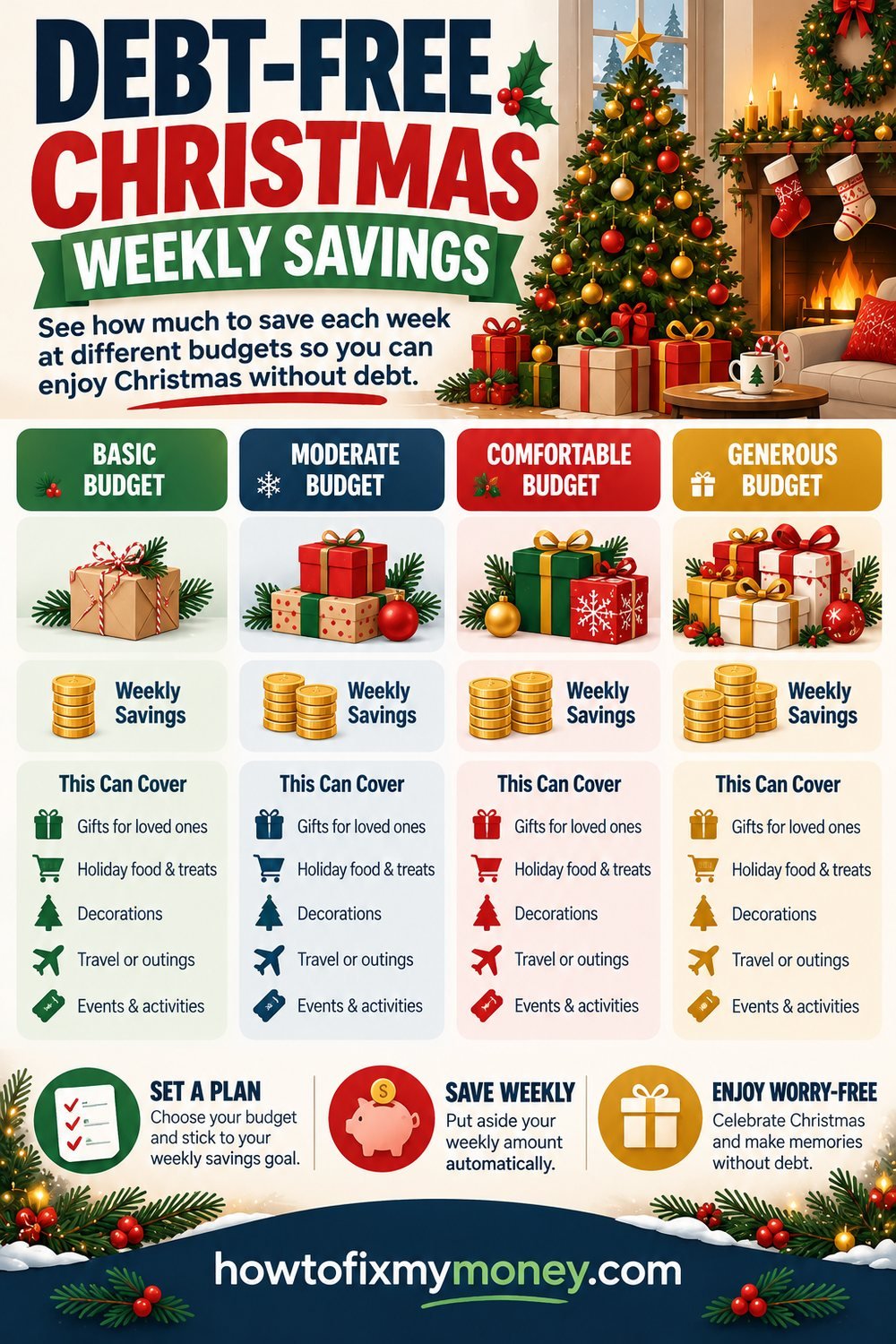
Here is what various totals cost per week, depending on how much time you have left.
| Weeks Left | Basic: $400 | Moderate: $600 | Comfortable: $890 | Generous: $1,200 |
|---|---|---|---|---|
| 12 weeks | $33 a week | $50 a week | $74 a week | $100 a week |
| 10 weeks | $40 a week | $60 a week | $89 a week | $120 a week |
| 8 weeks | $50 a week | $75 a week | $111 a week | $150 a week |
| 6 weeks | $67 a week | $100 a week | $148 a week | $200 a week |
| 4 weeks | $100 a week | $150 a week | $222 a week | $300 a week |
Find the row that matches your calendar, then find the column you can actually sustain. That cell is your debt-free Christmas.
One thing to be clear about before you pick: that total has to cover everything, not just presents. Gifts, holiday food, decorations, cards, travel, and whatever events happen in between. People budget for the gifts and charge the rest, which is where a debt-free Christmas usually breaks. Our Christmas budget calculator keeps every one of those lines in one place and tells you what to save each week.
Move the money to a separate account on payday, the same way you’d pay a bill. Money that stays in checking gets spent on groceries in week two and then Christmas gets charged after all, which is precisely how a planned debt-free Christmas quietly becomes an unplanned $1,223.
Write the Whole Gift List Before You Spend a Dollar, Because the List Is What Overspends
Budgets rarely break on one expensive gift. They break on eleven people nobody counted.
Count Every Name, Including the Ones You Forget Until December 20th
Write them all down now: immediate family, parents, siblings, in-laws, the kids’ teachers, a babysitter, the mail carrier, a Secret Santa at work, a host gift for whoever’s cooking, the neighbor who brings your trash cans in.
Most households are surprised by the total, and this is usually where a debt-free Christmas is won or lost. Twelve to twenty names is normal, and a list that long is exactly why $627 of gift spending disappears without anything memorable happening.
Put a Dollar Figure Next to Each Name Before You Look at a Single Product
Assign amounts until they add up to your debt-free Christmas total, then stop. If the names and the budget don’t reconcile, the names have to change, not the budget.
Writing the figure first also protects you from the thing shopping does to judgment. A $25 gift looks mean next to a $60 one on a shelf. It looks completely normal on a list written at your kitchen table in October.
Keep the List Where You Can Mark Things Off, Not in Your Head
A printed list with four columns, name, amount, idea, and bought, prevents the two most expensive mistakes of December: buying a second gift because you forgot the first, and buying a bigger gift than planned because you can’t remember what you’d allowed.
Where the Money for a Debt-Free Christmas Comes From When the Budget Is Already Tight
For a lot of households there is no spare $60 a week, and that’s the real question a debt-free Christmas has to answer.
It usually comes from four places at once, none of them large on their own.
- Selling things you already own. Ten to fifteen items at realistic prices on a local marketplace is commonly $150 to $400, and it costs you nothing but two evenings of photographing and listing.
- Gift card balances and rewards. Cards from last Christmas sitting in a drawer, credit card points, store loyalty rewards, cash-back app balances. These are already yours and they spend like cash.
- Pausing one category for eight weeks. Not everything, one thing. Food bought outside the house is usually the largest and the least missed, and it recovers fully in January.
- Extra hours, if they’re available. One four-hour shift a week at $15 is $60, which covers a $600 Christmas in ten weeks by itself.
Add a fifth if it applies: a seasonal bonus, a tax credit, overtime at the end of the year. Decide where it goes before it lands, because unplanned money has a two-week lifespan.
How to Shrink the Gift List Without Anyone Feeling Cut Out of Christmas
This is the part people avoid, and on a tight budget it is the single biggest lever a debt-free Christmas has.
The trick is timing. A proposal made in October reads as organized. The same proposal made on December 15th reads as a family member in trouble, which is why nobody makes it and everyone keeps buying.
For Extended Family: Suggest Drawing Names Before Anyone Starts Shopping
One gift each with a set limit, instead of everybody buying for everybody. In a family of ten adults that takes someone from nine gifts to one.
Send the message early and make it sound like a good idea rather than a confession. A debt-free Christmas gets far easier when half the list disappears by agreement, and for most of the people you send it to, that message will be a relief. LendingTree found 45% of Americans already planned to give fewer gifts last season. You are not the only one hoping somebody else raises it.
For Children: Four Gifts Is a Structure, Not a Punishment
Something they want, something they need, something to wear, something to read. It’s an old rule and it works because it caps the count without capping the fun, and it quietly moves spending you were doing anyway, like winter boots, under the tree. On a tight budget that one shift can be the difference between a debt-free Christmas and a card balance.
Young children respond more to the number of things to open than to what any one of them cost. That stops being true around nine or ten, which is when it’s worth asking for one specific thing instead of guessing at five.
For Everyone Else: Time, Skills, and Food Are Real Gifts
A batch of something homemade, a framed photograph, a coupon for childcare or a ride to the airport, a repair you can do and they can’t. These are not consolation gifts, and they are not a sign of a tight year. For most people over thirty they land better than something bought in a hurry, which is why a debt-free Christmas often ends up more memorable rather than less.
The Three Traps That Turn a Planned Debt-Free Christmas Into a January Problem
Buy Now, Pay Later, Which Feels Free and Is Not
Thirty-five percent of people with holiday debt used it last season. The appeal is obvious: four payments of $37 doesn’t feel like $150. The problem is that it’s easy to open several at once with different lenders, and nothing shows you the combined total. The CFPB’s report on the buy now, pay later market flags borrower overextension as the central risk, and that’s exactly how it happens.
If you use it at all, use one provider and write every payment date on the same calendar as your bills. Four plans running at once is how a $600 Christmas becomes a February that doesn’t balance.
The Store Card Offered at the Register, and the Math Nobody Does
Twenty percent off a $200 purchase saves you $40, which is real money. Here’s the part the cashier doesn’t mention.
Store cards commonly carry APRs around 30% or higher. Carry that $200 for twelve months at 32.99% and you’d pay about $38 in interest, which cancels the discount almost exactly. Pay it off within three months and you keep most of the $40.
So the honest answer isn’t never. It’s only if the balance is gone by February and you don’t open a second one at the next register. The danger was never that one transaction. It’s that the card stays open, gets used in March, and is still there next Christmas.
The Last Week, When Spending Stops Being a Decision
Almost all overspending happens in the final seven days. You’re short on time, the planned gift is sold out, shipping costs money now, and buying something more expensive feels like the only way to fix it.
The defense is finishing early, which is how a debt-free Christmas survives the final seven days. Have everything bought by the second week of December and the last week costs you nothing, because you’re not in a shop. That alone is worth more than any discount code.
What Christmas Actually Costs When You Put It on a Credit Card
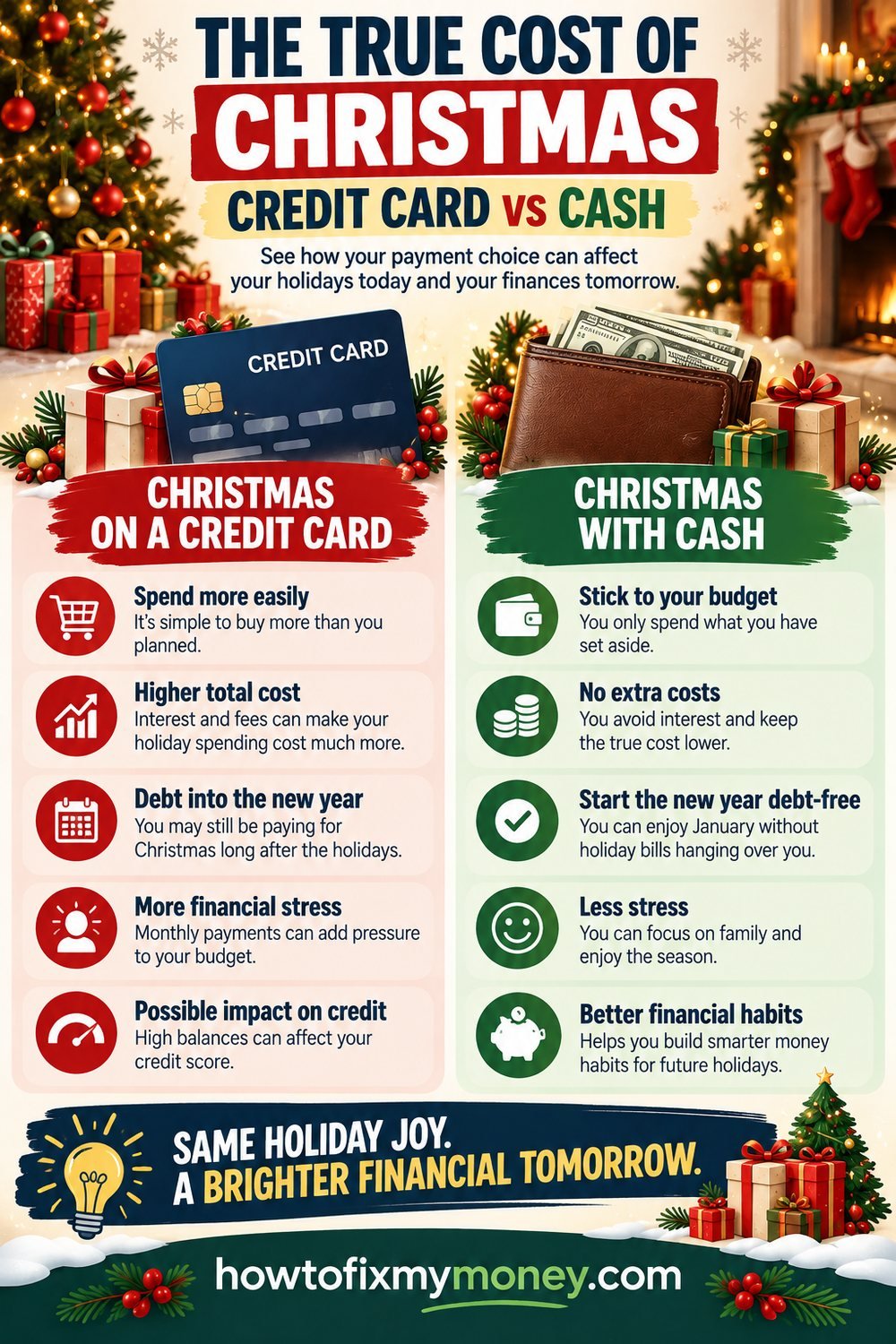
Charging it isn’t free, and the figures are worse than most people assume. The Federal Reserve’s G.19 release put the average rate on credit card accounts assessed interest at 22.36% in August 2026. At that rate, paying only the minimum, here is what three common Christmas balances cost.
| Balance | Minimum Payments Only | Paid Over 3 Months | Interest Saved |
|---|---|---|---|
| $600 | 21 months, $130 interest | $207 a month, $22 interest | $108 |
| $890 | 35 months, $327 interest | $308 a month, $33 interest | $294 |
| $1,223 (the average) | 58 months, $773 interest | $423 a month, $46 interest | $727 |
Read the bottom row again. The average holiday debt, paid at the minimum, takes nearly five years and costs $773. You would still be paying for this Christmas in 2031.
That’s the actual argument for a debt-free Christmas, and it isn’t a moral one. It’s that the same $1,223 of gifts costs $1,223 if you save for it and close to $2,000 if you don’t.
There’s a quieter cost too. How much of your available credit you’re using is one of the larger factors in a credit score, so a balance that sits there through spring can hold your score down months after the decorations come off. A debt-free Christmas skips that entirely.
The Week-by-Week Plan for a Debt-Free Christmas, From Today Until December 25th
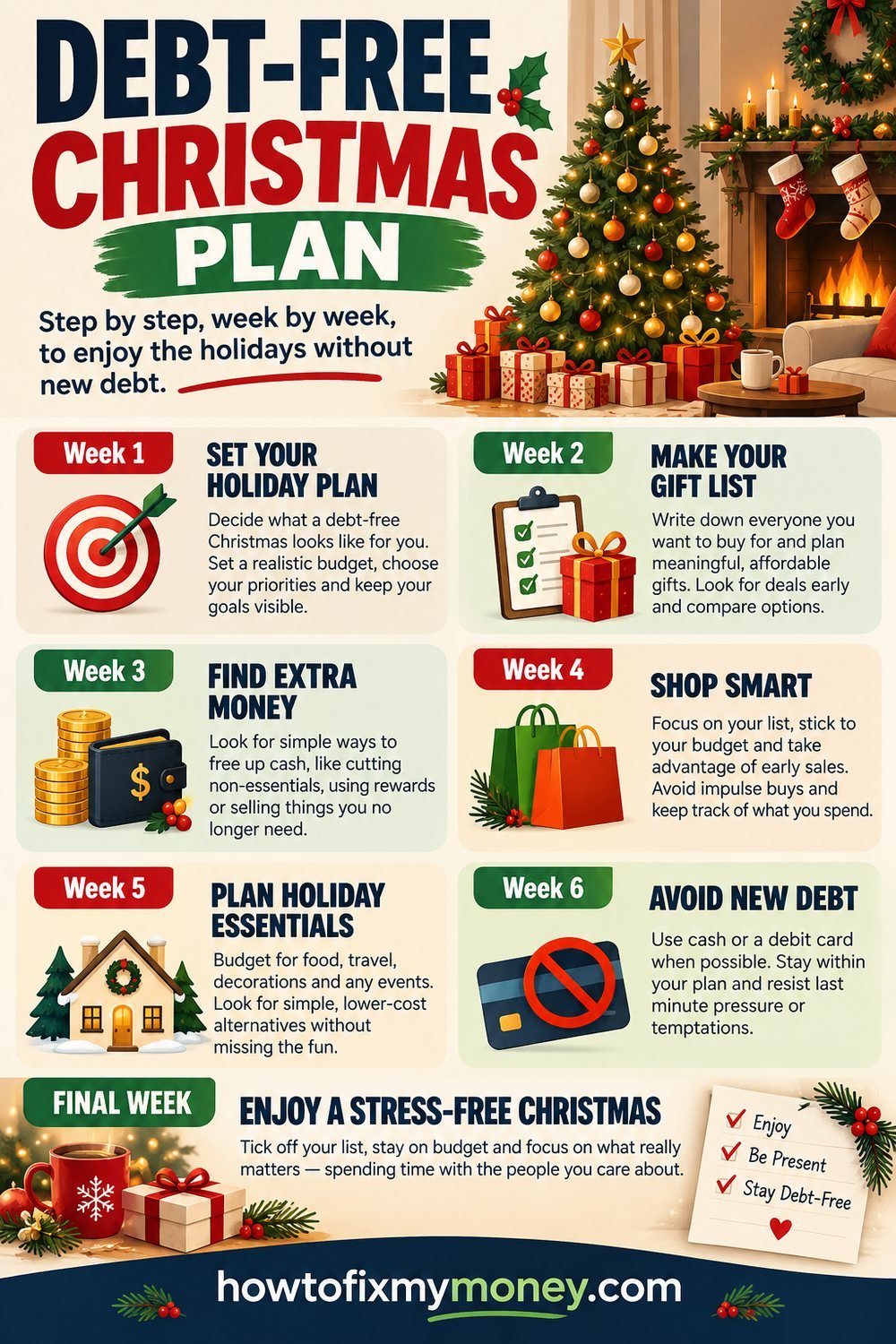
Seven stages, in order. If you have more time than that, stretch the first three. If you have less, compress them and start at week two.
Week 1: Set Your Holiday Plan and Decide the Number
Pick the total, divide it by the weeks you have left, open a separate account, and set the transfer to move automatically on payday. One evening’s work. A debt-free Christmas is decided in that single sitting, and everything after it is execution.
Week 2: Make the Gift List, Every Name and Every Amount
All the names, a dollar figure next to each, then a total. If that total overshoots what you set in week one, cut names or amounts now, on paper, at your kitchen table, rather than in a store on December 20th.
Week 3: Find the Extra Money Before You Need It
List what you’re selling while there’s still time for it to sell. Check what’s left on old gift cards and what your rewards balances are worth. Send the message about drawing names. This is the week that funds most of a debt-free Christmas on a tight budget.
Week 4: Shop Smart, and Only From the List
Buy as the money arrives rather than in one December spree, and cross each name off as you go. If you’re buying gift cards, buy them from the store itself rather than a resale site. The FTC’s guidance on gift card scams is worth two minutes: check the packaging hasn’t been tampered with, keep the receipt and the card number, and treat any request to pay someone in gift cards as a scam, always.
Black Friday is useful only for things already on your list. A discount on something you weren’t going to buy is not a saving, it’s a purchase with a story attached.
Week 5: Plan the Holiday Essentials Nobody Budgets For
Food, decorations, cards, travel, and the events in between. NRF puts this at $262.56 a person, close to a third of all holiday spending, and it is almost always the part that quietly ends a debt-free Christmas, because the gifts got budgeted and this didn’t.
Price it now: the grocery run, the tank of gas, the school concert, the gift for whoever is hosting. Put the figure in the same budget as the presents.
Week 6: Avoid New Debt in the Weeks It Gets Hardest
Cash or debit only from here. No store card at the register, no fourth buy now, pay later plan, no “I’ll move it off the card in January”.
This is the week the traps above come looking for you, and a debt-free Christmas only holds if the answer was already decided in week one.
The Final Week: Finish, Then Stop Shopping Entirely
Aim to be done by around the 12th. Wrap what you have, and when the list is complete, stop.
Then the last stretch costs you time rather than money, which is the whole point of a debt-free Christmas: you get to December 25th and nothing follows you into January.
Most holiday debt starts on one weekend. Use the 40% rule to work out how much to spend on Black Friday without touching a credit card.
Questions People Actually Ask About Having a Debt-Free Christmas
What does a debt-free Christmas actually mean?
It means every dollar of Christmas is paid for with money you already had by December 25th: no credit card balance carried into January, no buy now, pay later plans running into February, no store card opened at a register. It does not mean a cheap Christmas or a small one. A $1,500 Christmas paid in cash is a debt-free Christmas. A $300 one on a card is not.
How much should I spend on Christmas if money is tight?
Whatever you can set aside in cash before December 25th, and not a dollar more. For a household on a tight budget that’s often $200 to $500 in total, and that is a perfectly normal Christmas. The national average of $890 a person is inflated by higher-income households and is not a standard anyone needs to meet.
Is it rude to tell family you are not buying gifts this year?
No, and it’s far less awkward than people expect, especially if you say it early. Most families contain several people hoping someone else will bring it up. Propose a specific alternative rather than just opting out: drawing names, a $20 limit, kids only, or everyone bringing food instead of presents. Framed that way it sounds like a plan, which is all a debt-free Christmas is.
How do I do Christmas with no money at all?
Shift from buying to making and doing. Baked goods, a shared meal, a printed photo, a handwritten letter, an offer of time. Check local community programs too, since many churches, schools, and nonprofits run toy and food drives through December and they exist precisely for years like this one. Asking is not a failure, and the people running them would much rather you did.
Should I use buy now, pay later for Christmas gifts?
Only if the whole balance clears before the end of January and you use one provider, so you can see the total. The risk isn’t any single plan, it’s running four at once with different dates and no combined view. If the only way you can afford a gift is to split it into four payments you haven’t earned yet, that gift is over budget, and a debt-free Christmas means it comes off the list.
Is a store card discount worth taking at the register?
It can be, narrowly. Twenty percent off $200 is $40 up front. Carrying that balance a year at a typical store APR near 33% costs around $38, wiping the discount out. Take it only if you’ll clear the balance within a couple of months and you won’t open another one, and expect a hard inquiry on your credit file for the privilege.
How much should I spend on each child?
There is no correct figure, and children are much worse at estimating cost than adults assume. Structure beats amount: four gifts, or one bigger item plus a few small ones. If you have multiple children, keep the number of gifts even rather than the dollar amount, since that is what they actually compare.
What if I have already put Christmas on a credit card?
Then stop adding to it and switch to clearing it fast, because the difference between three months and minimum payments on an average balance is more than $700. Pay a fixed amount rather than whatever the statement asks for, and use January, which hands you more ways to find money than any other month.
When should I start saving for next Christmas?
January, while this year is still fresh. Saving $17 a week over fifty-two weeks covers $890. Eleven dollars and fifty cents a week covers $600. Set it to move automatically on payday into an account with no card attached and you’ll reach next December with the money already there, which is what makes a debt-free Christmas ordinary instead of an effort.
Why Your Next Debt-Free Christmas Will Be Far Easier Than This One
The hard version is the one you’re doing now, starting late with no fund and a deadline that doesn’t move.
The easy version costs $11 to $17 a week and takes one decision in January. Same Christmas, no January bill, and no part of your next year spent paying for it.
If something is already on a card, the Debt Payoff Calculator will give you a real payoff date in two minutes. If the weekly number still looks out of reach, start with how to cut $300 a month, or browse more guides in our Money Fixes section.

Bilal founded HowToFixMyMoney.com in 2026 to make US personal finance decisions easier to work through without a financial background. Every figure published here traces back to a primary source — the Bureau of Labor Statistics, the Federal Reserve, the IRS, the CFPB — and each article links to the data it relies on. He is not a licensed financial advisor, and nothing on this site is personalized advice.