
Nobody signs up for four loans. People buy a coat, then some toys, then headphones, and each time the checkout screen shows a small number instead of the real one. Six weeks later five payment dates arrive in the same month and the whole thing finally looks like what it always was.
LendingTree’s tracking puts the scale of it plainly. Forty-seven percent of buy now, pay later users paid late in the past year, up from 41% the year before and 34% the year before that. Sixty-three percent have carried more than one loan at a time, and a quarter have juggled three or more.
That last number explains why buy now pay later debt behaves so differently from a credit card. One card gives you one balance and one due date. Four split payments give you no balance anywhere, no statement, and a dozen dates nobody wrote down.
This walks through how to see all your buy now pay later debt at once, which payment to protect first, and how to shrink the calendar before the fees start.
Why Buy Now Pay Later Debt Disappears Until It All Arrives at Once
A credit card tells you what you owe. Log in and a single number sits at the top of the screen. Buy now pay later debt has no equivalent, because every loan lives inside a separate app with a separate schedule.
Three things combine to hide buy now pay later debt:
- Each loan shows you one installment, never the total. A $320 purchase presents itself as $80 and the brain files it as an $80 decision.
- Payments run on a 14-day cycle rather than a monthly one, so they drift across the calendar and land on different dates every month.
- Autopay pulls the money without asking. No bill arrives, no notification demands attention, and the first real signal comes when a payment fails.
The CFPB measured this behavior directly. Its research on consumer use of buy now, pay later found that 63% of borrowers held several loans at the same time during the year and 33% borrowed from more than one provider. The average borrower opened 9.5 of these loans in a single year.
Nine or ten loans a year, from two or three different apps, on a two-week cycle. That is how buy now pay later debt reaches a total nobody predicted.
Four Holiday Loans That Felt Like $185 and Actually Cost $1,160
Here is how buy now pay later debt builds in an ordinary holiday run. Nothing extravagant, nothing reckless, four purchases across five weeks.
| Purchase | Price | Plan | Each Payment | Payments |
|---|---|---|---|---|
| Coat, bought Black Friday | $240 | Pay in 4 | $60 | 4 |
| Toys, bought Cyber Monday | $180 | Pay in 4 | $45 | 4 |
| Headphones, bought three weeks later | $320 | Pay in 4 | $80 | 4 |
| Tablet, bought mid-December | $420 | 6 months, 0% | $70 | 6 |
| Total borrowed | $1,160 | 18 |
At the three checkouts that used Pay in 4, this shopper handed over $60, $45 and $80. A hundred and eighty-five dollars, spread across five weeks, for $740 of goods. The tablet asked for nothing at all upfront.
That gap is the whole mechanism behind buy now pay later debt. The purchase feels like $185. The obligation is $1,160, and $615 of it has not even come due by New Year.
Map Every Due Date Before You Pay Anybody Anything

Open each app, write down every piece of buy now pay later debt you carry with its date, and put it all in one list. Do this before you pay a cent, because the order you choose depends on seeing the whole month at once.
Our four loans produce this January:
| Date | Loan | Amount | Running Total |
|---|---|---|---|
| January 8 | Coat, final payment | $60 | $60 |
| January 9 | Headphones, 3rd of 4 | $80 | $140 |
| January 11 | Toys, final payment | $45 | $185 |
| January 15 | Tablet, 1st of 6 | $70 | $255 |
| January 23 | Headphones, final payment | $80 | $335 |
Three observations about this buy now pay later debt fall straight out of that table, and none of them show up inside any single app.
January costs $335. December cost $440. Together that is $775 leaving a household across eight weeks, from purchases that felt like pocket change at the till.
Second, the payments cluster. January 8, 9 and 11 bring three separate withdrawals inside four days, totaling $185. That figure deserves a second look, because it matches the $185 paid at checkout exactly. Pay in 4 splits every purchase into four equal installments, so the final payments cost precisely what the first ones did. They simply arrive in January, when the money has gone, rather than in November, when it felt available.
Third, the tablet keeps going. Its payments run through May, long after the holidays stop being a memory.
The Fee That Really Hurts Comes From Your Bank, Not the App
The late fee on your buy now pay later debt is rarely the expensive part. The charge that does more damage usually comes from somewhere else entirely.
These loans pull from a debit card or a bank account on a fixed date. When the balance falls short, two charges can land from one failed payment: the provider’s late fee, and your bank’s overdraft or returned-payment fee. Bank fees frequently run larger than the app’s.
Now apply that to a cluster. Three payments inside four days against a thin balance can fail together, and three separate bank fees arrive from what the shopper experienced as one bad week.
Late fee policies on buy now pay later debt vary by provider, by plan and sometimes by state, and they change. Affirm advertises that it charges no late fees. Others do charge them, usually capped against the order value. Open your own agreement and find the number rather than trusting a figure from an article, including this one. Search the app’s help section for the words late fee and read what it says about your specific plan.
The practical move costs nothing. Check which card or account each loan pulls from, then make sure that account holds enough on the clustered dates. Moving $200 into the right account the day before prevents more damage than any amount of worrying about fee schedules.
Pay Them in This Order When You Cannot Cover Everything

Credit card advice tells you to sort by interest rate. That logic fails here, because Pay in 4 charges no interest at all. Sort buy now pay later debt by consequence instead.
| Order | Pay This First | Because | Priority |
|---|---|---|---|
| 1 | Anything pulling from an account that will overdraft | One shortfall triggers two fees, provider and bank | Highest |
| 2 | Loans from a provider that reports to a credit bureau | A missed payment can reach your credit file | High |
| 3 | Loans already past due | These move toward collections fastest | High |
| 4 | The final payment on any loan | Clearing it removes a future date from the calendar | Medium |
| 5 | Longer plans with payments months away | Time exists to arrange these | Lowest |
Notice that balance size never enters the ranking of your buy now pay later debt. A $45 payment that bounces and triggers a bank fee damages you more than a $150 payment you postpone by arrangement.
Contact the provider before a payment fails rather than after, because buy now pay later debt stays negotiable right up until it defaults. Several allow a one-time date change through the app, and a payment moved on purpose costs nothing while a payment missed by accident costs twice.
Clear the Small Ones Outright and Shrink the Calendar
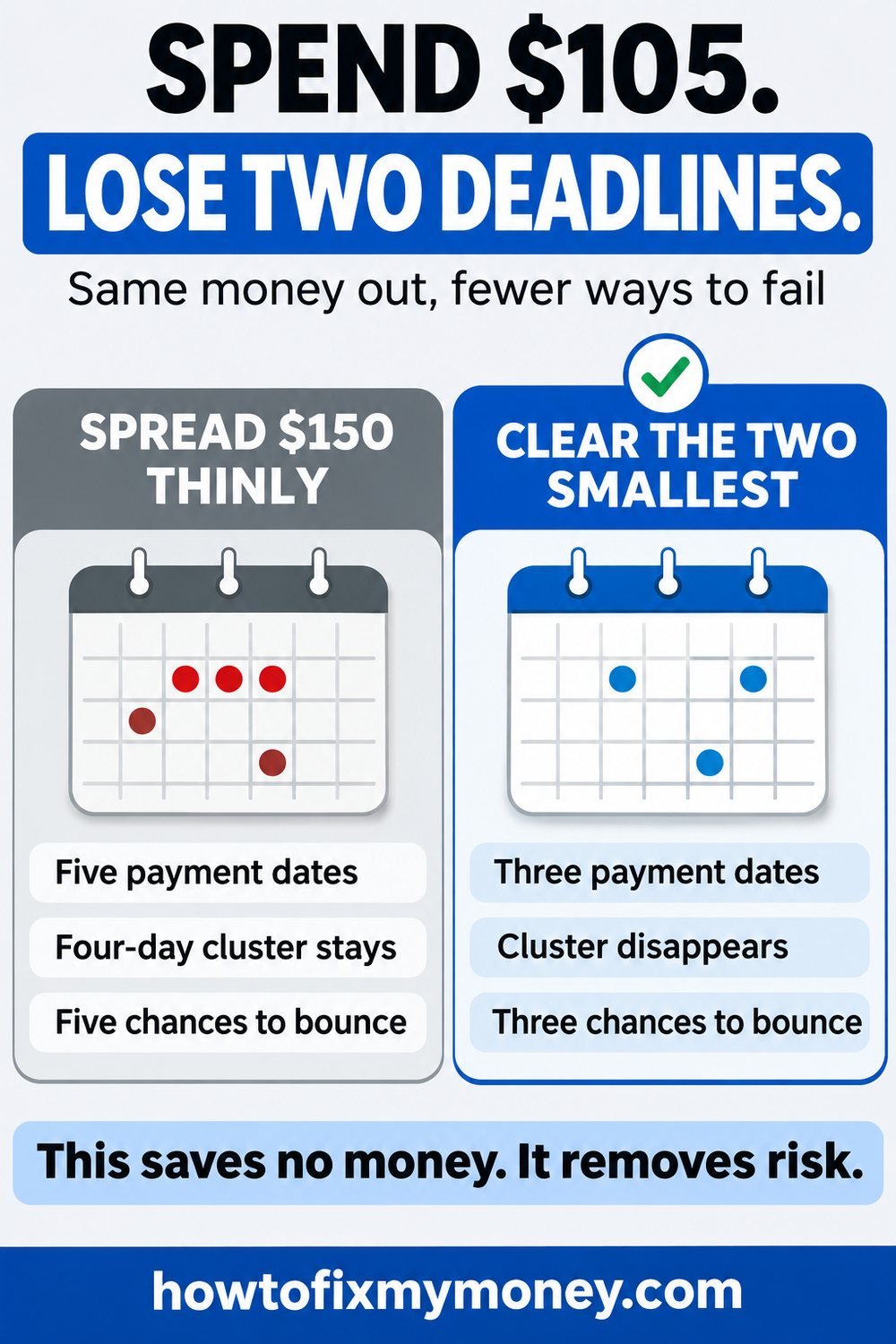
Suppose $150 becomes available to put against your buy now pay later debt in early January. Spreading it thinly across five loans accomplishes almost nothing. Killing the smallest ones outright changes the shape of the month.
The coat needs $60 and the toys need $45. Paying both off costs $105 and removes two of the five January dates. What remains is three payments instead of five, and the four-day cluster disappears entirely.
Be clear about what that achieves, because it does not save money. The same $335 leaves the household either way. What it buys is fewer chances to fail. Every date removed is one less opportunity for an autopay to bounce, one less chance of a double fee, and one less thing to track in a month that already feels crowded.
That trade matters most when cash arrives unpredictably. Fewer deadlines beats smaller deadlines when you cannot promise what any given Friday will look like.
What These Loans Now Do to Your Credit Report
The credit reporting rules around buy now pay later debt changed recently, and plenty of advice still circulating describes the old situation.
Affirm began reporting all of its pay-over-time loans, Pay in 4 included, to Experian from April 2025, according to American Banker. Those Pay in 4 loans appear on your own Experian report, though they had not yet fed into traditional credit scores and other lenders could not see them.
A FICO study with Affirm, covering roughly 500,000 consumers, found the score effect modest. More than 85% of people in the study moved fewer than ten points in either direction, which FICO described as consistent with opening any new account. Borrowers with five or more of these loans generally held steady or scored higher.
Treat that as reassuring about opening loans and say nothing about missing payments, which is a separate matter. Reporting practices also differ sharply between providers and keep changing. The safe assumption is that your buy now pay later debt may well be visible on a credit file, so handle a missed payment as seriously as you would a missed card payment.
Your Legal Protections Are Thinner Than Most People Assume
This part rarely appears in articles about buy now pay later debt, and it changes how carefully you should treat disputes.
In May 2024 the CFPB issued an interpretive rule treating buy now pay later debt like credit card debt, which would have given borrowers familiar protections. In 2025 the Bureau said it would not prioritize enforcement based on that rule and signaled an intention to rescind it.
The National Consumer Law Center argues the withdrawal carries little legal significance and that courts may still apply the 2024 reading. Under it, you could dispute a charge and withhold payment on goods you never received or already returned, and the lender could not demand payment or report you late while it investigated. Billing errors carry a 60-day written dispute window.
What nobody can promise is that a provider will honor those rights voluntarily. So protect yourself through records rather than through rules. Dispute in writing, not by phone. Keep the return receipt and the tracking number. Screenshot the app showing what you owe before and after. NCLC notes that some providers chase a loan even after the customer returned the purchase, which is precisely when documentation decides the outcome.
When to Stop Using Them Altogether
Buy now pay later debt suits a planned purchase you could have afforded anyway, split across a few weeks for convenience. These loans stop being that and become something else when particular signs appear.
- You use one to cover groceries, gas, rent or a utility bill. Financing something you consume this week is a cash flow problem, not a payment preference.
- You open a new loan to free up money for an older one. That is refinancing, and it ends badly in every form of borrowing.
- You have stopped knowing the total without opening every app to count.
- A payment has already failed once. The next one will arrive against the same tight balance.
- You are holding four or more at once. The CFPB found a fifth of borrowers averaging more than one new loan a month, which is a volume no household budget tracks reliably.
If several of those ring true, the problem reaches past buy now pay later debt and into the budget underneath it. Run through the warning signs that say you carry too much debt and work out where you actually stand before next December arrives.
Questions People Ask About Buy Now Pay Later Debt
Does buy now pay later debt hurt my credit score?
It depends on the provider. Affirm reports its loans to Experian, where Pay in 4 appears on your own report without yet feeding traditional scores. Other providers report differently, and several have changed their practice recently. Assume a missed payment can reach your file and treat it accordingly.
What happens if I stop paying my buy now pay later debt?
The provider charges whatever late fee its agreement allows, keeps attempting the autopay, and eventually refers the balance to collections. A collections account causes far more damage than the original purchase was worth, and the debt does not disappear because the loan was small.
Can I pay a loan off early?
Yes, and every major provider allows it through the app at no cost. Pay in 4 charges no interest, so early payoff saves nothing in money. It saves you a date on the calendar, which is the thing actually worth having when payments cluster.
Should I use a credit card to pay off buy now pay later debt?
Rarely. You would swap a no-interest obligation for one that charges interest, which moves you backward. The exception is a genuine overdraft risk, where a card payment that costs a few dollars in interest beats a bounced autopay that triggers two separate fees.
Why do my payments land on such strange dates?
Pay in 4 runs on a 14-day cycle starting from your purchase date, not on a monthly one. Buy things on different days and the schedules drift apart, then collide. That is why mapping every date in one list reveals clusters no individual app will show you.
Can I return something and cancel the loan?
Usually, but the refund and the loan are handled separately and the timing rarely lines up. Keep paying until the app shows the balance cleared, because a loan can stay active and accrue late fees while a return works its way through. Keep the receipt and tracking number in case you need to dispute it.
How much buy now pay later debt is too much?
A workable test ignores how many loans you hold. Can you name the total you owe and every remaining date without opening an app? If not, you have more than you can manage, whether that is two or seven.
What to Do This Week
List every piece of buy now pay later debt you hold. Open each app you have used since November and write down every remaining payment with its date and amount. One list, one page. Most people find this takes about fifteen minutes and produces a total they did not expect.
Circle the dates that sit within a few days of each other, then check which account each one pulls from. Those clusters are where overdraft fees come from, and a transfer made the day before costs nothing.
If spare cash exists, aim it at the smallest buy now pay later debt you hold and clear it outright rather than spreading it across five loans. You will not pay less, but your January will hold three deadlines instead of five.
Stop the stack before it forms next year.
The cheapest buy now pay later debt is the kind that never starts. A holiday sinking fund turns December into a cash purchase, and setting a Black Friday number before the sales begin stops the stack forming in the first place. If balances have already grown past what these apps caused, compare a consolidation loan against the card you are carrying before you borrow anything else.
Sources
- LendingTree, Buy Now, Pay Later Statistics
- Consumer Financial Protection Bureau, Consumer Use of Buy Now, Pay Later and Other Unsecured Debt
- American Banker, Affirm to report BNPL loans to Experian following FICO study
- National Consumer Law Center, What Rights Do Buy Now, Pay Later Purchasers Have?
- Consumer Financial Protection Bureau, Announcement Regarding Enforcement Actions Related to Buy Now, Pay Later Loans

Bilal founded HowToFixMyMoney.com in 2026 to make US personal finance decisions easier to work through without a financial background. Every figure published here traces back to a primary source — the Bureau of Labor Statistics, the Federal Reserve, the IRS, the CFPB — and each article links to the data it relies on. He is not a licensed financial advisor, and nothing on this site is personalized advice.