
Most people decide they have too much debt the way they decide a room is cold. It feels wrong, so it probably is. That instinct arrives either far too late or far too early, and neither timing helps you decide whether you really do have too much debt.
Too much debt is a number, not a feeling. Four tests produce that number, you can run all four tonight with a bank app and a calculator, and each result points to a different action.
Plenty of households are running these tests right now. The New York Fed put total household debt at $18.771 trillion in the second quarter of 2026, with credit card balances at $1.263 trillion and 6.97% of card balances flowing into serious delinquency over the year. You are not an outlier. You just need the number.
Why Too Much Debt Has a Real Answer Instead of a Vague One
Lenders settled this decades ago. They refuse to guess whether a borrower carries too much debt, so they measure it instead, and you can run the same measurement on yourself.
The four tests below move from the most objective to the most personal, and together they tell you whether you have too much debt. Run them in order. The first one alone resolves the question for most people, and the other three catch the situations a single ratio misses.
- Test one measures what your debt costs each month against what you earn, which is the standard definition of too much debt.
- Test two measures how long your current payments would actually take.
- Test three measures whether new borrowing is covering old borrowing.
- Test four measures whether a small emergency would create more debt.
None of them require a credit score, a login, or anyone else’s involvement.
Test One: The Two Ratios That Measure Too Much Debt
Your debt-to-income ratio is the standard measure. The CFPB defines it as all your monthly debt payments divided by your gross monthly income, meaning your pay before tax and deductions.
Run it twice, because a single ratio misleads you about whether you carry too much debt.
- Total ratio: every monthly debt payment, housing included, divided by gross monthly income. This is what a lender sees.
- Consumer ratio: the same calculation with housing removed, so cards, car loans, student loans and personal loans only. This is what you can actually change.
The split matters more than any single threshold. Rent and a mortgage are expensive, yet you cannot restructure them the way you can restructure a credit card. A household with a high total ratio and a low consumer ratio has an expensive home, not too much debt. A household with a high consumer ratio has a problem it can act on.
| Situation | Housing | Other Debt | Gross Income | Total Ratio | Consumer Ratio |
|---|---|---|---|---|---|
| Doing fine | $1,200 | $480 | $4,800 | 35% | 10% |
| Manageable | $1,450 | $700 | $5,000 | 43% | 14% |
| Getting tight | $1,500 | $1,050 | $4,800 | 53% | 22% |
| In trouble | $1,600 | $1,600 | $4,700 | 68% | 34% |
Look at the last two rows, because they show how two similar households end up in different places. Both pay similar housing costs on similar incomes. The difference sits entirely in the consumer column, and that column is the one you can move.
How to Work Out Your Own Two Numbers in Ten Minutes
Open your banking app and write down the minimum or required payment on every debt you owe. Not the balance, the monthly payment.
Include the mortgage or rent, the car loan or lease, every credit card minimum, student loans, personal loans, buy now pay later installments, and any court-ordered payment such as child support. Leave out utilities, groceries, insurance and subscriptions, which are bills rather than debts.
Add them up, then divide by your gross monthly income. Multiply by 100 and you have the total ratio that decides whether lenders think you hold too much debt. Remove the housing line and repeat for your consumer ratio. Or let our debt-to-income ratio calculator do the math and show where you sit against lender cutoffs.
What Your Consumer Ratio Actually Means
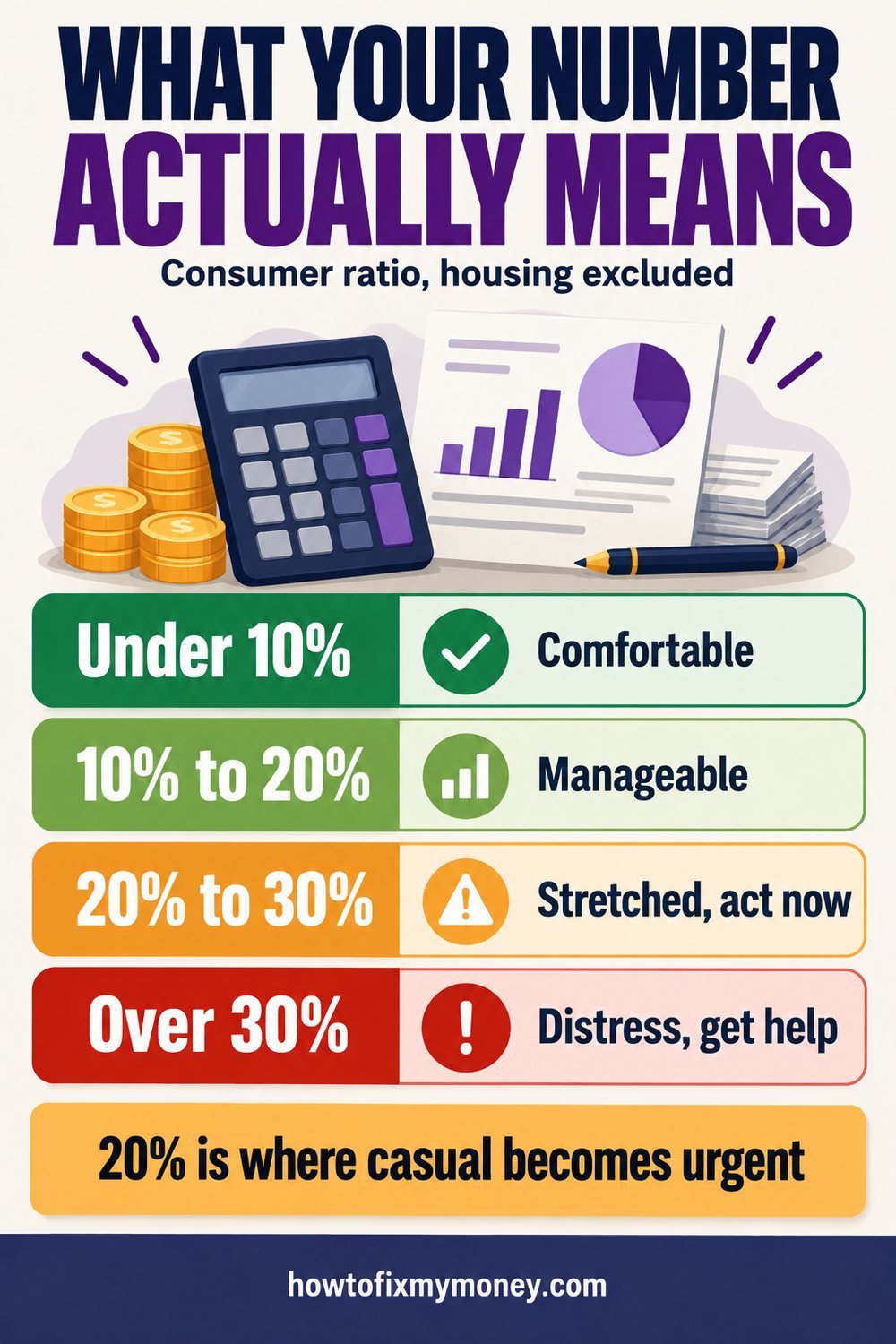
The total ratio tells you what a lender will say about your application. The consumer ratio tells you whether you have too much debt in the sense that matters, because it isolates the debt you can restructure, refinance or clear.
| Consumer Ratio | Where You Stand | What It Feels Like | What to Do |
|---|---|---|---|
| Under 10% | Comfortable | Payments barely register | Keep going, build savings |
| 10% to 20% | Manageable | Noticeable but not painful | Raise payments above the minimum |
| 20% to 30% | Stretched | One bad month causes trouble | Act now, before anything slips |
| Over 30% | Distress | Juggling, borrowing, falling behind | Get free help this month |
The 20% line is where too much debt stops being a worry and starts being a plan. Below it you have options. Above it your options narrow every month you wait, because interest compounds against you while your choices shrink.
Over 30%, the arithmetic rarely resolves itself through willpower. That number signals too much debt for your current income, and the realistic fixes involve either restructuring the debt or raising the income.
Test Two: The Minimum Payment Clock
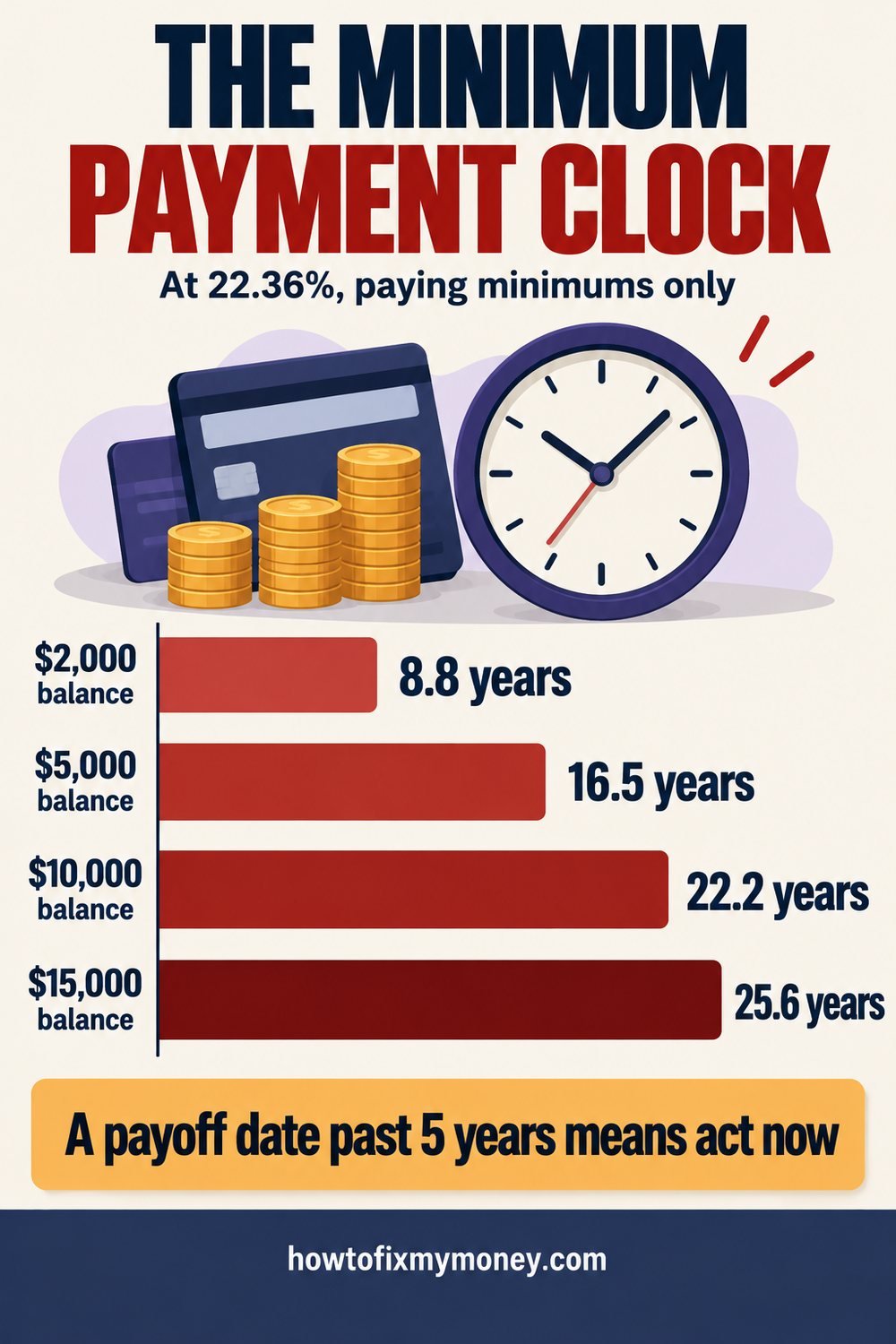
A ratio can look survivable while the timeline says you have too much debt. So run the second test, using the 22.36% average rate on cards carrying a balance from the Federal Reserve’s G.19 report for August 2026.
| Card Balance | Minimums Only | You Repay in Total | That Is |
|---|---|---|---|
| $2,000 | 106 months, 8.8 years | $4,221 | 2.1 times the balance |
| $5,000 | 198 months, 16.5 years | $12,811 | 2.6 times the balance |
| $10,000 | 267 months, 22.2 years | $27,128 | 2.7 times the balance |
| $15,000 | 307 months, 25.6 years | $41,444 | 2.8 times the balance |
Here is the test. Find your payoff date at your current payment, which most card statements now print. If that date sits more than five years out, you have too much debt relative to what you are paying, regardless of what your ratio says.
The fix is often smaller than people expect. On a $10,000 balance, minimums alone run 267 months. Paying $350 a month clears it in 42 months and saves $12,717 in interest. The balance did not change and neither did the rate. Only the payment did.
So before concluding that you need outside help, check whether you have too much debt or simply too small a payment. Those call for completely different responses.
Test Three: The Borrowing Test
This test for too much debt takes thirty seconds and no arithmetic. Look back over the past three months and answer two questions honestly.
- Did you use a credit card, an overdraft or a buy now pay later plan to cover groceries, fuel, utilities or rent?
- Did you use any form of credit to make a payment on another debt?
A yes to the first means your income no longer covers your essentials, and credit is quietly filling the gap. That gap grows, because next month carries the same shortfall plus interest on this month’s.
A yes to the second is more serious. Borrowing to service borrowing has no stable version. Balance transfers and consolidation loans are deliberate, planned versions of this and they can work. Reaching for a cash advance to cover a card payment is not planning, and it signals too much debt by any measure.
Either answer overrides a comfortable ratio and points to too much debt. Someone at 15% who covered groceries on a card last month has a live problem that the ratio has not caught up with yet.
Test Four: The $500 Test That Too Much Debt Always Fails
Could you pay an unexpected $500 expense tomorrow without borrowing? The Federal Reserve’s Economic Well-Being of U.S. Households report found that 30% of adults could not cover a $500 expense from savings.
A no here does not mean you have too much debt today. It means any progress you make stays fragile, because the next car repair or medical bill rebuilds the balance you just cleared.
This is why every sensible plan puts a small buffer ahead of aggressive repayment. Clearing $500 into a separate savings account before you accelerate payments feels like going slower, and it is the difference between a plan that survives the year and one that resets every few months.
The Signal That Shows Up in No Ratio at All
Money stress is real, it is not a character flaw, and it often arrives before the numbers confirm too much debt. If debt is keeping you awake, making you avoid opening the mail, or dominating conversations at home, that matters whatever the four tests say.
Treat it as information rather than as a verdict on you. Persistent worry usually means the numbers have sat unresolved for a while, and getting the actual figures on paper tends to reduce the weight rather than add to it, because a defined problem is smaller than an undefined one.
If the stress is affecting your sleep, your health or your relationships, talk to someone about it alongside working the numbers. A nonprofit credit counselor will review your situation free of charge, and talking to a doctor or a trusted person about the toll is a reasonable step rather than an overreaction.
What to Do at Each Level

Your consumer ratio and the borrowing test together decide what too much debt means in your case, and what to do next.
| Where You Landed | Your Next Step | Why This One |
|---|---|---|
| Under 20%, no borrowing flags | Raise payments above the minimum | The timeline is the problem, not the debt |
| 20% to 30%, no borrowing flags | Price a lower rate before anything else | You still qualify for options that cost little |
| 20% to 30%, borrowing flags | Free nonprofit credit counseling review | The gap needs fixing before the balance will fall |
| Over 30%, can still pay something | Credit counseling or a debt management plan | Cuts the rate without damaging your credit |
| Over 30%, cannot pay the minimums | Counselor first, then a bankruptcy attorney | Both consultations are free and tell you where you stand |
Two steps cost nothing and almost nobody takes them. Call each creditor and ask for a hardship program or a lower rate, which involves no fee and no credit inquiry. Then book a free review with a nonprofit agency affiliated with the National Foundation for Credit Counseling.
Do both before you consider anything that charges a fee or damages your credit.
Get your two numbers in one sitting
Put your payments and income into the free Budget Planner, then run your largest balance through the Debt Payoff Calculator to find the real payoff date. Those two figures decide everything that follows.
Where People Go Wrong After They Measure Too Much Debt
- Running the ratio on take-home pay. This inflates your result and can push you toward drastic action you do not need. Use gross income.
- Counting bills as debt. Utilities, insurance, groceries and subscriptions belong in a budget, not in a debt ratio, and including them distorts the answer.
- Treating a high total ratio as proof of too much debt. If the consumer column is low, the issue is housing cost, and the fix is different.
- Skipping the buffer to pay debt faster. The next emergency undoes the progress and the discouragement costs more than the interest saved.
- Paying a company to do what a nonprofit does free. Credit counseling agencies give an initial review at no charge.
- Waiting for a round number before acting. Nothing about too much debt improves at 25% that would not improve at 22%, and the options are better the earlier you use them.
Questions People Ask About Having Too Much Debt
What debt-to-income ratio counts as too much debt?
No single figure applies to everyone, which is why the two-ratio split matters. As a working guide, a consumer ratio under 20% leaves you room to fix things yourself, 20% to 30% calls for action before anything slips, and above 30% usually needs outside help. Lenders focus on the total ratio including housing, and most tighten considerably above the mid-forties.
Should I use gross or net income?
Gross, meaning your pay before tax and deductions. Every published guideline on too much debt assumes gross income, so using net income produces a number that is not comparable to any published guideline and makes your position look worse than a lender would score it.
Does my mortgage count?
It counts in your total ratio and not in your consumer ratio, which is exactly why running both is worth the extra two minutes. Housing is a debt you generally cannot restructure quickly, so separating it shows you how much of your problem is actually solvable.
Do buy now pay later plans count?
Yes. Include every scheduled installment in your monthly debt total. These plans are easy to overlook because they rarely appear on a statement alongside everything else, and households commonly run several at once without ever seeing the combined figure.
My ratio looks fine but I still feel stretched. What am I missing?
Usually one of three things, and none of them show up as too much debt on the first test: a high cost of living that no debt ratio captures, irregular income that averages out on paper but not in practice, or minimum payments that keep the ratio low while the payoff date sits twenty years out. Run tests two and three, which catch all three cases.
Will checking any of this hurt my credit score?
No. Every test for too much debt on this page uses figures you already have. Checking your own credit report counts as a soft inquiry and never affects your score, and you can pull all three reports free at AnnualCreditReport.com.
How quickly can a bad ratio improve?
Faster than most people expect, because too much debt is measured on payments rather than balances. Clearing one small account removes its minimum payment permanently, which lowers the ratio immediately and frees that money for the next account. Two or three cleared accounts can move the number several points within a year.
Is there a point where I should stop trying to fix it alone?
When the minimum payments alone exceed what you can reliably pay each month, or when the payoff date at your best realistic payment still sits beyond five years. Either case means the structure needs changing rather than the effort, and a free counseling review is the right next call.
Your Next Three Moves
Write down every monthly debt payment tonight and work out both ratios. Fifteen minutes, and you replace a feeling about too much debt with a figure you can act on.
Then check the payoff date on your largest card at your current payment. If it sits beyond five years, work out what payment brings it inside three, because that figure is your real target rather than the minimum printed on the statement.
Finally, if either borrowing-test answer was yes, or your consumer ratio came in above 20%, book a free review with a nonprofit credit counseling agency this week. The call costs nothing, touches nothing, and people routinely finish it with options they did not know existed.
Work out your own figures with our free Budget Planner and Debt Payoff Calculator. If a lower rate looks possible, the break-even rate that decides whether a consolidation loan saves you money shows when it pays. If someone has pitched you a settlement program, read the debt settlement risks worth pricing first before you sign anything. More guides sit in our Debt Relief section.
Sources
- Federal Reserve Bank of New York, Household Debt and Credit, Q2 2026 – $18.771 trillion total household debt, $1.263 trillion in card balances, 6.97% of card balances flowing into serious delinquency.
- CFPB, what is a debt-to-income ratio – the definition and calculation method used throughout this article.
- Federal Reserve, G.19 Consumer Credit, August 2026 – 22.36% average rate on cards carrying a balance.
- Federal Reserve, Economic Well-Being of U.S. Households – 30% of adults could not cover a $500 expense from savings.
- The consumer ratio bands reflect common lending practice. No regulator publishes a fixed cutoff, and the CFPB page above states that limits vary by loan product and lender.
- Payoff timelines and interest totals calculated by How To Fix My Money using standard amortization and a minimum payment of 1% of the balance plus interest.

Bilal founded HowToFixMyMoney.com in 2026 to make US personal finance decisions easier to work through without a financial background. Every figure published here traces back to a primary source — the Bureau of Labor Statistics, the Federal Reserve, the IRS, the CFPB — and each article links to the data it relies on. He is not a licensed financial advisor, and nothing on this site is personalized advice.