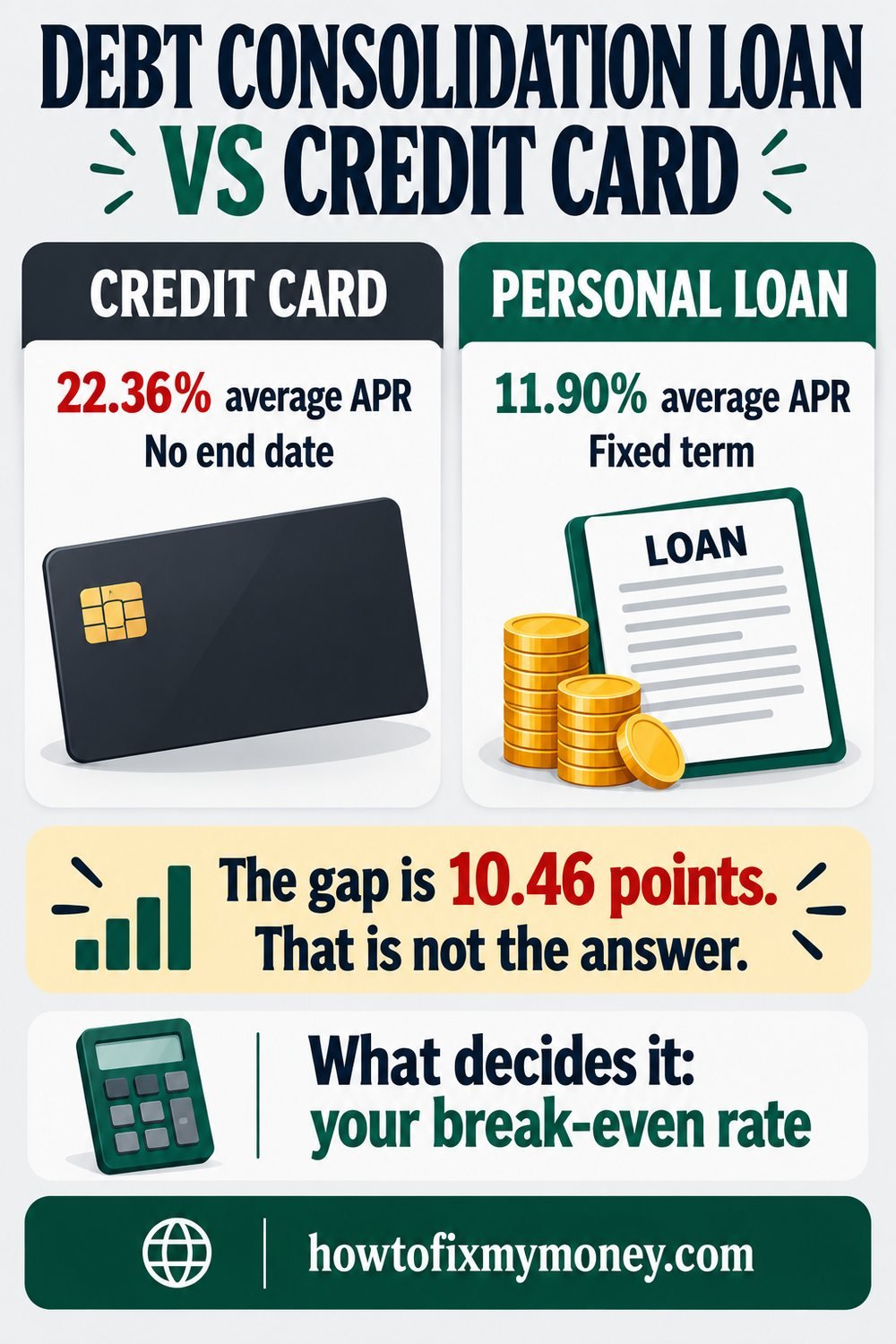
Everyone compares a debt consolidation loan to a credit card on rate alone. The loan charges 12%, the card charges 22%, so the loan wins. That comparison looks obvious and it answers the wrong question.
A credit card has no end date. A debt consolidation loan has one. The moment you fix a term, the length of that term matters more than the rate printed on it, and plenty of households move a balance to a cheaper loan and pay more interest than they would have paid by leaving it alone.
This article gives you the actual break-even figure: the exact loan rate at which a debt consolidation loan starts saving you money, which changes depending on what you would have paid the card each month. To test a real offer against your own cards, use our debt consolidation calculator.
What a Debt Consolidation Loan and a Credit Card Actually Cost Right Now
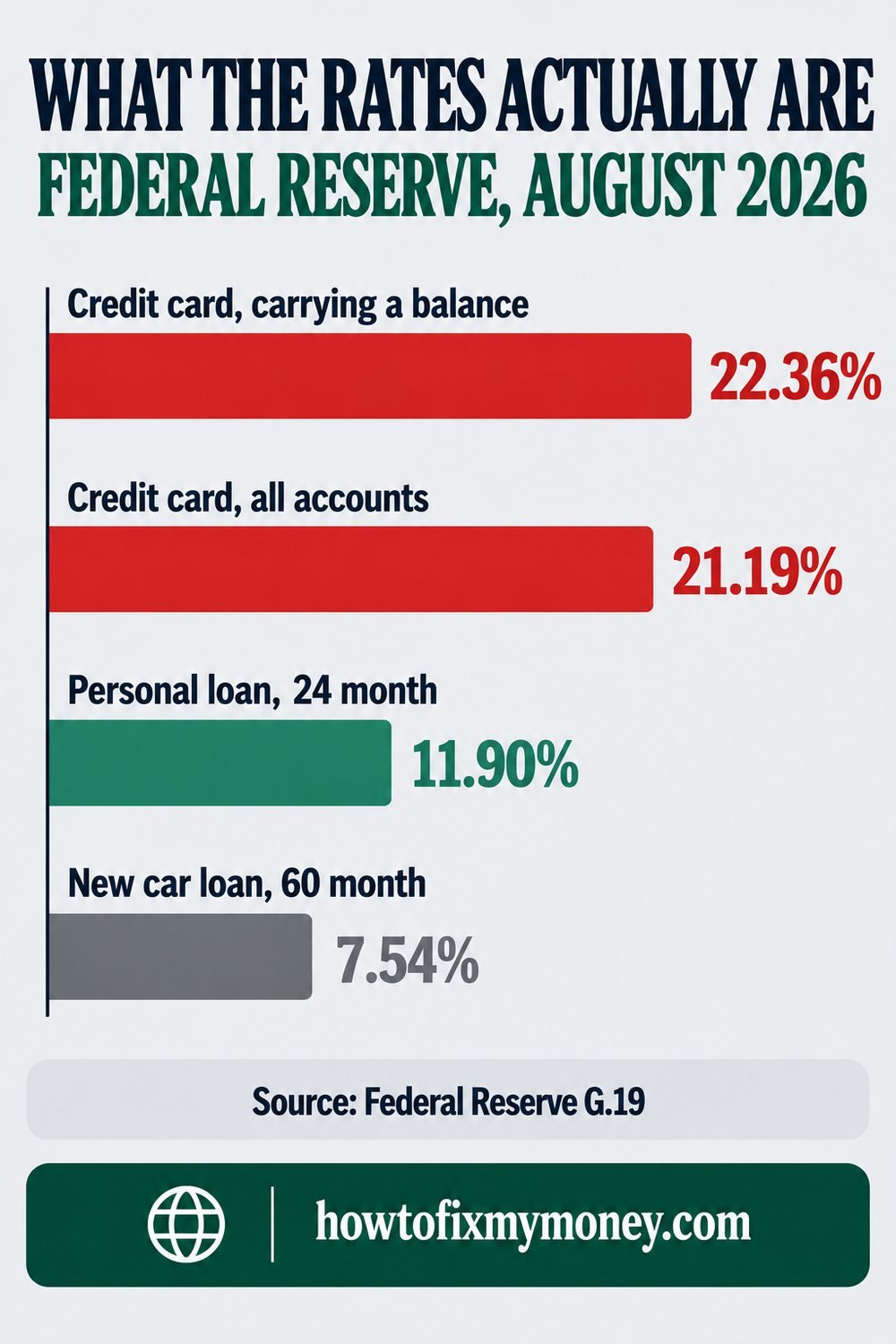
The Federal Reserve publishes both numbers in the same release every month. These come from the G.19 Consumer Credit report for August 2026.
| What You Are Borrowing On | Average APR | What It Covers |
|---|---|---|
| Personal loan, 24 month, at commercial banks | 11.90% | The typical rate behind a debt consolidation loan |
| Credit card, accounts assessed interest | 22.36% | Cards that actually carried a balance and paid interest |
| Credit card, all accounts | 21.19% | Every card, including those paid off in full each month |
| New car loan, 60 month | 7.54% | Shown for scale, since the loan has collateral behind it |
The gap between a debt consolidation loan and a card carrying a balance runs 10.46 percentage points. That gap is real and it is large.
It has also widened. In 2021 the same two figures sat at 9.38% and 16.45%, a gap of 7.07 points. Card rates climbed faster than loan rates over those five years, which is why lenders pitch consolidation harder now than they did then.
Why Comparing the Two Rates Tells You Almost Nothing
A debt consolidation loan carries one rate for a fixed number of months. A credit card charges interest on whatever balance survives each month. You control how fast that balance falls, so you control the total cost.
Take $8,000 at 22.36% and watch what the payment does.
| What You Pay the Card | Time to Clear It | Interest Paid | Total |
|---|---|---|---|
| Minimum payment only | 244 months | $13,401 | $21,401 |
| $250 a month | 50 months | $4,282 | $12,282 |
| $300 a month | 38 months | $3,163 | $11,163 |
| $400 a month | 26 months | $2,103 | $10,103 |
| $500 a month | 20 months | $1,588 | $9,588 |
Same balance, same rate, and the interest swings from $1,588 to $13,401 purely on what you pay. Minimum payments on $8,000 take twenty years and cost more than the original balance.
Now put an 11.90% debt consolidation loan next to it. On the same $8,000:
| Loan Term | Monthly Payment | Interest Paid | Total |
|---|---|---|---|
| 24 months | $376 | $1,029 | $9,029 |
| 36 months | $265 | $1,552 | $9,552 |
| 48 months | $210 | $2,093 | $10,093 |
| 60 months | $178 | $2,653 | $10,653 |
Read those two tables together and the real debt consolidation loan comparison appears. A 60-month loan at 11.90% costs $2,653. Paying the card $400 a month costs $2,103. The cheaper rate loses by $550, because it runs for 60 months instead of 26.
The Break-Even Rate That Tells You Whether a Debt Consolidation Loan Helps
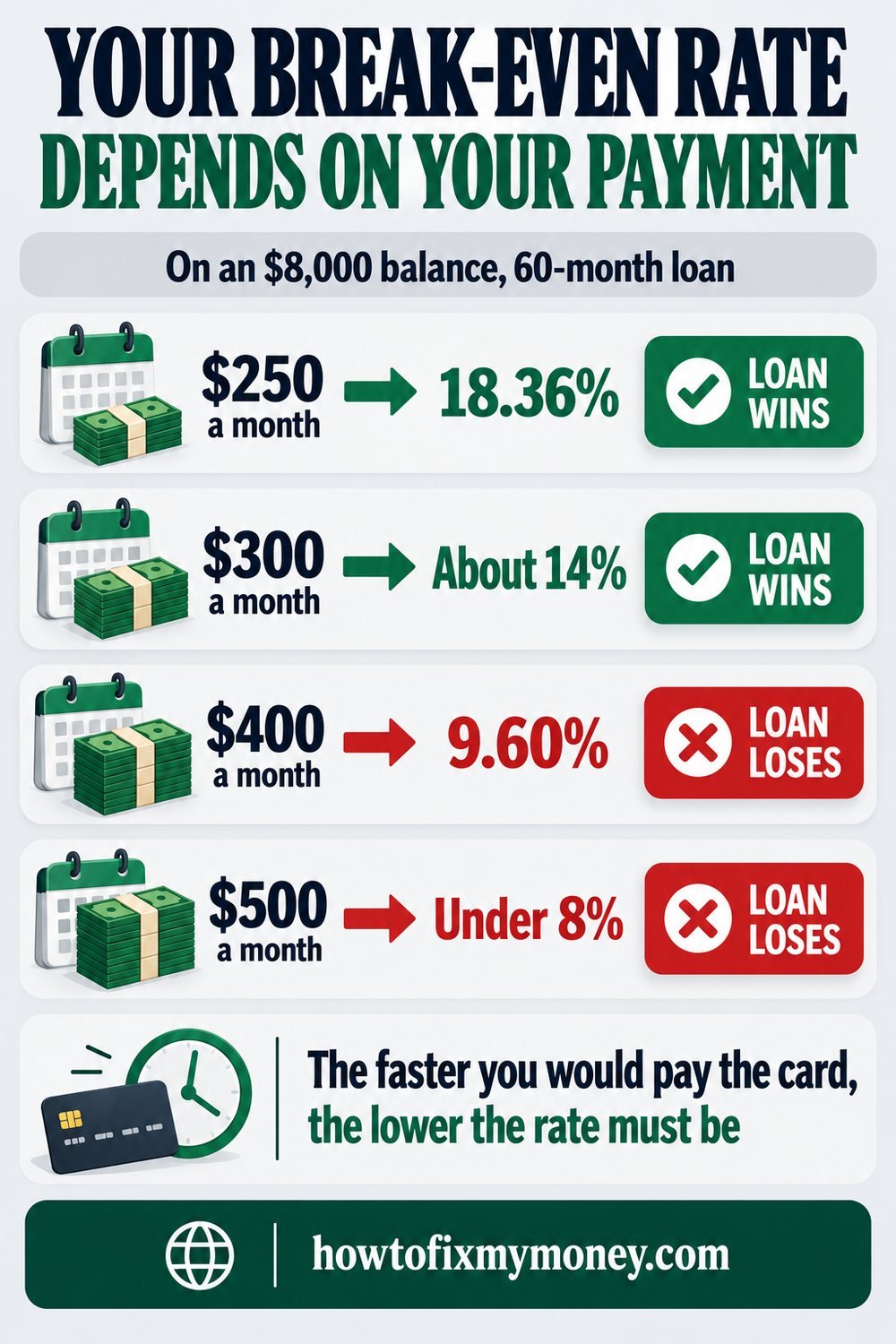
Here is the rule nobody prints. The break-even rate for a debt consolidation loan depends entirely on how fast you would otherwise have paid the card.
Work out the interest you would pay on the card at your realistic monthly payment, then find the loan rate that produces the same interest over the term you are being offered. That rate is your ceiling for any debt consolidation loan you consider.
| If You Would Pay the Card | Card Interest | Break-Even Loan APR Over 60 Months | Verdict at 11.90% |
|---|---|---|---|
| $250 a month | $4,282 | 18.36% | Loan wins comfortably |
| $300 a month | $3,163 | About 14% | Loan still wins |
| $400 a month | $2,103 | 9.60% | Loan loses |
| $500 a month | $1,588 | Under 8% | Loan loses clearly |
The pattern runs in one direction. The faster you would have cleared the card, the lower the loan rate has to go before it helps you.
Someone scraping together $250 a month on an $8,000 balance has a ceiling of 18.36%, so almost any debt consolidation loan improves their position. Someone already paying $400 a month needs a rate under 9.60%, which sits below the national average, so for them the loan is a worse deal dressed as a better one.
Shortening the term fixes this. The same borrower paying $400 a month beats their own card by taking a 36-month loan at 11.90%, which costs $1,552 against the card’s $2,103. The rate did not change. The term did.
Work out your own break-even figure in two minutes
Put your balance, your APR and the payment you can genuinely manage into the free Debt Payoff Calculator. The interest total it gives you is the number every loan offer has to beat.
The Debt Consolidation Loan Fee That Almost Nobody Puts in the Comparison
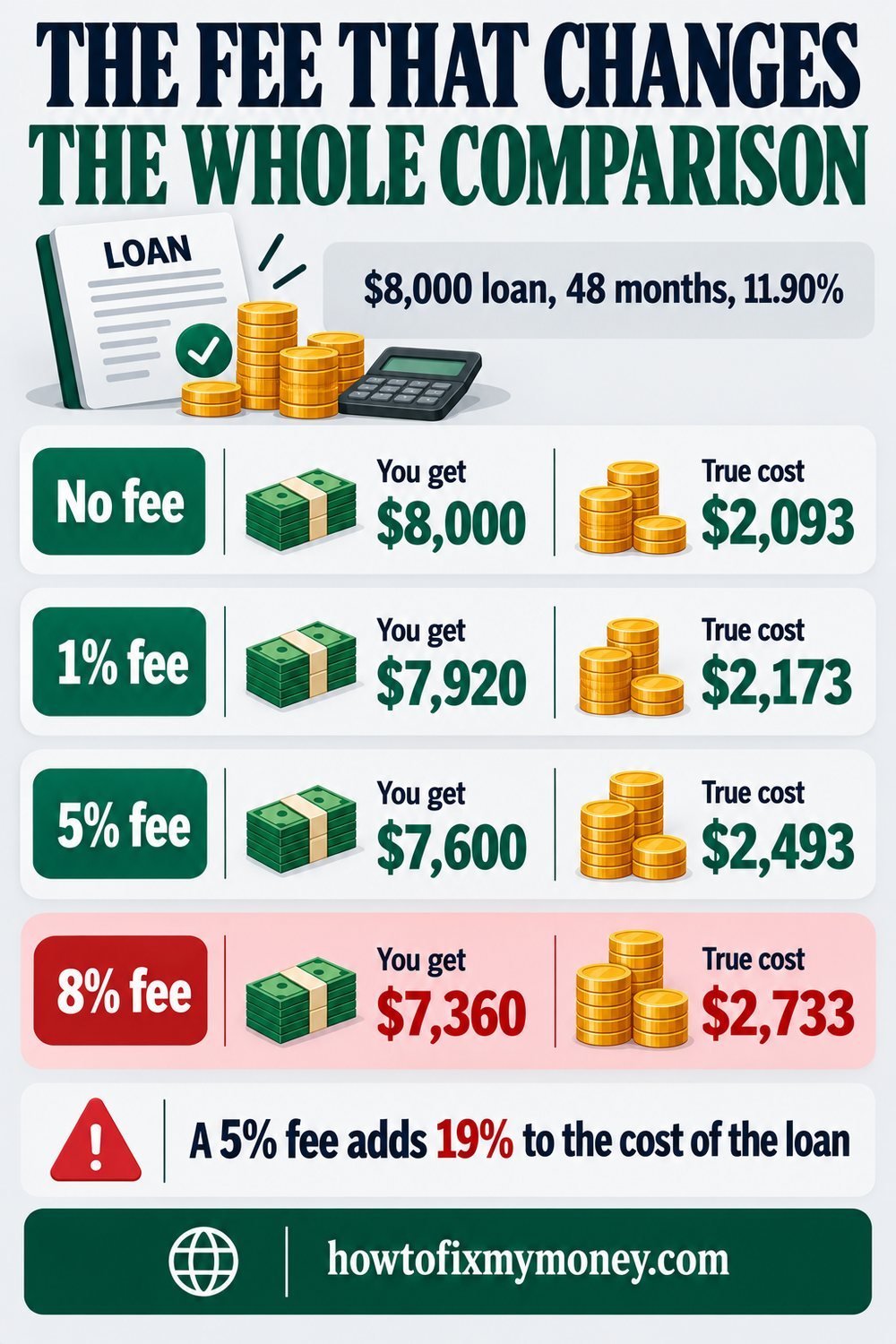
Personal loan lenders commonly charge an origination fee between 1% and 10% of the amount borrowed, and some charge as much as 12%. Most deduct it from the money they send you, so you receive less than you borrowed and repay the full amount with interest.
A fee changes the arithmetic of a debt consolidation loan more than people expect.
| On an $8,000 Loan, 48 Months | You Receive | You Repay | True Cost |
|---|---|---|---|
| No origination fee | $8,000 | $10,093 | $2,093 |
| 1% fee | $7,920 | $10,093 | $2,173 |
| 5% fee | $7,600 | $10,093 | $2,493 |
| 8% fee | $7,360 | $10,093 | $2,733 |
A 5% fee pushes the true cost from $2,093 to $2,493, a 19% increase, and it flips the comparison against anyone who would have paid the card $400 a month.
Three Rules That Decide Whether a Debt Consolidation Loan Helps You
- Compare total cost, never rate against rate. Multiply the loan payment by the number of months, subtract what you borrowed, and put that figure beside the card interest at your realistic monthly payment. Whichever number is smaller wins.
- Never take a term longer than the one you would have finished anyway. A lower payment that runs twice as long is a cash-flow decision, not a saving, and you should know which of the two you are making.
- Add the origination fee to the interest before you decide. A 5% fee on an $8,000 loan is $400, which is real money and belongs in the total.
Those three rules answer the debt consolidation loan question for almost every household. Everything else is detail.
Five Things to Check in the Agreement Before You Sign
Lenders advertise the rate. The agreement holds everything else, and five clauses change the real cost of a debt consolidation loan.
- The APR, not the interest rate. APR folds the origination fee into the figure, so it tells you the true annual cost. A lender quoting an interest rate without an APR is quoting you the smaller number.
- Prepayment penalties. Search the document for the word prepayment. Without the right to overpay, you lose the ability to turn a long safe term into a short cheap one later.
- Whether the lender pays your creditors directly. Some send the money to your card issuers for you. Others deposit it in your account and trust you to transfer it, which leaves a gap where the money can go somewhere else.
- The autopay discount and what happens if you cancel it. A quarter point off for autopay is common, and so is losing it the month a payment bounces.
- Late fees and the grace period. Compare them to your cards before you assume the loan is gentler.
Read the first two before anything else. The APR tells you what you are paying, and the prepayment clause decides whether you can fix a decision you got wrong.
Three Alternatives Worth Pricing First
A debt consolidation loan competes with three other options, and two of them cost nothing to ask about.
Call your card issuer and ask for a hardship program. Issuers run them, they rarely advertise them, and a reduced rate for six or twelve months beats a new loan with a fee attached. The call costs you ten minutes and no credit inquiry.
Price a balance transfer card next if your balance is small enough to clear inside the promotional window. Zero percent beats 11.90%, though the transfer fee commonly runs 3% to 5% and anything left when the promotion ends reverts to a standard card rate.
Then consider a nonprofit credit counseling agency, which can negotiate a debt management plan with your creditors. Look for a member of the National Foundation for Credit Counseling, and treat any agency that charges large upfront fees as a reason to walk away.
Price all three against your break-even figure before you apply for anything. Each one takes an afternoon, and the cheapest option is frequently the one nobody suggested.
When a Debt Consolidation Loan Clearly Wins
- You pay close to the minimum each month. Minimum payments on $8,000 run twenty years and cost $13,401, so almost any fixed-term loan beats that outcome.
- You hold balances on three or four cards with different due dates. One payment on one date removes the late fee risk that comes from juggling, and late fees cost more than most rate differences.
- Your rate drops by more than five points and you keep the term short. A 36-month loan at 11.90% against a card at 22.36% saves real money at almost any payment level.
- You need a fixed end date to stay motivated. A card with no end date lets the balance drift. A loan with 36 payments does not.
When a Debt Consolidation Loan Quietly Costs You More
- You stretch the term to lower the payment. This is the single most common way a debt consolidation loan turns a cheaper rate into a bigger bill.
- You were already paying the card down fast. Above roughly $400 a month on an $8,000 balance, the average loan rate stops helping.
- The lender charges a large origination fee and you compare rates without it.
- The loan carries a prepayment penalty. Read for it specifically, because the whole strategy depends on your freedom to overpay later.
- You keep the cards open and use them again. This one outranks every figure in this article.
The Thing That Decides This More Than Any Interest Rate
A debt consolidation loan does not reduce your debt. It moves the debt and changes the price. The balance only disappears when you pay it.
So the question that matters more than any debt consolidation loan rate is simple: what happens to the cards afterward?
Clearing $8,000 of card balances leaves you with $8,000 of available credit and a loan payment. If the next unexpected bill lands on those cards, you now carry both. People describe this as a discipline failure. It usually is not.
The Federal Reserve’s Economic Well-Being of U.S. Households report found that 30% of adults could not pay a $500 expense from savings. Without a buffer, the next repair goes on a card, because nothing else exists to catch it.
So build a few hundred dollars of savings before or alongside the loan, and close or freeze the cards you just cleared. Those two moves protect the saving a debt consolidation loan creates. Skipping them is how households end up with the loan and the balances together.
Questions People Actually Ask Before Taking a Debt Consolidation Loan
Is a personal loan cheaper than a credit card?
Usually on rate, not always on total cost. The Federal Reserve put the average 24-month personal loan at 11.90% in August 2026 against 22.36% for cards carrying a balance. Whether that saves you money depends on the term you take and the fee you pay, because a 60-month loan can cost more than a card you would have cleared in 26 months.
What credit score do I need for a debt consolidation loan?
Lenders set their own thresholds and the published averages hide a wide spread. The practical test is the rate a lender actually offers you rather than the score itself: if the offer comes back above your break-even rate, the loan does not help you no matter what the approval says. Check your rate through a soft inquiry before you apply formally.
Does consolidating hurt my credit score?
Expect a small dip when a debt consolidation loan adds a hard inquiry and a new account, then usually an improvement as the card balances fall, because how much of your available credit you use carries significant weight in scoring. Closing the cleared cards reduces your available credit, which can push utilization the other way, so weigh that against the temptation to use them.
Should I close the credit cards after I pay them off?
Freeze them before you close them. Closing drops your available credit and shortens your average account age, both of which affect your score. Putting the cards somewhere inconvenient achieves most of the protection without the scoring cost. Close them only if you know you will use them otherwise.
What is a good interest rate for a debt consolidation loan?
Any rate below your break-even figure, which depends on your own payment rather than a market average. Work out the card interest at the amount you realistically pay each month, then accept only a loan whose total cost comes in under it. For many households paying near the minimum, that ceiling sits close to 18%.
Can I pay a debt consolidation loan off early?
Most lenders allow it, but check the agreement for a prepayment penalty before you sign. Early payoff is what turns a safe long term into a cheap short one, so losing that right removes most of the flexibility the loan offers.
Is a balance transfer card better than a debt consolidation loan?
For smaller balances you can clear inside the promotional window, often yes, since 0% beats 11.90%. Weigh the transfer fee, which commonly runs 3% to 5%, and be honest about finishing before the promotional rate expires. Anything you fail to clear reverts to a regular card rate, which puts you back where you started.
How much can I actually borrow?
That depends on income, existing debts, and credit history rather than on any fixed rule. Borrow the amount that clears the balances and nothing more, and remember that an origination fee deducted from the proceeds leaves you short unless you account for it when you choose the amount.
What to Do Before You Apply for a Debt Consolidation Loan
Four steps before you sign anything, and all of them fit in one evening.
Write down every card balance and its APR. Decide what you can genuinely pay each month and work out the card interest at that figure. Check your rate with two or three lenders using soft inquiries. Then compare total cost against total cost, with any origination fee added in.
If the debt consolidation loan wins, take the shortest term you can afford rather than the lowest payment offered. If it loses, you have just proved that paying your own cards down aggressively beats the market, which is a useful thing to know.
Run your own figures first with the free Debt Payoff Calculator. If you decide to attack the cards directly instead, debt snowball vs avalanche covers which order to pay them in, and why your credit card minimum payment went up explains what the card is doing to you in the meantime. More guides sit in our Debt Relief section.
Sources
- Federal Reserve, G.19 Consumer Credit, August 2026 – average personal loan, credit card and auto loan rates.
- Federal Reserve, Economic Well-Being of U.S. Households – share of adults unable to cover a $500 expense from savings.
- NerdWallet, What Is an Origination Fee – typical origination fee range.
- Payoff times, interest totals and break-even rates calculated by How To Fix My Money using standard amortization on an $8,000 balance.

Bilal founded HowToFixMyMoney.com in 2026 to make US personal finance decisions easier to work through without a financial background. Every figure published here traces back to a primary source — the Bureau of Labor Statistics, the Federal Reserve, the IRS, the CFPB — and each article links to the data it relies on. He is not a licensed financial advisor, and nothing on this site is personalized advice.