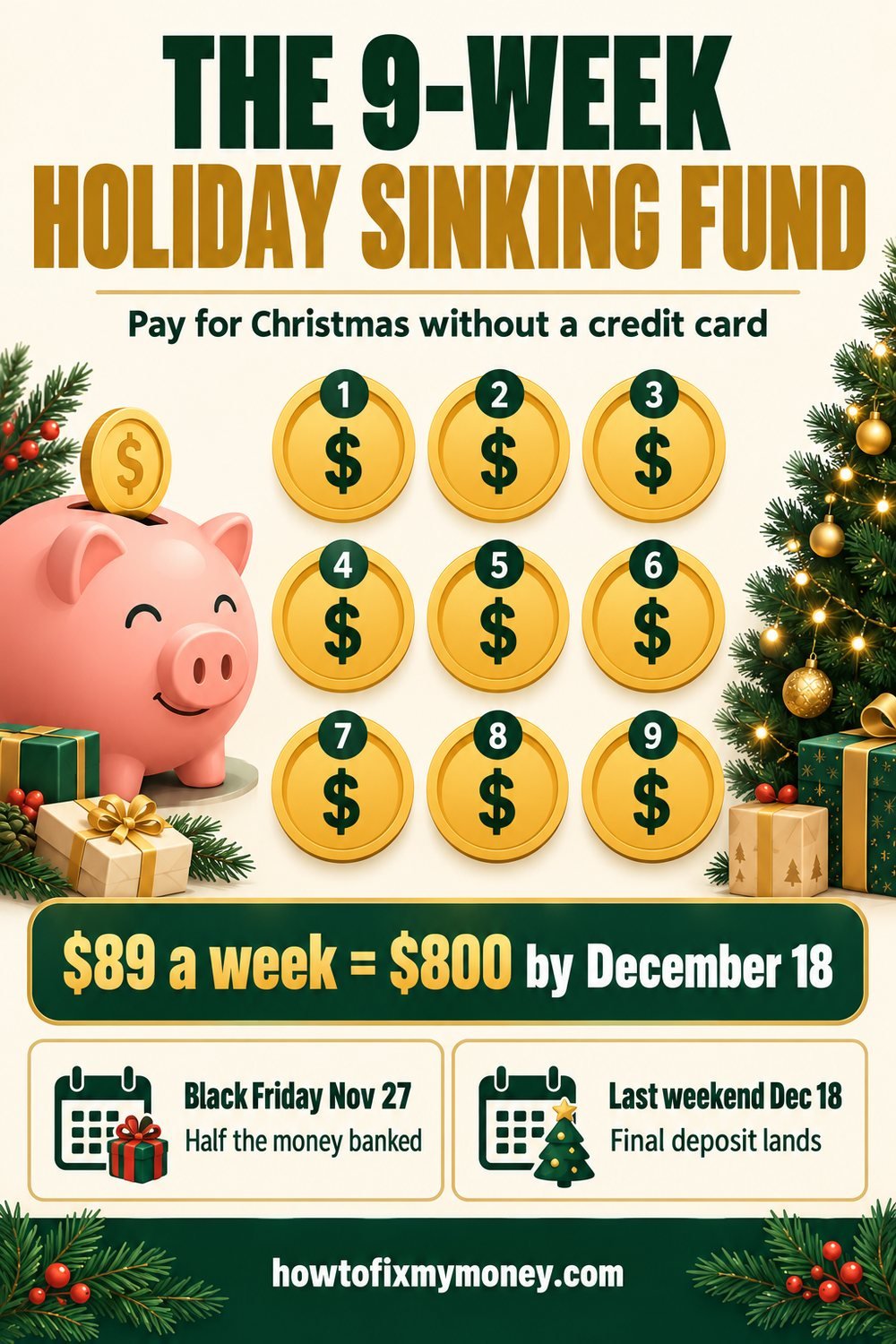
Christmas does not ruin budgets in December. It ruins them in February, when the statement lands and the gifts already sit in somebody else’s house.
LendingTree surveyed 2,032 American adults right after last Christmas and found that 37% had taken on holiday debt, averaging $1,223 each. That figure climbed from $1,181 the year before, and it sits at the highest level since 2022. Nearly two thirds of those borrowers expected to need three months or longer to clear it.
A holiday sinking fund fixes the timing problem rather than the spending problem. You decide the number now, split it across the weeks you have left, and arrive in December with cash already sitting in an account. Today leaves you nine of those weeks, and this article turns that into an exact weekly figure.
What a Holiday Sinking Fund Actually Does That a Holiday Budget Cannot
A budget tells you what you may spend. A holiday sinking fund tells you where that money physically comes from, which is the part most holiday advice skips.
Set a $700 gift budget in October and you have written down an intention. December arrives, the money never materialized, and the card absorbs the difference. Nothing in the budget created the $700.
A holiday sinking fund works backward instead. You name the total, divide it by the weeks remaining, and move that smaller amount into a separate account on a fixed day. By mid-December the money exists because you built it, not because you hoped for it. Our Christmas budget calculator divides your total by the weeks left, counting from today, and the savings goal calculator works the same way for any other target.
Savers borrow the term from accounting, where a sinking fund sets money aside for a known future cost. Christmas qualifies perfectly. The date never moves, the cost repeats every year, and almost nobody plans for it the way they plan for rent.
The Two Deadlines That Decide Whether Your Holiday Sinking Fund Works
Most people count the weeks to Christmas. That count misleads you, because your money runs out long before December 25.
Two dates matter this year:
| Deadline | Weeks From Today | What It Means for Your Fund |
|---|---|---|
| Black Friday, November 27 | About 5 | Your fund must already hold roughly half the target |
| Final shopping weekend, December 18 | About 8 | Every deposit needs to land by this date |
| Christmas Day, December 25 | About 9 | Too late to matter, since the spending finished weeks earlier |
Black Friday falls on November 27, just over five weeks away. Shoppers who plan to catch the discounts need more than half the holiday sinking fund banked before that weekend, not by Christmas.
So build your holiday sinking fund on a nine-week schedule, and treat week five as the checkpoint that actually counts.
What Americans Really Spend, So You Pick a Target You Will Hit
The National Retail Federation forecasts $1.013 trillion in holiday sales between November 1 and December 31 this year, a 4.2% rise on last season. Its most recent consumer survey, which reached 8,247 adults, put average planned spending at $890.49 a person. Expect a similar figure this year.
That per-person figure splits in a way that surprises people:
| Where the Money Goes | Average Amount | Share of the Total |
|---|---|---|
| Gifts for family and friends | $627.93 | 71% |
| Food, candy, decorations and cards | $262.56 | 29% |
| Total per person | $890.49 | 100% |
Nearly $3 in every $10 leaves your account for things nobody unwraps. Shoppers who budget only for gifts underestimate the season by about 40%, then cover the shortfall with plastic in the final two weeks.
Your holiday sinking fund target therefore needs both lines in it. Count the gifts, then add the groceries, the wrapping, the cards, the tree, the travel and the office gift exchange.
Your Weekly Number, Worked Out for Five Different Targets
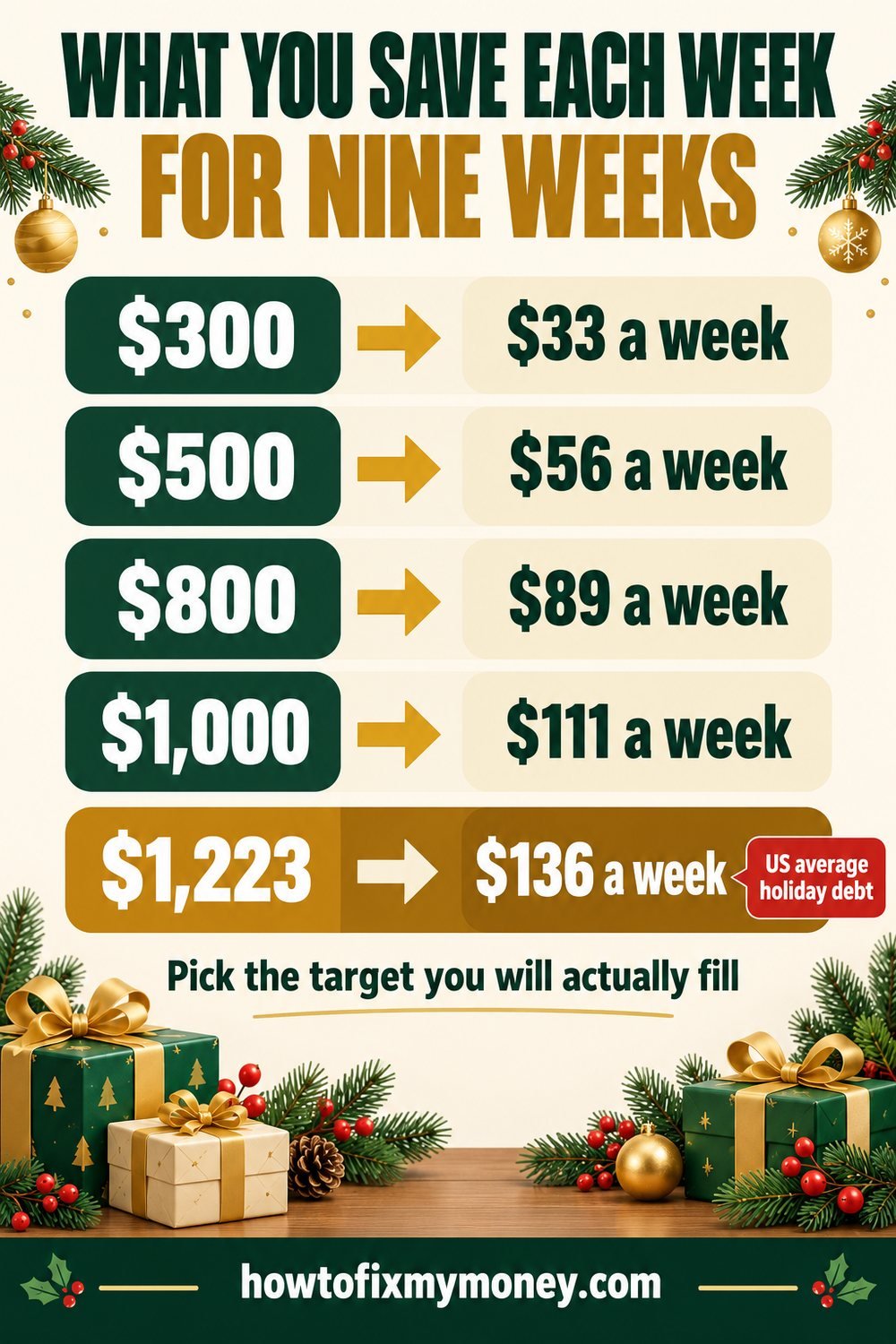
Divide the target by nine and the holiday sinking fund stops feeling like a savings goal and starts feeling like a bill.
| Your Target | Each Week | Each Payday if Paid Every Two Weeks | Per Day |
|---|---|---|---|
| $300 | $33 | $67 | $4.76 |
| $500 | $56 | $111 | $7.94 |
| $800 | $89 | $178 | $12.70 |
| $1,000 | $111 | $222 | $15.87 |
| $1,223 | $136 | $272 | $19.41 |
The last row matches the average holiday debt LendingTree recorded. Saving that same amount costs $136 a week for nine weeks. Borrowing it costs considerably more, and the next section prices the difference exactly.
Pick the target you can actually fund rather than the one that matches your gift list. A $500 holiday sinking fund that fills completely beats a $1,000 target that stalls in week four and sends you back to the card.
What the Same Christmas Costs When the Card Pays for It Instead
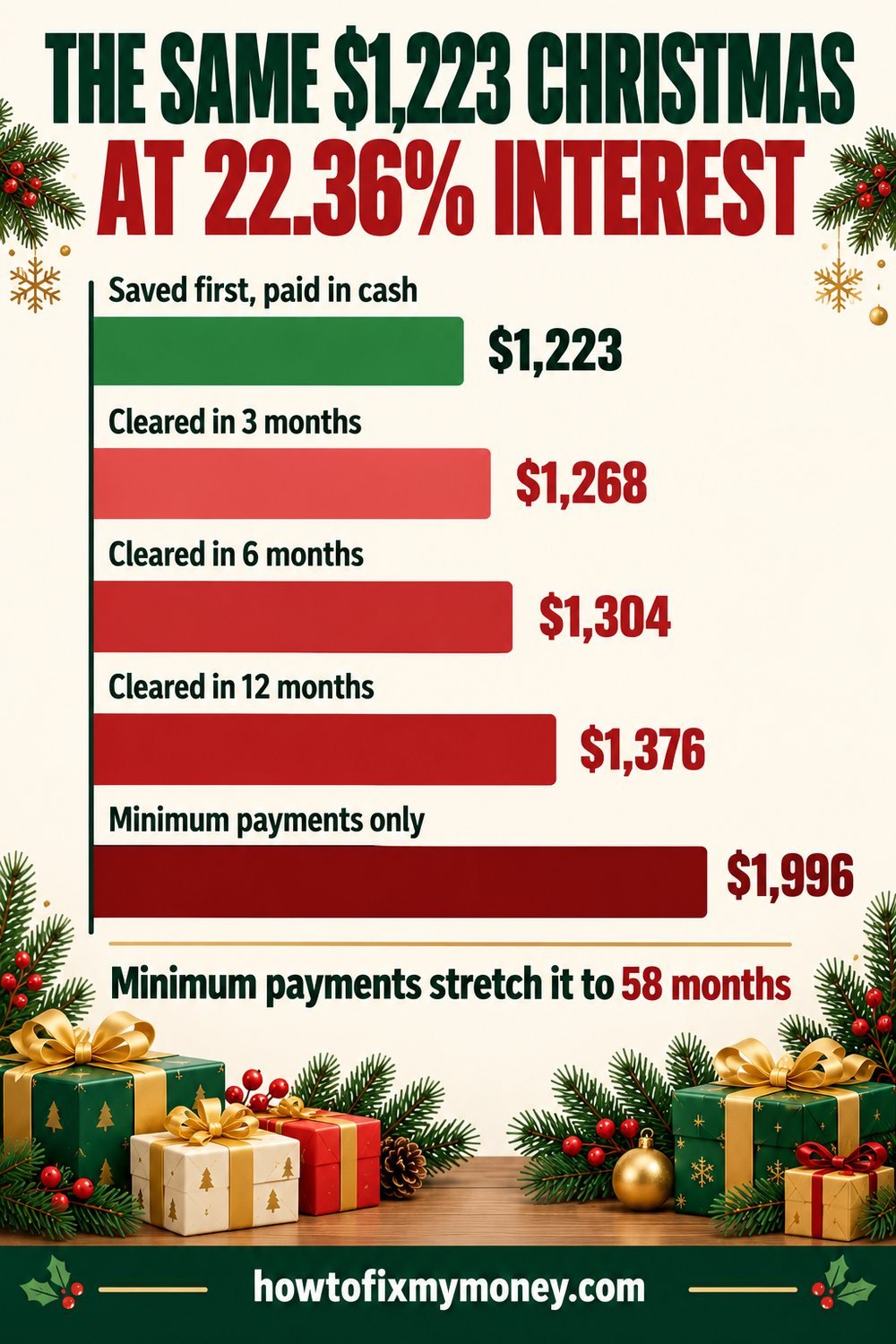
The Federal Reserve puts the average rate on credit card accounts carrying a balance at 22.36% in its G.19 Consumer Credit report for August 2026. Apply that rate to the average $1,223 holiday balance and the arithmetic turns ugly fast.
| How Fast You Clear It | Monthly Payment | Interest Added | Total Cost |
|---|---|---|---|
| Saved first, paid in cash | $136 a week | $0 | $1,223 |
| 3 months | $422.95 | $45.86 | $1,268.86 |
| 6 months | $217.33 | $80.99 | $1,303.99 |
| 12 months | $114.68 | $153.14 | $1,376.14 |
| Minimum payments only | Falls each month | $773.21 | $1,996.21 |
Minimum payments turn a $1,223 Christmas into a $1,996 Christmas spread over 58 months. You would still carry last year’s gifts in the fall of 2031.
Even the fast repayers lose ground. Clearing the balance in three months still costs $45.86, which buys a decent gift on its own.
Where the Weekly Deposit Comes From When the Budget Has No Room
Most households cannot find $136 a week lying unused. They find it in pieces, and nine weeks gives you enough time for small pieces to add up.
- Pause one subscription until January. Streaming services, a second music plan, a meal kit and an unused gym membership together often release $40 to $60 a month.
- Move the grocery budget down by $15 a week deliberately. Plan three repeat dinners, shop the list once, and transfer the difference the same day.
- Sell three things you already decided to replace. Marketplace listings for a phone, a game console or a bike clear faster in November than in January.
- Redirect a windfall on arrival. A tax refund, a bonus, a rebate or an insurance adjustment belongs in the holiday sinking fund before it reaches your checking balance.
- Claim overtime in October and November instead of December, when retail and delivery shifts fill up and employers cap the hours.
- Cash out rewards points now. Card issuers and grocery loyalty programs often allow a statement credit or gift card, which covers part of the target without new money.
Combine three of these and most households fill a holiday sinking fund at the $56 to $89 weekly rate without touching a single fixed bill.
How to Set Up the Account So You Cannot Quietly Spend It
A holiday sinking fund fails most often because the money never leaves checking, where it blends into the balance and disappears into ordinary spending.
Open a separate savings account and name it Holiday Sinking Fund. Most online banks open one in under ten minutes and allow several named sub-accounts under one login, which keeps the Christmas money visibly apart from the emergency fund.
Then automate the transfer for the day after payday, not the day before. Money that moves on payday morning never enters your spending window, so you adjust around its absence instead of defending it.
Finally, leave the debit card for that account at home, or decline the card entirely. Friction protects the balance far better than willpower does during a December sale.
Build the Gift List Before You Build the Number
Shoppers who pick a round number first almost always miss. Write the list first and the target sets itself.
List every single person, including the ones you forget until mid-December: the mail carrier, your child’s teacher, the neighbor who watches the dog, the secret gift exchange at work. Put a dollar figure beside each name, add the non-gift costs from the NRF split, and total it.
That total usually shocks people, which makes it useful. You now hold a real number to cut rather than a vague sense that Christmas costs too much. Trim the list before you trim the plan, because a holiday sinking fund only works when the target reflects what you genuinely intend to spend.
Write the list on paper or in a note on your phone and keep it open while you shop. Shoppers who track against a written list stop at the list. Shoppers who improvise stop when the money runs out, which happens later and costs more.
The Black Friday Trap That Empties the Fund Five Weeks Early
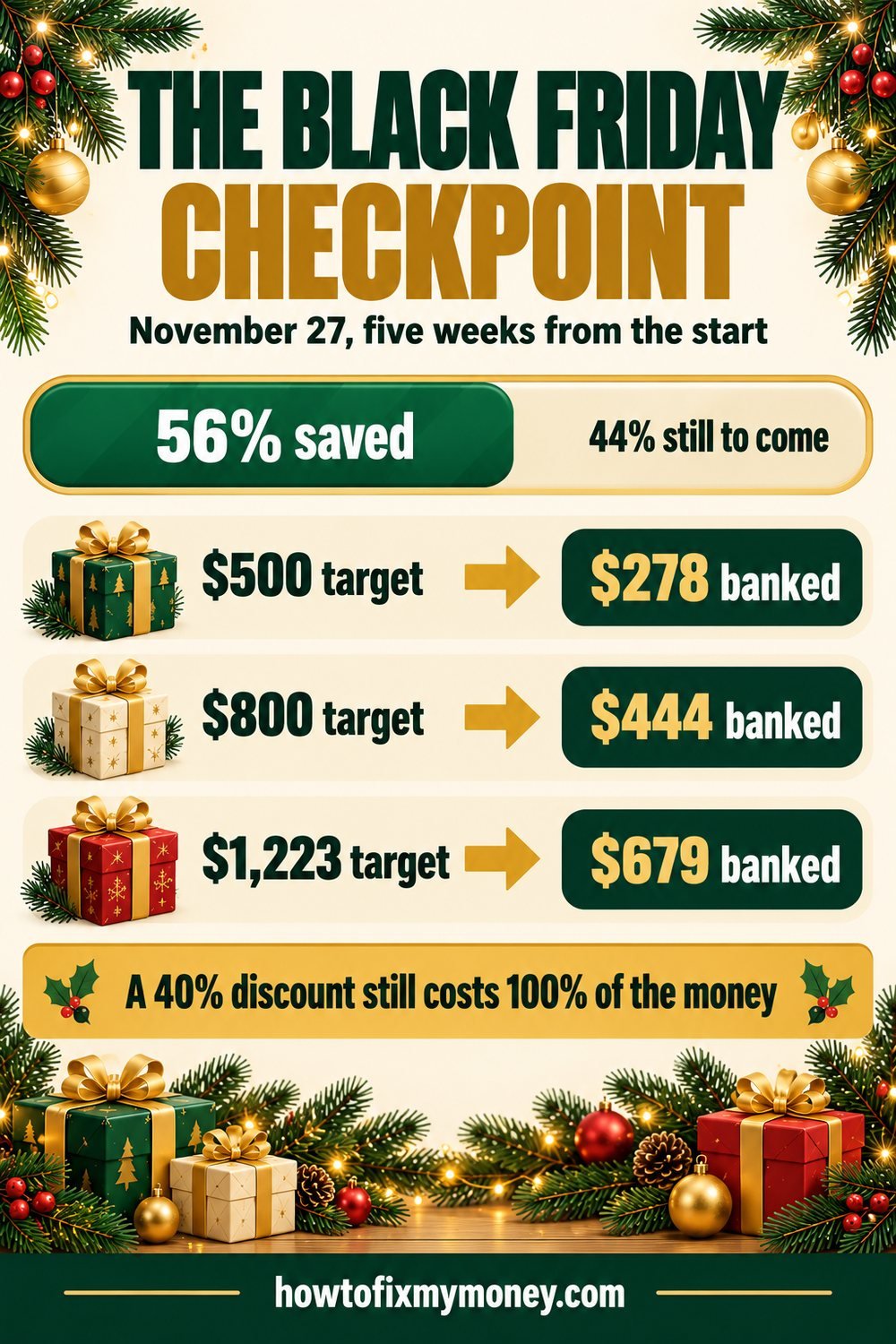
Your holiday sinking fund hits roughly 56% of its target by Black Friday, since five of the nine deposits will have landed. That number creates the single biggest risk in the whole plan.
Retailers design the weekend to feel like a deadline. A half-full account plus a countdown timer produces exactly the behavior the discount exists to create, and shoppers routinely spend the whole balance on three or four items that happened to look urgent.
So cap the weekend before it starts. Decide in advance which names you will buy for on Black Friday, hold the rest of the balance for December, and compare the sale price against what you actually planned to spend rather than against the crossed-out original.
A 40% discount on something nobody asked for still costs 100% of the money. Your holiday sinking fund does not care how much you saved; it only tracks how much left the account.
Why Buy Now, Pay Later Does Not Replace a Holiday Sinking Fund
Experian surveyed 1,002 consumers and found that 43% had used or planned to use buy now, pay later for holiday shopping, up from 20% in 2023. More than half of adults aged 25 to 54 said the same.
Split payments feel different from a credit card because the first installment lands immediately and the plan charges no interest. That framing hides two real problems.
First, the plans multiply. Four purchases across four retailers create four separate payment schedules, each with its own dates, and none of them appear together on a statement you can total at a glance. Shoppers lose track of the combined monthly commitment, then miss a payment and collect a late fee.
Second, the bill still arrives in January and February. Buy now, pay later moves the cost forward exactly the way a card does, so you face the same January squeeze without even the benefit of a single due date.
A holiday sinking fund inverts that sequence. You pay the discomfort in October and November, then spend December owing nothing.
What to Do If You Start Late and Nine Weeks Is Already Six
Readers arriving in mid-November can still build a holiday sinking fund, because a shorter timeline changes the weekly figure rather than the method.
| Weeks Remaining | To Save $500 | To Save $800 | Realistic Move |
|---|---|---|---|
| 9 weeks | $56 a week | $89 a week | Run the full plan |
| 6 weeks | $83 a week | $133 a week | Cut the target by a third |
| 4 weeks | $125 a week | $200 a week | Save what you can, cut the list hard |
Four weeks out, stop aiming for the full amount. Save whatever the weeks allow, cover the rest by cutting names from the list, and accept a smaller Christmas instead of a February statement.
Partial funding still pays. A holiday sinking fund holding $400 against a $700 Christmas leaves you borrowing $300 rather than $700, which more than halves the interest you would otherwise carry into spring.
Turn This Year Into Next Year, When the Numbers Get Easy
Nine weeks forces a large weekly deposit. Fifty-two weeks does not.
| Target | Over 9 Weeks | Over 12 Months | Difference |
|---|---|---|---|
| $500 | $56 a week | $42 a month | Far easier |
| $890 | $99 a week | $74 a month | Far easier |
| $1,223 | $136 a week | $102 a month | Far easier |
So keep the holiday sinking fund open and leave the transfer running past Christmas. On January 2, reset the monthly amount using this year’s actual total and let it run untouched for twelve months.
That single change turns a holiday sinking fund from an annual scramble into a line item you stop noticing, roughly the way you stopped noticing your insurance payment.
Set your own target in two minutes
Put your real income and bills into the free Budget Planner and find the weekly amount your budget can actually release. That figure, times nine, is your honest holiday sinking fund target.
Black Friday is the first big test of your sinking fund. Our guide to setting a Black Friday budget shows how much of it to spend that weekend and how much to keep for December.
Questions People Ask Before Starting a Holiday Sinking Fund
How much should I put in a holiday sinking fund?
Build the number from your own list rather than from an average. Add every gift, then add roughly 40% on top for food, decorations, cards, wrapping and travel, since the NRF data shows those items account for 29% of total holiday spending. Most households land between $400 and $900.
Where should I keep the money?
Keep your holiday sinking fund in a separate high-yield savings account at an online bank, apart from both your checking account and your emergency fund. The interest matters less than the separation over nine weeks, though a competitive account still adds a few dollars. Avoid keeping it in checking, where it blends into your everyday balance.
Is a holiday sinking fund the same as a Christmas club account?
They share a purpose and differ in flexibility. Credit unions designed Christmas club accounts to lock the money until November, which helps some savers and penalizes others who hit an emergency. A holiday sinking fund in an ordinary savings account gives you the same structure while leaving the money reachable if a genuine crisis arrives.
Should I save for Christmas before building an emergency fund?
Build a small emergency buffer first, then run both together. Without a few hundred dollars set aside for car repairs and medical bills, an unexpected expense in November simply drains the Christmas money and sends you back to the card anyway. Split the weekly deposit between the two if the budget allows.
What if I already carry credit card debt?
Shrink the Christmas target rather than skipping the fund entirely. Paying 22.36% interest while saving at 4% loses money on paper, yet a household with no holiday cash adds new debt every December and never escapes the cycle. A smaller funded Christmas breaks that pattern without derailing your payoff plan.
Can I use a holiday sinking fund alongside credit card rewards?
Yes, and the combination works well when you follow one rule. Spend on the rewards card, then transfer the matching amount out of the fund and pay the card in full the same week. You collect the points and carry no balance. Skip this approach if paying the card in full each week feels uncertain.
What happens to money left over in January?
Roll it straight into next year’s holiday sinking fund rather than absorbing it into checking. A $120 surplus becomes the first month of next year’s plan, which lowers every monthly deposit that follows. Savers who sweep the leftover back into checking almost always spend it by February.
Does this work on an irregular income?
Switch from a fixed weekly amount to a fixed percentage. Send 8% to 10% of every payment that arrives between now and mid-December into the holiday sinking fund, which protects lean weeks and captures the strong ones. Freelancers and commission earners usually reach the target faster this way than by promising a flat weekly figure they cannot always meet.
Three Moves That Start Your Holiday Sinking Fund This Week
Nine weeks gives you room, and the first week decides if the holiday sinking fund survives.
Write the full list tonight, every name and every non-gift cost, then total it honestly. Open a named savings account tomorrow and schedule the automatic transfer for the day after your next payday. Then cancel or pause one subscription before Friday and send that money across as deposit number one.
Those three steps take under an hour. They also decide if you open February’s statement calmly or spend the spring paying for a Christmas that ended months earlier.
Work out your own target with our free Budget Planner, and read Christmas on a budget: what to cut first if your list already runs past what the weeks allow. Our guide to a debt free Christmas on a tight budget covers the same season from the spending side, and more plans sit in our Saving Money section.
Sources
- LendingTree, holiday debt study – 2,032 adults surveyed; 37% borrowed, averaging $1,223.
- National Retail Federation, 2026 holiday sales forecast – $1.013 trillion, up 4.2%.
- National Retail Federation, holiday consumer survey – $890.49 average planned spending per person, split $627.93 gifts and $262.56 seasonal items.
- Federal Reserve, G.19 Consumer Credit, August 2026 – 22.36% average rate on cards carrying a balance.
- Experian, buy now, pay later holiday survey – 43% of 1,002 consumers used or planned to use BNPL.
- Weekly deposit amounts, payoff timelines and interest totals calculated by How To Fix My Money using standard amortization and a minimum payment of 1% of the balance plus interest.

Bilal founded HowToFixMyMoney.com in 2026 to make US personal finance decisions easier to work through without a financial background. Every figure published here traces back to a primary source — the Bureau of Labor Statistics, the Federal Reserve, the IRS, the CFPB — and each article links to the data it relies on. He is not a licensed financial advisor, and nothing on this site is personalized advice.