The January statement is a different kind of mail. You knew roughly what you’d spent. Seeing it printed, with a due date next to it, is still a small shock.
Here’s the useful news. Holiday debt is the easiest debt most people will ever clear, and the reason is timing. You’re catching it at a few weeks old, before interest has had a chance to do much, and January happens to hand you more ways to find money than any other month of the year.
You can pay off Christmas debt in three months, and for most households that’s a realistic target rather than an optimistic one. Not because three is a magic number, but because it’s short enough that you’ll actually finish and long enough that the monthly amount doesn’t break your budget.
This is how to do it.
First, Find All of It
Most people underestimate their holiday spending, and it’s not carelessness. It’s that the money left through four or five different doors.
When LendingTree surveyed US consumers in December 2025, 37% had taken on holiday debt, averaging $1,223. The part worth noticing is how they paid: 62% used credit cards, 35% used buy now, pay later, and 32% used store cards. Those add up to well over 100%, which tells you most people used more than one.
So before anything else, write down every balance in one place:
- Every credit card, including the one you only use at Christmas.
- Every buy now, pay later plan. Klarna, Afterpay, Affirm, whatever the checkout offered. These are the ones people forget, because the payments are small and automatic.
- Store cards opened at the register for a discount. Check the interest terms carefully on these; there’s a section below on why.
- Anything you borrowed from a person. It still counts, even if nobody’s charging you interest.
- Money you took out of savings, if you intend to put it back.
Add it up. The total is usually higher than the number you’d been carrying in your head, and that’s normal.
Write down the interest rate next to each one too. You’ll need it in a minute.
Divide by Three and See the Real Cost
Now the arithmetic, which is the easy part.
Take your total and divide it by three. That’s roughly your monthly payment, plus a little for interest. Here’s what that looks like at a few common balances, using a 22.36% card rate.
| Holiday Debt | Pay Each Month | Total Interest | Done By |
|---|---|---|---|
| $1,223 (the average) | $423 | About $46 | End of March |
| $2,000 | $692 | About $75 | End of March |
| $3,500 | $1,210 | About $131 | End of March |
Look at that interest column. On the average balance, moving fast costs you around forty-six dollars in total.
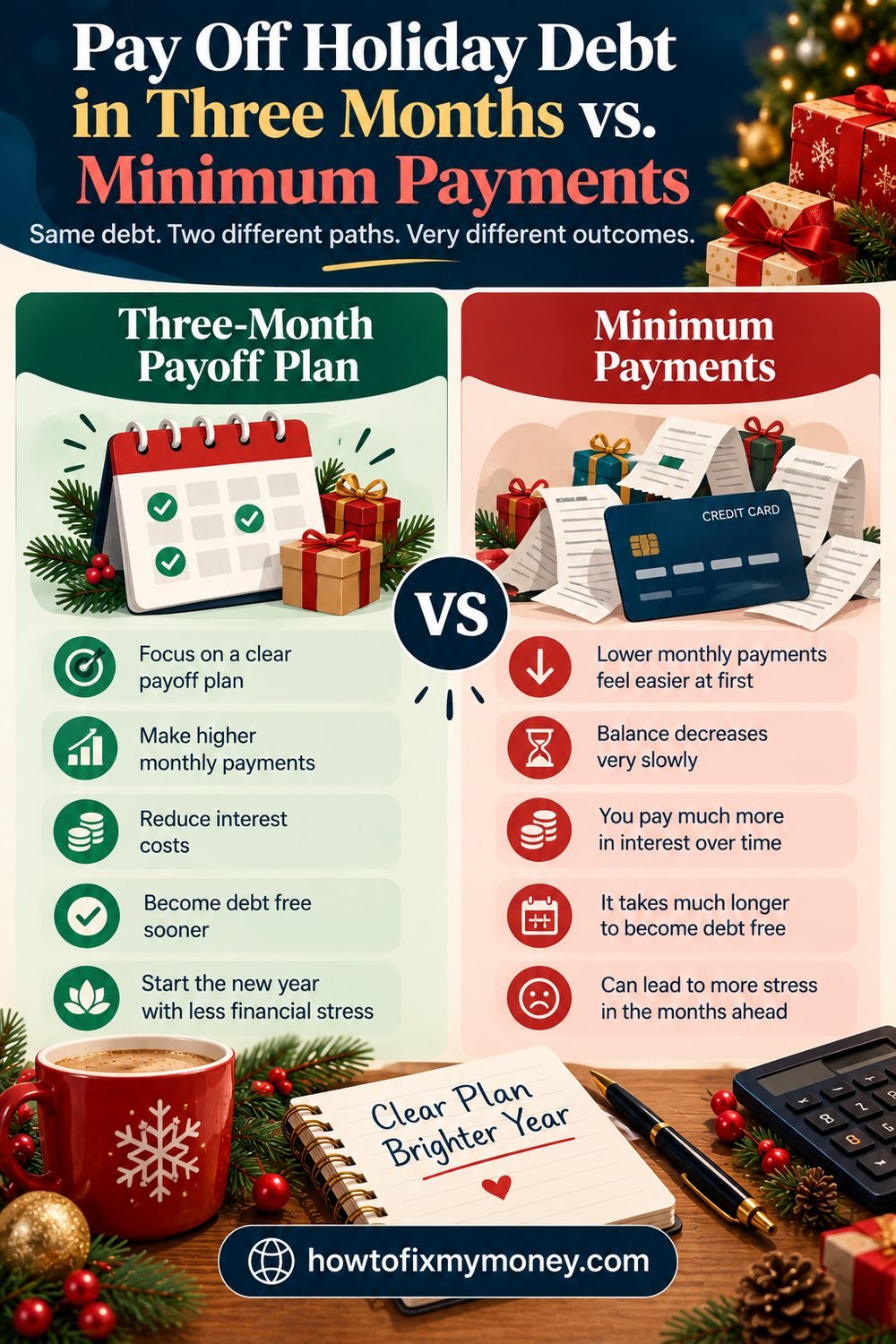
Now the comparison that matters. That same $1,223, paid at the minimum each month, takes nearly five years and costs about $773 in interest. The $3,500 balance takes over thirteen years and costs close to $5,000.
Same debt. The only variable is how fast you move at the start.
Run your own figures rather than borrowing mine. The free Debt Payoff Calculator will give you your actual date in about two minutes.
Why January Is the Best Month to Pay Off Christmas Debt

This is the part most articles skip, and it’s the reason three months is achievable when twelve months of ordinary debt payoff is a grind.
January is the only month that comes with its own funding sources. They expire, though, so the order matters.
Return What You Can, Quickly
Return windows are the first thing to close. Many retailers extend theirs for the holidays, but extended usually means mid-January, not whenever you get round to it.
Go through what’s still in boxes. The gadget nobody’s opened, the second slow cooker, the sweater in the wrong size. A hundred dollars back on the card this week is worth more than two hundred found in March.
Cash In the Gift Cards
There’s a drawer in most houses. You know the one.
Gift cards you were given are effectively money you’ve already got. Use them for groceries, gas, and things you’d buy anyway, then send the cash you didn’t spend straight to the card balance. It feels like a trick. It isn’t; it’s just moving money you already had.
The same goes for cards from previous years. Unused balances sit around for a long time.
Spend Nothing Extra in January
You just had a month of gifts, food, travel, and events. January is the one month where buying nothing beyond essentials feels normal rather than punishing.
Use that. A no-spend January, run properly, often covers the first month’s payment on its own.
Decide About Your Tax Refund Before It Lands
If you’re expecting a refund, it typically arrives somewhere in February or March for people who file early. That’s conveniently close to month two or three of this plan.
Decide now where it’s going. A refund that arrives without a job attached to it has a way of becoming a weekend.
If the monthly number still looks out of reach after all that, there’s usually more room in the fixed bills than people expect. Our guide on how to cut $300 a month without touching your rent walks through where it hides.
Do Not Ignore the Buy Now, Pay Later Plans
Thirty-five percent of holiday borrowers used BNPL, and it’s the category people most often leave off the list. Partly because the payments are small, partly because they’re automatic, and partly because it never quite felt like borrowing.
A few things worth knowing before you decide where these sit in your plan.
- Most plans are interest-free if you pay on schedule, which is why they usually rank below credit cards for urgency.
- Late fees are the real risk. They’re often a flat charge, which on a $60 purchase can be proportionally brutal.
- Several providers have started reporting activity to the credit bureaus. If yours does, a missed installment can show up where it used to be invisible.
- The payments keep coming out whether or not you’ve budgeted for them. Four plans at $40 each is $160 a month you may not have counted.
Log into each app and write down what’s left and when it ends. Most of these plans run six or eight weeks, which means several will finish on their own inside your three months. That frees up money, and you want to know in advance when it arrives.
The Store Card Problem
This one deserves its own section because it’s urgent and because it catches people who did nothing wrong.
A third of holiday borrowers used store cards, and many of those cards come with deferred interest promotions. The sign at the register said something like “No interest if paid in full within 12 months.”
Read that sentence again, slowly. It doesn’t say no interest. It says no interest if the balance is gone by the deadline.
If any balance remains when that window closes, the issuer can charge you all the interest that would have accrued from the day you bought the sofa. Not interest going forward. The whole lot, retroactively.
So: find the expiry date on every promotional balance you have. It’s on the statement, usually in a box near the top. If one of those deadlines falls inside your three months, that balance goes first, ahead of everything else, whatever its interest rate says.
Cut the Interest While You Are At It
Two things worth trying in your first week. Both are free, both take under half an hour, and the worst outcome is no.
Ask for a Lower Rate
Call the number on the back of the card and ask whether a lower APR is available on your account. Mention how long you’ve been a customer and that you’re carrying a balance you intend to clear.
People assume this never works. It works often enough to be worth twenty minutes, and a few points off your rate on a balance you’re clearing in three months is a small win rather than a large one. Still free money.
Consider a Balance Transfer, Carefully
If your credit is still in decent shape, a 0% balance transfer offer can move the whole thing somewhere interest-free for a year or more.
Three cautions. Transfer fees usually run 3% to 5%, which on $2,000 is $60 to $100 up front. The 0% period ends, and if the balance isn’t gone by then you’re back where you started with a new card. And applying opens a new account, which is fine if you’re clearing the debt and then leaving the card alone, less fine if you’re about to apply for a mortgage.
If you’re clearing it in three months anyway, the transfer fee may well cost more than the interest you’d save. Do the arithmetic before you apply.
Carrying balances on several cards? The order you attack them in changes the total. Our comparison of the debt snowball and avalanche methods covers both, and for a three-month sprint the difference is small enough that you should pick whichever you’ll stick with. The debt snowball calculator shows both orders side by side with your real balances.
Running the Three Months
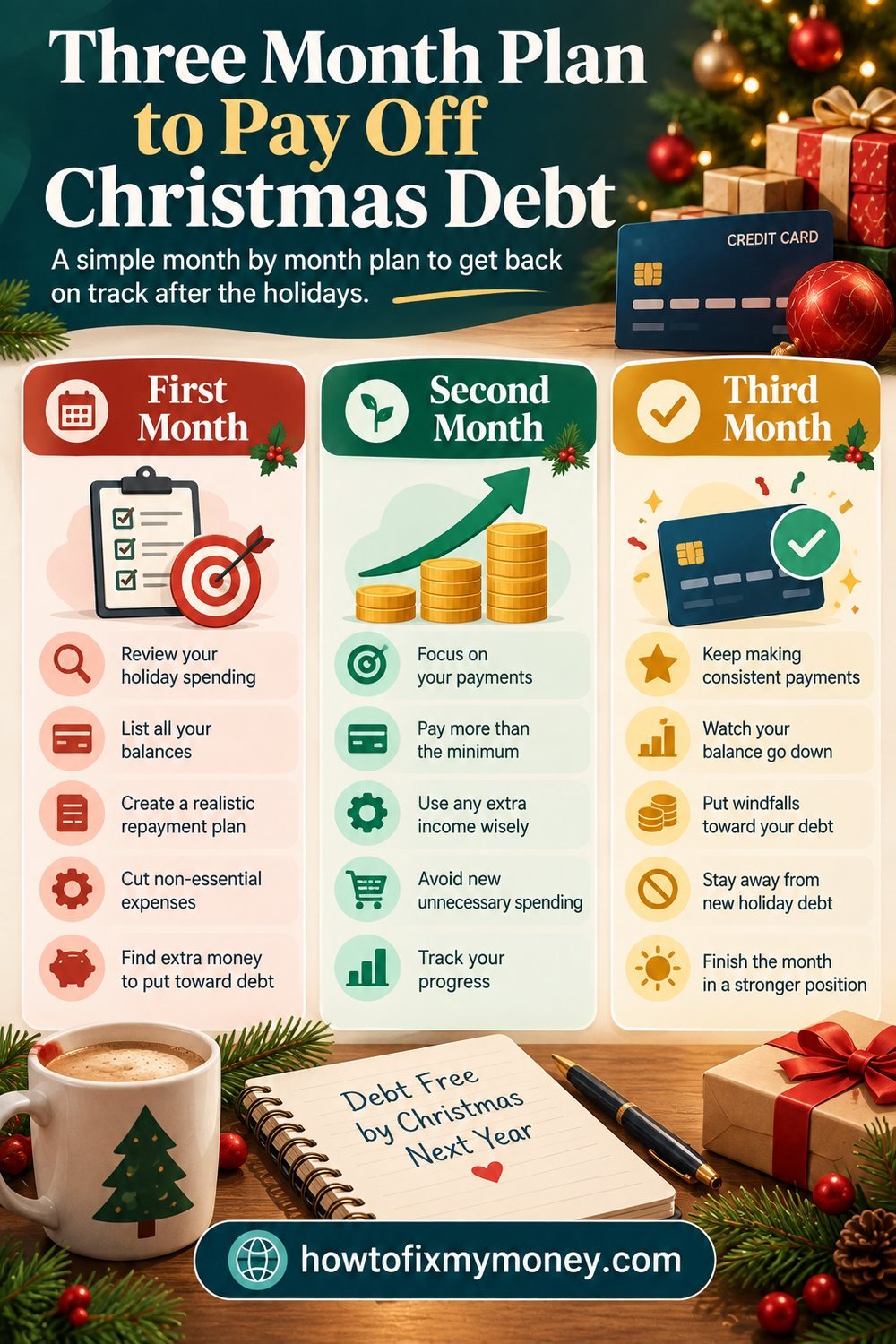
The plan itself is almost boringly simple, which is why it works. Each month has one job.
Month One: Set It Up
This is the month with the most moving parts, and the only one that needs real effort.
- List every balance and rate, as above.
- Set up an automatic payment for your monthly number, dated the day after you get paid. Not the due date. The day after payday, before the money has other ideas.
- Do the returns and cash in the gift cards now, while the windows are still open.
- Put the cards in a drawer. Not cut up, just somewhere inconvenient. Take them out of your phone’s wallet and off any sites that have them saved.
Month Two: Hold the Line
Nothing new happens in month two, and that’s the point. It’s also where most people quietly stop.
Check in once a week, on the same day. Five minutes. Balance, what’s left, what’s coming. That weekly check is worth more than it sounds, mostly because you notice a problem in week two rather than month two.
When a balance hits zero, move that whole payment onto the next one immediately. This is the bit people miss, and it’s where most of the speed comes from. If a BNPL plan finishes, that money goes to the next balance, not back into spending.
Month Three: Finish It
Any windfall that lands this month goes straight at the balance. Tax refund, bonus, money from something you sold. All of it.
And hold the line on new spending until the last balance reads zero. The temptation at the end is to celebrate slightly early, which is how a three-month plan becomes a five-month one.
When Three Months Is Not Realistic
Sometimes the number doesn’t work. If your total is $4,000 and you can find $300 a month, you’re not going to pay off Christmas debt by April, and pretending otherwise just means quitting in week six.
Stretching it out is not failure. Here’s what the same balances cost over longer windows.
| Holiday Debt | Over 3 Months | Over 6 Months | Over 12 Months |
|---|---|---|---|
| $1,223 | $423/mo, $46 interest | $217/mo, $81 interest | $115/mo, $153 interest |
| $2,000 | $692/mo, $75 interest | $355/mo, $132 interest | $188/mo, $250 interest |
| $3,500 | $1,210/mo, $131 interest | $622/mo, $232 interest | $328/mo, $438 interest |
Twelve months on the average balance costs about $153 instead of $46. That’s a hundred dollars more across a year, which is a real cost but not a catastrophe.
What does turn into a catastrophe is drifting. The difference between a deliberate twelve-month plan and no plan at all is roughly $620 on that same balance, plus four more years of carrying it.
So pick a timeline you can actually hold. Any timeline beats none.
And if holiday debt landed on top of bills that were already slipping, deal with that first. Our guide for when you’re behind on every bill covers which bills to protect before you put money anywhere else.
Free Help Worth Knowing About
- The Consumer Financial Protection Bureau explains how card terms work, including what issuers can and cannot change, and takes complaints if something looks wrong.
- The Federal Trade Commission covers your options when debt gets away from you and how to spot a bad actor.
- MyMoney.gov has free budgeting worksheets, which are more useful than they sound when you’re trying to find $400 a month.
Non-profit credit counseling agencies also do free budget sessions. A legitimate one never charges before doing any work.
If your card took a hit over Thanksgiving weekend, see what your Black Friday bill will look like in January and how much interest each payoff speed costs.
Questions People Actually Ask
Is three months long enough to pay off Christmas debt?
For most people, yes. The average is around $1,223, which works out near $423 a month. If your balance is much larger than that or your budget is already tight, six months is a perfectly good target and costs very little extra.
Should I pay off buy now, pay later first or the credit card?
Usually the credit card, because BNPL plans are often interest-free and credit cards rarely are. The exception is a BNPL plan with late fees you’re at risk of triggering. Those fees can be steep relative to the purchase, so protect the ones with a deadline you might miss.
What happens if I only make minimum payments?
On the average $1,223 balance at a typical card rate, you’d be paying it off for nearly five years and spending around $773 in interest. The minimum is designed to keep the account current, not to clear it.
Will paying off holiday debt quickly help my credit score?
It usually helps, mostly because how much of your available credit you’re using is a significant scoring factor. Bringing balances down tends to move that in the right direction within a cycle or two.
Should I use savings to clear it?
If you have savings beyond a small emergency buffer, often yes. Paying 22% interest while earning far less on savings is a losing trade. Keep a few hundred dollars back, though. Emptying the account is how people end up right back on the card in February.
What if I lost track of a buy now, pay later plan?
Check your email for order confirmations and your bank statement for small recurring charges in the $20 to $60 range. The apps also list active plans once you log in. Missing one is common, and it’s better found in January than discovered by a late fee.
Before Next December
One short thought, and then you can get on with it.
The reason holiday debt happens isn’t overspending in December. It’s that December is the only month we treat as a surprise, despite it arriving on the same date every year.
Whatever it costs you monthly to pay off Christmas debt this winter, keep paying that same amount afterward. Into savings this time, into an account you don’t carry a card for. By November you’ll have most of next Christmas sitting there in cash, and this article will be something you don’t need to read again.
Start by putting your real numbers into the Debt Payoff Calculator, or browse more guides in our Debt Relief section.

Bilal founded HowToFixMyMoney.com in 2026 to make US personal finance decisions easier to work through without a financial background. Every figure published here traces back to a primary source — the Bureau of Labor Statistics, the Federal Reserve, the IRS, the CFPB — and each article links to the data it relies on. He is not a licensed financial advisor, and nothing on this site is personalized advice.