
January 1st is the easiest day of the year to make a money decision. Nothing has gone wrong yet.
That’s also the trap. Most no-spend months get designed on the first, by someone who has just seen a December credit card statement, and they get built for a version of your life with no car repair in it, no birthday in week three, and no Tuesday where you’re too tired to cook.
A no-spend January works. It also gets abandoned a lot, and when it does, the design is usually what failed rather than the person running it.
So this is a no-spend January you can finish: what counts as spending, what the month is realistically worth in dollars, how to get through the week where most people quit, and where to send the money so February doesn’t quietly absorb it.
Why Roughly a Third of People Abandon a No-Spend January Before February Arrives
The idea is more popular than it has ever been. A NerdWallet survey conducted by The Harris Poll found that 26% of Americans have attempted a no-spend January at least once, and 12% started one in 2026. US Google searches for the term hit an all-time high that month, up 67% year over year, well ahead of the 47% rise for Dry January.
Then the same survey found the uncomfortable half of the story. By the time people were asked, about a third of that year’s participants had already given up. The most common reason people gave for starting was not a specific goal; 44% simply said life feels really expensive.
Three design flaws account for most of those failures.
- The rules were never written down. “No spending” sounds clear on January 1st, until you need gas on the 3rd and have no agreed definition of essential. The first unavoidable purchase then feels like the whole thing collapsing.
- The money had no destination. Cash left sitting in checking gets reabsorbed by the first week of February, and the month ends up feeling pointless even though it worked.
- Known events weren’t planned for. A birthday you already knew about on December 29th should cost one budgeted line, not the entire challenge.
Fix those three things in advance and a no-spend January stops being a test of willpower. It becomes a month with slightly different rules, which is a much easier thing to finish.
What “No Spend” Actually Means When You Still Have to Buy Groceries, Gas, and Diapers
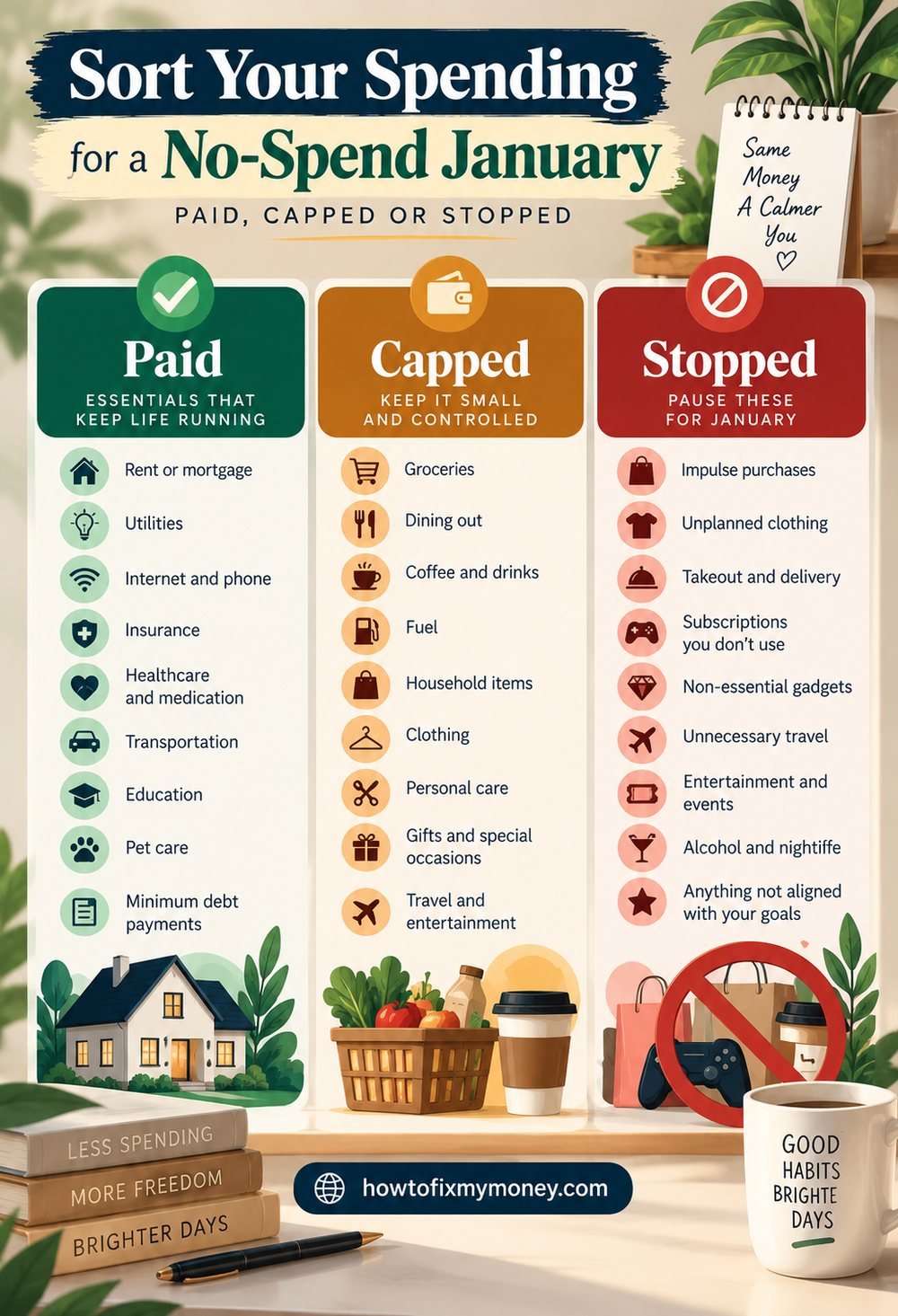
A no-spend month is not a month where no money leaves your account. Rent leaves. Insurance leaves. Your minimum debt payments leave, and they have to, because a missed payment costs more in fees and credit damage than the entire challenge can save.
What you’re actually doing is freezing one slice of your spending: the discretionary slice, the part that moves when your mood moves.
That distinction is the whole challenge, and it only works if you write it down before January starts, while you’re calm and nothing is urgent.
The Three Columns Worth Writing on Paper Before January 1st
Take one sheet and sort every outgoing dollar into one of three columns: paid, capped, or stopped. Most households finish this in twenty minutes.
| Column | What Goes in It | What Happens to It in January |
|---|---|---|
| Paid | Rent or mortgage, utilities, internet and phone, insurance, healthcare and medication, transportation, education, pet care, minimum debt payments | Paid in full and on time. Skipping any of these costs more in fees, interest, and credit damage than a no-spend January can save |
| Capped | Groceries, fuel, household items, personal care, and gifts or occasions already on the calendar | Still bought, but to a written weekly limit. Genuinely needed, yet the amount is negotiable in a way rent is not |
| Stopped | Impulse purchases, takeout and delivery, unplanned clothing, subscriptions you do not use, gadgets, events, nights out | Nothing for the month. This is the category a no-spend January is really about |
Look closely and you’ll see clothing, eating out, and entertainment appear in two columns at once. That isn’t a mistake. A meal you planned into the budget on December 30th belongs in capped. The same meal ordered at seven o’clock because nobody wants to cook belongs in stopped. The item is never what decides it. What decides it is whether you chose it in advance.
Write a dollar figure on the grocery cap and tape the sheet somewhere visible. The physical copy matters more than it sounds like it should, because the argument you have on day twelve is with a past version of yourself who already thought this through.
The Honest Math: How Much Money a No-Spend January Actually Puts Back in Your Pocket
This is where most articles wave at “hundreds of dollars” and move on. Here are real numbers instead.
The Bureau of Labor Statistics Consumer Expenditure Survey puts average annual household spending at $78,535 for 2024. Three of those categories are the ones a no-spend month targets directly: food away from home at $3,945 a year, entertainment at $3,609, and apparel and services at $2,001.
That’s $9,555 a year, or roughly $796 a month, sitting in exactly the places a no-spend January tells you to stop.
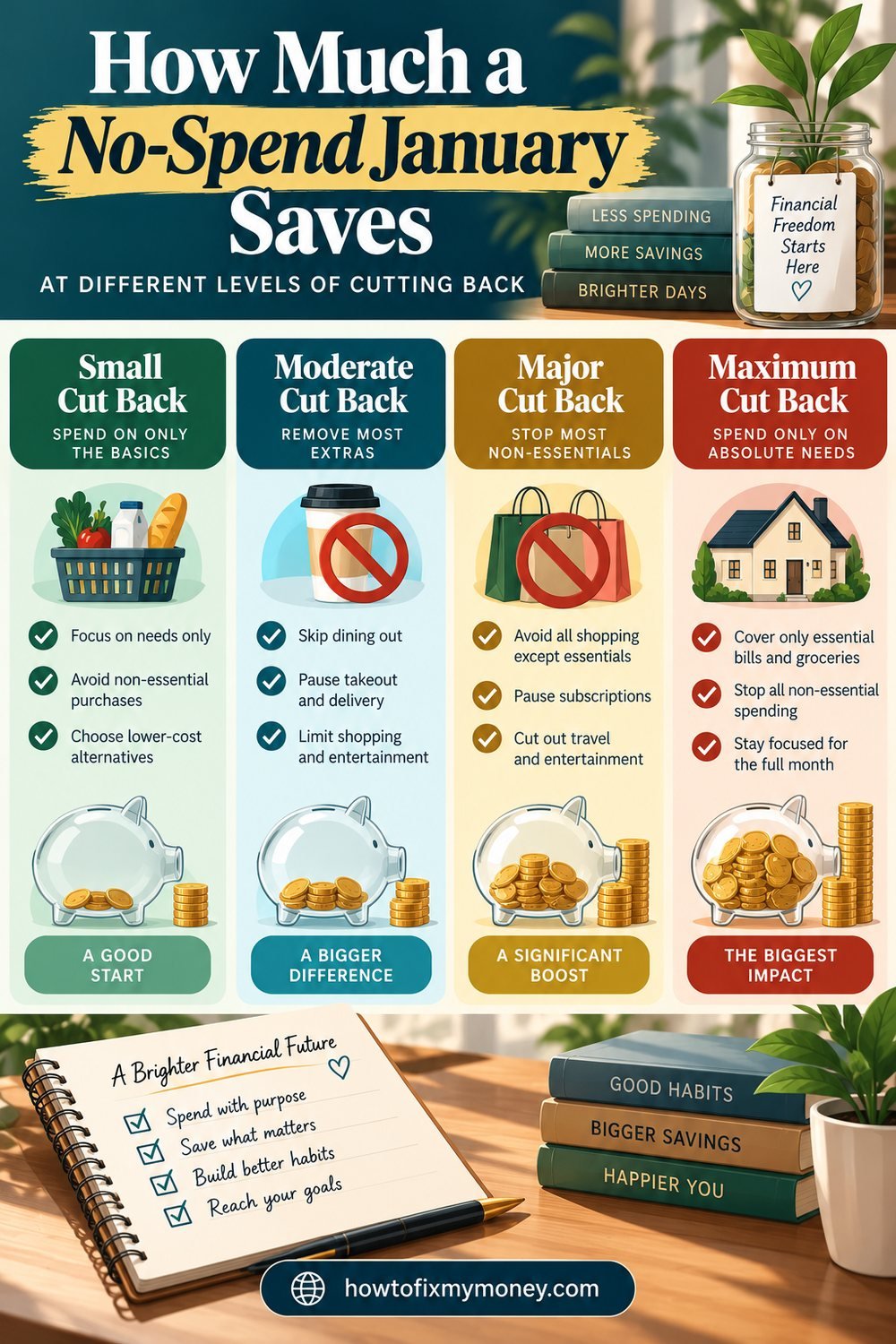
You will not get all of it. Nobody does. So here is what different levels of discipline are worth on those averages:
| How Far You Cut Back | Kept in January | What That Looks Like Day to Day |
|---|---|---|
| Small: the basics only, about half of it | About $398 | Needs only, cheaper alternatives, one planned night out still allowed |
| Moderate: most extras gone, about 60% | About $478 | Dining out skipped, delivery apps paused, shopping limited to essentials |
| Major: most non-essentials stopped, about 70% | About $557 | Subscriptions paused, no takeout at all, travel and entertainment cut |
| Maximum: absolute needs only, all of it | About $796 | Essential bills and groceries alone, which is rare and usually only works in a household of one or two adults |
Two cautions on those figures. They’re averages across all US households, and averages in spending data get pulled upward by high earners, so a median household will land lower. They also assume you were spending in all three categories to begin with.
Your own number is more useful than any national average, and you can get it in half an hour from three months of bank statements. The CFPB publishes a free spending tracker if you’d rather fill in a sheet than build one. Whatever the total comes to, write it at the top of your rules page. That figure is what you’re playing for.
How to Set Up the Four Weeks So Week Two Doesn’t Break You
A no-spend January has a predictable shape. Week one is easy, week two is where it dies, week three is where it gets interesting, and week four is where it either turns into a habit or turns into a story about that one time you tried. Plan each week for what it actually demands.
Week One: Spend Your Energy Removing Temptation Instead of Resisting It
Motivation is at its highest on day one of a no-spend January, and it is the least reliable tool you have. Convert it into changes that keep working after it fades.
- Delete saved cards from Amazon, every delivery app, and your browser’s autofill. Having to find your wallet adds about ninety seconds of friction, and a surprising share of impulse purchases don’t survive it.
- Cancel or pause every subscription you can live without for a month. Do it in the first three days, because a renewal that hits on the 9th is money the challenge never gets back.
- Unsubscribe from retail email and mute the shopping accounts you follow. You are not going to out-willpower a sale notification every morning.
- Plan the month’s meals around what’s already in the freezer and the back of the cupboard from December, then build one grocery list per week from that plan. It’s easy to do now and very hard to start doing on the 14th.
- Open a separate savings account if the money has nowhere to go yet, and move the first chunk the same day you save it.
None of this is about discipline. It’s about making the easy path and the right path the same path for thirty-one days.
Week Two: The Week Most No-Spend Challenges Die, and the Two Things That Prevent It
The pattern is consistent. The novelty has worn off, nothing visible has been achieved yet, and the ordinary stress of January is back. This is the point where that third of no-spend January participants drops out.
Two things carry people through it.
The first is a visible number. Add up what you haven’t spent so far and write it on the sheet. Seeing $180 next to a date is a different experience from vaguely feeling like you’ve been good.
The second is one free thing you’re looking forward to. A library run, a long walk somewhere you don’t usually go, a film night with whatever is already in the house. Week two fails when a no-spend January starts to feel like nothing but subtraction.
Make week two your pantry week too. Cook what’s already in the freezer and the back of the cupboard from December. It cuts the grocery bill at the exact moment your resolve is thinnest, and it clears out food you were going to throw away in March anyway.
Week Three: Trade “I Can’t Buy That” for “I’m Buying That in February”, Then Fill the Gap With Something Free
By now you’ve wanted several things and not bought them, and that friction builds up.
The fix is a single list. When you want something, write it down with the date and the price, and tell yourself you’ll buy it on February 1st. Nothing is being denied, only moved.
Then read the list at the end of the month. Most people find that half of what they wrote down no longer interests them, which is the most useful thing a no-spend January teaches you. The wanting was real. The need mostly wasn’t.
Keep the list afterward. It’s a record of which categories your money leaks out of, and it’s more honest than any budgeting app, because you wrote it in the moment you wanted to spend.
The other half of week three is replacing the habit rather than only blocking it. Most discretionary spending is a response to boredom, stress, or wanting an hour that belongs to you. Remove it without putting anything in its place and the feeling stays, with nowhere to go.
So book the free things deliberately this week. A library trip, a long walk somewhere you don’t normally go, an evening with friends where nobody buys anything, an early night. These aren’t consolation prizes for a month of restriction. They’re the difference between a no-spend January you’d run again and one you merely survived.
Week Four: Count It, Move It, and Decide What Carries Into February
Three jobs in the final week, all of them short.
Count the total you kept. Move it the same day, out of checking and into whatever destination you picked, because money that sits in a spending account gets spent. Then choose two changes from the month to keep permanently.
Two, not ten. The subscriptions you didn’t miss and the takeout night you replaced are usually the obvious candidates, and together they often save more over the following year than the no-spend January itself did.
Five Rules That Separate a Finished No-Spend January From an Abandoned One
- Write the rules down and date them. A rule you can reread beats a rule you’re reconstructing from memory while standing in a store.
- Give the money a destination before January 2nd. Not “savings” in the abstract. A named account, or a specific balance you’re paying down.
- Allow one planned exception for the month, decided in advance. People who build in a single exception finish far more often than people who swear off everything and then treat one slip as the end.
- Track it somewhere physical. A sheet on the fridge gets looked at. An app you downloaded on January 1st gets ignored by the 10th.
- Tell exactly one person. Someone in the house, or a friend who’ll ask how it’s going. Announcing it publicly tends to replace the satisfaction of finishing with the satisfaction of announcing.
Where the Money Should Go Before You Get a Chance to Re-Spend It
A no-spend January with no destination for the savings is a month of effort that disappears. This is not a rare failure, either. Bureau of Economic Analysis data put the US personal saving rate at 3.5% in November 2025, the lowest level since late 2022, which tells you how quickly spare money gets absorbed in an ordinary American household.
Send it somewhere on the day you count it, in this order.
First, December’s balances. LendingTree’s December 2025 survey of 2,032 consumers found 37% took on holiday debt, averaging $1,223. A 60% cut in a no-spend January is around $478, which clears close to 40% of that average balance in one month. If that’s your situation, read how to pay off Christmas debt in 3 months next, because January is the one month that hands you extra ways to fund it.
Second, a small buffer if you have none at all. A few hundred dollars between you and the next unexpected bill is what stops February putting the card back to work.
Third, your highest-interest balance. At a typical card rate above 20%, $478 against the principal is worth considerably more than $478 in a savings account earning a fraction of that. The free Debt Payoff Calculator will show you what a one-time payment that size does to your payoff date.
The Mistakes That Quietly Sink a No-Spend January
- Stockpiling in late December. Buying three months of groceries on the 28th isn’t a no-spend January. It’s a December purchase with a different date on the receipt.
- Leaving the savings in checking. It gets spent on the 29th, usually on something you can’t even remember in March.
- Going absolute on groceries. Under-buying food in week one is the single most reliable way to end up ordering takeout in week two.
- Keeping the total in your head. Untracked progress feels like no progress, and no progress is what makes people quit.
- Imposing it on a household that didn’t agree to it. A no-spend January one adult decided on alone tends to end in an argument rather than a balance payment.
- Treating February 1st as a release valve. A $500 catch-up spree on the first wipes out the whole no-spend January exactly, and people do it more often than they admit.
Questions People Actually Ask Before Starting a No-Spend January
What is the No-Spend Month Challenge?
It’s a month in which you pay your bills, buy genuine essentials, and stop everything else: no takeout, no new clothes, no impulse orders, no subscriptions you aren’t using. You set the rules yourself before it starts, which is why two people can both run one and end up with very different lists. The point isn’t deprivation. It’s finding out which of your spending you actually miss. January is simply the most popular month to run one, which is where the no-spend January name comes from.
What are the rules for a No-Buy Month challenge?
There is no official set, and that’s deliberate; you write them. A workable version fits in five lines. Pay every fixed bill and minimum payment. Cap groceries and fuel at a written weekly number. Buy nothing from the stopped column. Allow one exception you decided on in advance. Write down anything you wanted but didn’t buy, with the date. A no-buy January and a no-spend January describe the same challenge, and the name tends to change with whoever is running it.
Does a no-spend January include bills, rent, and groceries?
No. Fixed obligations and genuine essentials get paid as normal, and so do minimum debt payments. The month freezes discretionary spending only. Groceries sit in the middle: you keep buying food, but with a written weekly cap.
What happens if a real emergency comes up in week two?
You pay for it and keep going. A car that won’t start is not a failure of discipline, it’s a car. Write it on the sheet as an emergency rather than an exception, and carry on with the remaining weeks of your no-spend January. The households that finish are the ones that treat one unavoidable expense as a line item instead of an ending.
Is a no-spend January better than just making a budget?
They do different jobs. A budget sets ongoing limits; a no-spend January is a short diagnostic that shows you which spending you actually miss. Most people learn more about their habits in one no-spend month than in six months of budgeting, then use what they learned to build a budget that holds.
What is the 70-10-10-10 budget rule?
It splits take-home pay four ways: 70% for living expenses, 10% for short-term savings, 10% for long-term investing, and 10% for paying down debt faster than the minimum. Some versions swap that last slice for giving. It asks more of you than the better-known 50/30/20 split, because it treats saving, investing, and debt as three separate jobs instead of one. A no-spend January is a fast way to find out whether that final 30% is realistic in your household, since it shows you in four weeks what your discretionary spending is really worth.
Can I do this if I live with someone who isn’t doing it?
Yes, as long as you only commit your own discretionary spending and say so clearly. Shared categories like groceries need agreement, or you’ll spend the month arguing about a cap one of you never signed up for.
What is a realistic amount to save in one no-spend month?
On national average spending in the three target categories, a 60% cut during a no-spend January comes to about $478. Households of one or two adults with high takeout spending sometimes clear $700 or more. If you’re on a tight budget already, with little discretionary spending to cut, $150 to $250 is a normal and perfectly respectable result.
Is there a way to save $100 in 30 days?
Yes, and it’s less dramatic than it sounds. A hundred dollars across a month is $3.34 a day. On national average spending, food away from home runs about $329 a month, so cutting roughly a third of it covers the whole target by itself. Canceling the subscriptions you don’t use is worth around $252 a year on its own, according to CNET’s 2026 survey. Most households find their $100 in two decisions rather than thirty small sacrifices.
What is the biggest money waster?
The recurring charge nobody decided on this month. CNET’s 2026 survey put average subscription spending at $111 a month, about $1,332 a year, with roughly $252 of that going to services people never open. It beats takeout and impulse buying for one reason: it requires no decision to keep happening. Everything else at least makes you choose it. That’s exactly why week one of a no-spend January starts with cancellations instead of willpower.
Why is Gen Z not saving money?
Mostly they are, and the premise is worth correcting. Bank of America’s 2026 Better Money Habits study, which surveyed 1,133 adults aged 18 to 29, found 66% are saving, up from 60% in 2024, and nearly 70% had taken concrete steps against rising costs in the past year. The squeeze is on the cost side: 49% named the cost of living as their biggest barrier, nearly 30% named housing and rent, and 42% were living paycheck to paycheck. A no-spend month helps with the spending half of that. It can do nothing about rent, and it’s worth being honest about which half of the problem you’re solving.
Does it have to be January?
No, and the month matters less than the timing. A no-spend January works because December just emptied the account and the cultural permission to stay home is at its highest point all year. February and September work for similar reasons. Any month with a reason behind it beats a random one. If a full month feels like too much on a first attempt, a single week or one category for thirty days teaches you most of the same lesson.
What You Do on February 1st Decides Whether January Mattered
The real return on a no-spend January isn’t the few hundred dollars. It’s the list of things you wanted and then stopped wanting, and the subscriptions you didn’t notice were gone.
So do two things on February 1st. Keep whatever you didn’t miss, permanently. And set up an automatic transfer for the amount you saved, on the day you get paid, so a one-month exercise turns into twelve.
Do that and next December arrives with cash already waiting for it, which means next January you’ll be running a no-spend month because you want to, not because the statement left you no choice.
From here, the Debt Payoff Calculator will turn your January total into a payoff date, or see where else your monthly spending can give in how to cut $300 a month. More guides are in our Money Fixes section.

Bilal founded HowToFixMyMoney.com in 2026 to make US personal finance decisions easier to work through without a financial background. Every figure published here traces back to a primary source — the Bureau of Labor Statistics, the Federal Reserve, the IRS, the CFPB — and each article links to the data it relies on. He is not a licensed financial advisor, and nothing on this site is personalized advice.