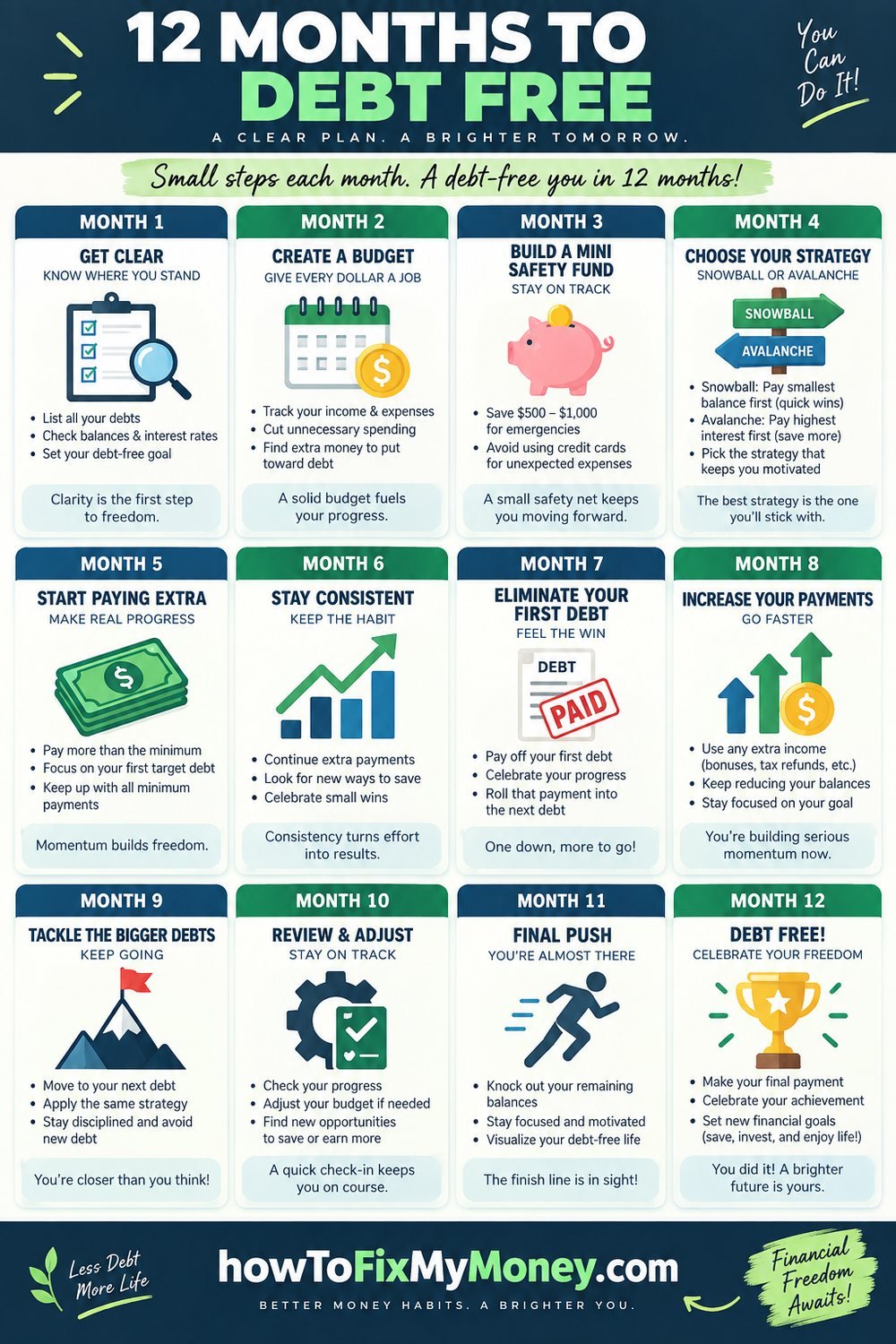
Going from 12 months to debt free is not a slogan. It’s a schedule. Most people fail at debt payoff because they start with motivation and no calendar, and motivation runs out somewhere around week nine.
This plan gives you the calendar. Each of the 12 months to debt free has one job, so you never have to sit there wondering what you should be doing. You do that month’s job, and you move on.
One honest note before we start. A year is enough time for plenty of households, but not all of them. If you owe forty thousand dollars on a modest income, no calendar compresses that into twelve months. What this plan really shows you is the exact shape of 12 months to debt free, so you can see whether yours fits inside a year or whether you’re looking at two.
Is 12 Months to Debt Free Realistic for You?
There’s a quick test. Add up everything you owe, then divide it by twelve. If that answer is anywhere near what you could put toward debt each month, you’re in range.
Add a little for interest while you’re at it. Roughly ten percent on top of the balance covers a year of interest at typical credit card rates.
| Total Debt | Roughly What 12 Months Needs | Verdict |
|---|---|---|
| $5,000 | About $460 a month | Realistic for many households |
| $8,400 | About $800 a month | Realistic on a decent income |
| $15,000 | About $1,375 a month | Hard, but possible for some |
| $25,000 | About $2,290 a month | Usually needs 24 to 36 months |
| $40,000 | About $3,670 a month | Plan for 3 to 5 years instead |
If your number lands somewhere out of reach, don’t throw the plan away. Use the same 12 months to debt free structure and accept a longer finish date. The structure is what does the work here, not the deadline.
Run your own figures first with the free Debt Payoff Calculator. It takes two minutes, and it will tell you honestly whether twelve months is your timeline or whether you’re looking at twenty.
The Example We Will Follow All Year
Plans are easier to follow when there are real numbers attached, so here’s one household we’ll track from January to December.
| Debt | Balance | Rate | Minimum |
|---|---|---|---|
| Store card | $1,100 | 24.5% | $35 |
| Credit card | $3,600 | 22.1% | $90 |
| Personal loan | $3,700 | 12.9% | $125 |
| Total | $8,400 | $250 |
Their minimums come to $250 a month. Clearing this inside a year means paying $800 a month in total, so they need to find $550 on top of what they’re already paying.
That’s the hard part, and it’s why the first two months of this plan are about finding money rather than paying it. Across the year they’ll pay roughly $860 in interest, bringing the total to about $9,260.
One assumption worth stating: the $800 payment runs from month one. The early months are about building the system around a payment that has already started, not about waiting until month five to begin.
Month 1 of 12 Months to Debt Free: Get Clear
Month one has one job, and it isn’t paying anything extra. It’s knowing exactly where you stand.
- List every debt on one page: balance, interest rate, minimum payment, and due date.
- Pull your credit reports from all three bureaus and check nothing is missing or wrong.
- Write down your take-home pay and every fixed bill.
- Work out the gap between what you have spare right now and what the twelve-month plan needs.
That gap will probably be uncomfortable. Our example household needs $550 extra and likely starts with about $150 spare. Almost everyone starts there. Month two exists to close it.
Write it all on one sheet of paper rather than three apps. A single page you can look at in ten seconds beats a system you stop opening by March.
If any of your everyday bills are already behind, stop here and sort that out first. Our guide for when you are behind on every bill explains which bills to protect before you start any payoff plan. And if an account has gone to collections, work through our 6-month plan to get out of collections alongside this one.
Month 2: Create a Plan and Give Every Dollar a Job
This is the month that decides whether your 12 months to debt free plan actually happens. You’re hunting for $550 a month in our example, and it comes from two places: smaller bills and extra income.
Lower Your Fixed Bills First
Fixed bills are where the fast money is, because one phone call keeps paying you every month for the rest of the year. Skipping a coffee saves you money on the days you remember. Renegotiating your phone plan saves you money whether you think about it or not.
- Call your phone provider and ask what plan actually fits your usage.
- Call your internet provider and ask what a new customer would pay.
- Get three insurance quotes before your renewal, then take the best one back to your current insurer.
- Cancel every subscription you haven’t opened in the last month.
- Move to a bank account with no monthly maintenance fee.
Our full guide on how to cut $300 a month without touching your rent walks through each of these with typical savings for every category.
Then Raise Some Temporary Income
For twelve months only, extra income is worth more than it usually would be, because every dollar of it goes straight at a balance instead of into everyday life.
- Sell the things you own and don’t use. Most households have a few hundred dollars sitting in cupboards.
- Ask about overtime, or pick up a short contract.
- Send any tax refund, bonus, or gift straight to the debt before it gets absorbed.
Be realistic about what you sign up for. A plan built on twenty extra hours a week collapses by April. Build it on changes you can hold for a full year without resenting them.
Month 3: Build a Mini Safety Net
This step looks like it slows you down. It’s the thing that keeps the whole year from falling apart.
Put aside a small buffer, somewhere between $500 and $1,000, and keep it in a separate account. Without it, the first flat tire or vet bill goes straight back onto a credit card, and you spend month four undoing month three.
- Keep it somewhere you can reach the same day, not invested.
- Don’t touch it for anything you could have planned for.
- Rebuild it immediately after you use it, before resuming extra payments.
Yes, this delays your finish by a few weeks. It also stops the plan from breaking, which is worth far more than a few weeks.
Month 4: Choose Your Strategy
By now you know your numbers and you have a buffer. This is the month you commit to an order and stop second-guessing it.
You have two sensible options. The snowball means paying your smallest balance first, whatever its rate, because the early win keeps you going. The avalanche means attacking the highest interest rate first, because it costs you the least overall.
Our example household goes with the snowball. Their store card at $1,100 clears early, and that first cleared debt does more for their odds of finishing than the interest difference does for their wallet.
Our comparison of the debt snowball and avalanche methods runs the numbers on both and explains which one suits which situation.
Months 5 and 6 of 12 Months to Debt Free: Pay Extra, Stay Consistent
The system is built. From here, 12 months to debt free is mostly a matter of letting it run.
Set up automatic payments so the money leaves your account the day after payday, before you have a chance to think about it. Pay the minimum on everything, then send the entire extra amount at your target debt.
- Automate it. A payment that depends on how motivated you feel on the 3rd of the month is not a plan.
- Check in once a month, not once a day. Watching a balance daily makes slow progress feel slower than it is.
- When a debt clears, roll its payment onto the next one immediately. This is the engine of the whole method.
- Track months remaining rather than the balance. That number moves more visibly.
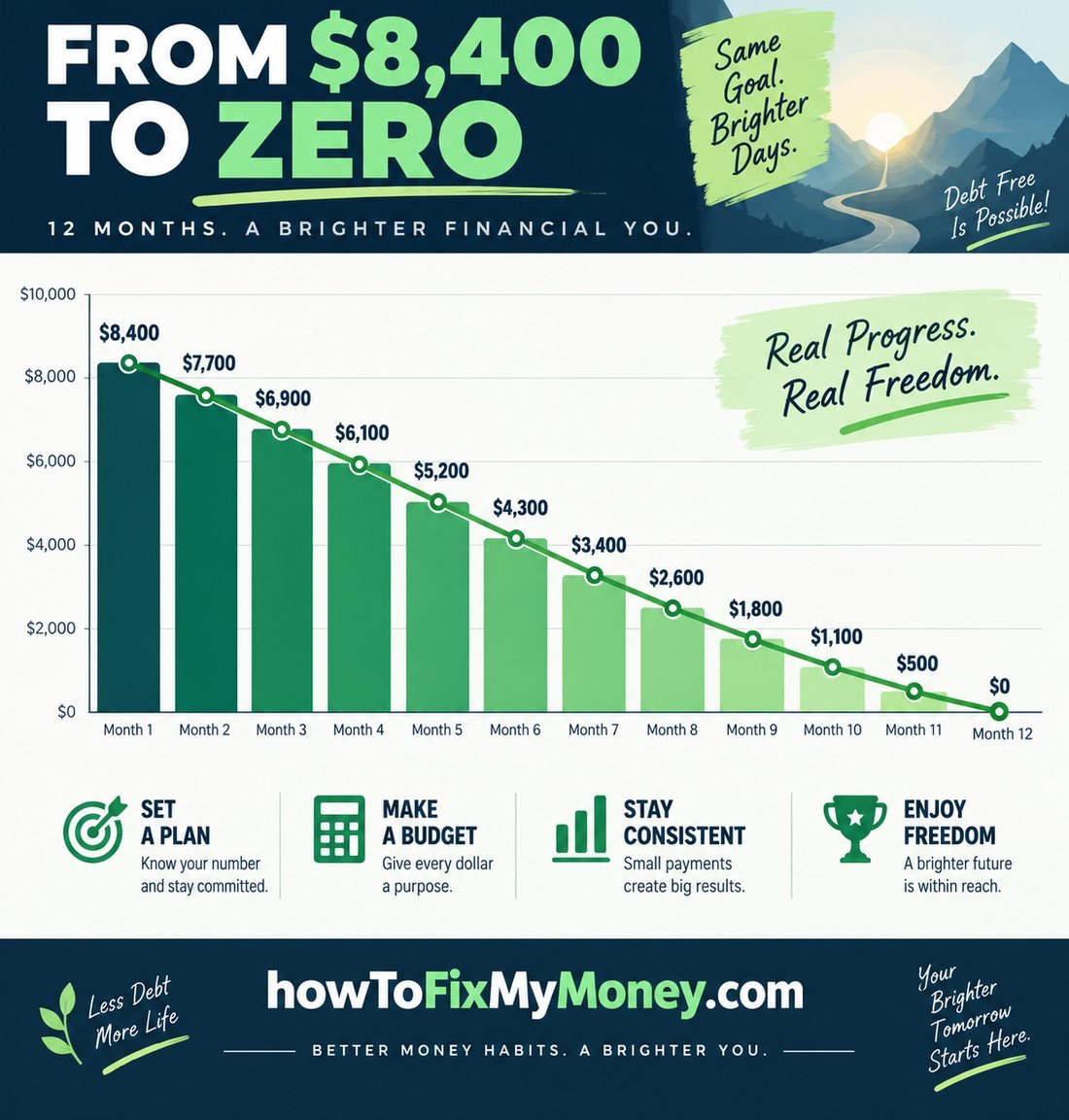
By the end of month six our example household is down around $4,300, roughly half of where they started, and their payment now carries two debts’ worth of freed-up minimums.
Month 7: Eliminate Your First Debt
Somewhere in here, a balance hits zero for the first time.
The dollar amount is usually small. The effect is not. You’ve just proved to yourself that the plan works, and that proof is what carries you through the back half of the year when nothing feels like it’s moving.
Do two things when it happens. Mark it somehow, even if that just means crossing it off the sheet in front of you. Then immediately redirect that payment to the next debt, before it quietly becomes grocery money.
Months 8 and 9: Increase Payments and Tackle the Bigger Debts
This is where most twelve-month plans die, so it’s worth a warning.
The novelty has gone. You’re three quarters of a year into saying no to things, the finish is still months out, and the remaining balance is the big one that moves slowly.
What to Do When Motivation Runs Out
- Go back to the calculator and look at your payoff date. A real date on a real calendar beats staring at a balance.
- Add up what you’ve already paid this year. It’s almost always more than people think.
- Plan one small, cheap thing to look forward to. Deprivation with no relief in sight is what breaks plans, not the math.
- If a bad month happens, drop to minimums for that month and restart the next one. Pausing isn’t quitting.
That flat stretch is a normal stage of the process rather than a sign something has gone wrong. Our guide to the 5 stages of paying off debt explains why the middle feels hardest and what gets people through it.
In our example, the personal loan clears in month eight. Its $125 minimum rolls onto the credit card, and the last balance finally starts falling fast.
Months 10 to 12: Review, Final Push, Debt Free
The end is close enough to see. The rolled-up payment is large by now, so the last balance drops quickly.
- Take no new debt until the final balance reads zero. No upgrades, no financing, nothing.
- If a bonus or refund lands in these months, put it straight on the balance and finish early.
- Get written confirmation from each lender that the account is paid, and closed if that’s what you want.
- Check your credit report about thirty days after the last payment to make sure everything updated.
Our example household makes their final payment in month twelve, having paid about $9,260 on an $8,400 debt.
The Full 12 Months to Debt Free Calendar
Here’s the entire year in one table, with the running balance from our example so you can see the shape of it.
| Month | That Month’s Job | Balance | Milestone |
|---|---|---|---|
| 1 | Get clear. List everything, pull your reports | $8,400 | You know your number |
| 2 | Create a plan. Cut bills, raise extra income | $7,700 | Found $550 a month |
| 3 | Build a mini safety net | $6,900 | Buffer in place |
| 4 | Choose your strategy | $6,100 | Snowball or avalanche |
| 5 | Start paying extra | $5,200 | Payment automated |
| 6 | Stay consistent | $4,300 | Roughly halfway |
| 7 | Eliminate your first debt | $3,400 | Store card gone |
| 8 | Increase your payments | $2,600 | Loan cleared |
| 9 | Tackle the bigger debts | $1,800 | |
| 10 | Review and adjust | $1,100 | |
| 11 | Final push | $500 | Nearly there |
| 12 | Last payment | $0 | Debt free |
Balances here are rounded, and yours will look different. The pattern won’t. Every version of 12 months to debt free has the same shape: slow going at first, an early win, a long flat middle, then a finish that arrives faster than you expect.
Print Your Own 12-Month Plan
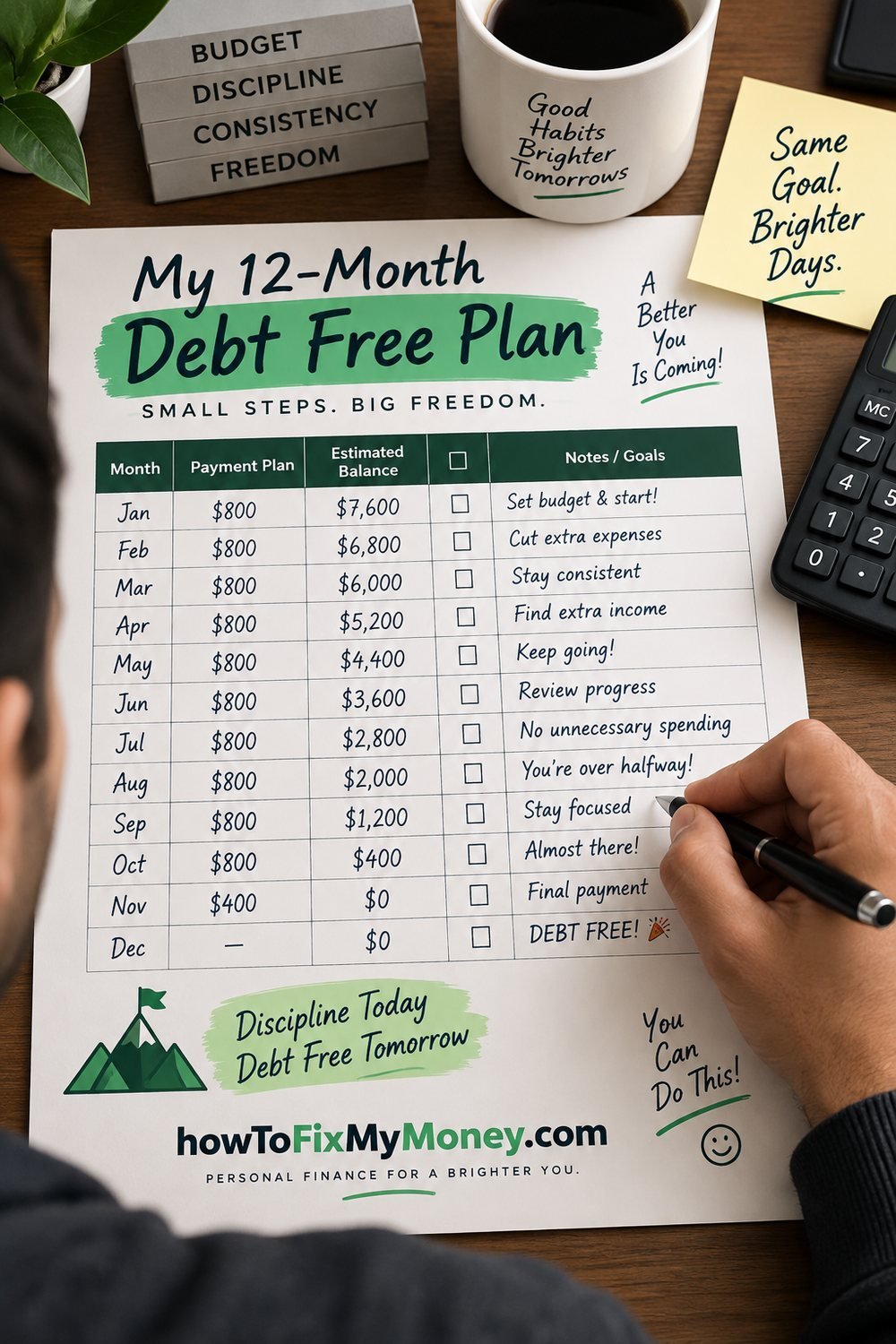
A plan you can see beats a plan you remember. Draw twelve rows on a sheet of paper, one for each of your 12 months to debt free. Write your payment in each row and put your estimated balance next to it.
Stick it somewhere you’ll actually walk past. The fridge works better than a folder. Crossing off a row by hand at the end of each month does something a banking app notification never quite manages.
What to Do the Month After You Are Debt Free
People skip this step constantly, and skipping it is why so many end up back in debt within two years.
You now have $800 a month that used to belong to lenders. If you don’t decide where it goes, it dissolves into everyday spending within about three months, and the habits that got you here go with it.
- Keep paying the same $800, but send it to savings instead.
- Build a full emergency fund first. That’s what stops the cycle restarting.
- Then split it between longer-term saving and a bit more everyday comfort. You’ve earned both.
- Keep the monthly check-in. Of all the habits from this year, that’s the one worth carrying forward.
Mistakes That Break a 12 Months to Debt Free Plan
- Starting with payments instead of planning. Months one and two exist for a reason.
- Setting the payment at your best month rather than your worst. A plan that only survives perfect months isn’t a plan.
- Not rolling freed-up payments forward. This is the engine. Without it you’re just making minimums with extra steps.
- Keeping zero buffer. One flat tire puts the whole thing back on a credit card.
- Using a new card while paying off the old one. The balance moves sideways and the year ends where it started.
- Quitting in month eight because it feels slow. It always feels slow in month eight.
Where to Get Free Help
You never need to pay anyone for good information about debt. Several government sources are free and reliable.
- MyMoney.gov has free budgeting worksheets and money basics from the U.S. government.
- The Consumer Financial Protection Bureau explains your rights if an account falls behind during the year.
- The Federal Trade Commission covers your options for getting out of debt and how to spot a scam.
Non-profit credit counseling agencies also offer free budget reviews. A legitimate one will never charge you before doing any work, and will never promise to make your debt disappear.
Frequently Asked Questions
Can you really go from debt to debt free in 12 months?
Yes, if your balance divided by twelve is close to what you can afford each month. For most households that means somewhere under about ten thousand dollars. Larger balances usually need two to three years, and that is still a good outcome.
How much do I need to pay each month for 12 months to debt free?
Take your total balance, add roughly ten percent for a year of interest, then divide by twelve. On an $8,400 debt that works out at about $800 a month.
What if I cannot afford the monthly payment?
Extend the timeline rather than abandoning the plan. Eighteen or twenty-four months using the same twelve steps beats a twelve-month plan you give up on in month five.
Should I save money during these 12 months?
Keep a small buffer of $500 to $1,000, and no more than that. Without it, one unexpected bill goes straight back on a credit card and undoes months of work. Beyond the buffer, put your money on the debt.
Which debt should I pay first?
Smallest balance first if you need the motivation of an early win, or highest interest rate first if you want to pay the least overall. Both work. The one you will actually finish is the right one.
What happens if I miss a month?
Drop to minimum payments for that month, protect your essential bills, and restart the following month. Your finish date moves by a few weeks. That is all. Missing a month is not the same as failing.
Does paying off debt in 12 months help my credit score?
Usually yes. Payment history and how much of your available credit you are using are both major factors in most scoring models, and a year of on-time payments with falling balances improves both.
Should I close my credit cards once they are paid off?
Not necessarily. Closing a long-held account can shorten your credit history and reduce your available credit, which may lower your score. Many people keep the card open and simply stop using it.
Final Thoughts
The reason 12 months to debt free works isn’t that a year is magic. It’s that twelve months is short enough to stay real in your head and long enough to actually finish.
That’s the whole idea. Month one is the list. Month two is the money. Month three is the safety net. Then you hold the line through the middle and finish fast.
Start with month one today. Write every balance on one page. It takes twenty minutes, and that single sheet is the entire plan.
Then check your real timeline with the Debt Payoff Calculator, or read more guides in our Debt Relief section.