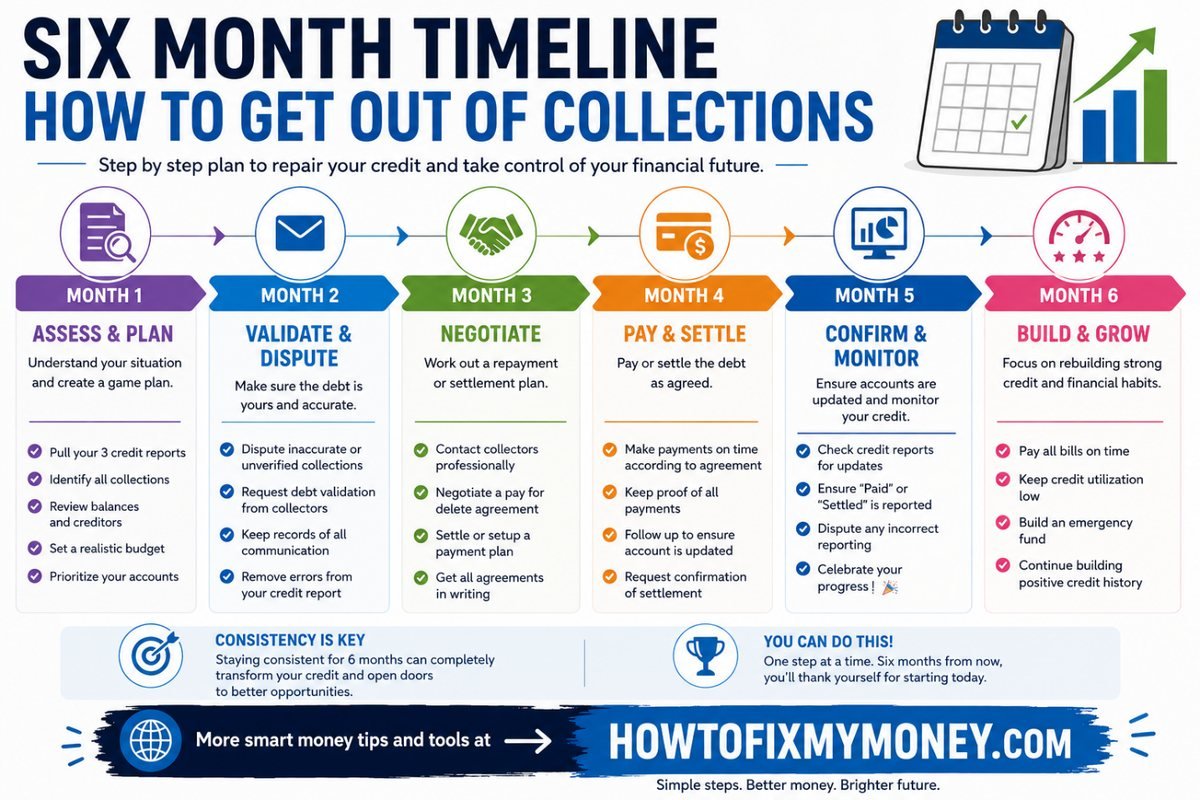
To get out of collections you need a plan, not a panic. Most people do the opposite. They answer a frightening phone call, agree to something on the spot, and end up paying a debt they never checked was theirs, on terms they never should have accepted.
This guide gives you the other version. It is a six-month plan to get out of collections without paying anyone to help, laid out month by month, and every step in it is something you can do yourself for free. No credit repair company, no upfront fees, no one taking a cut.
Six months sounds slow when the calls are coming daily. But rushing is what costs people money here. The steps below are ordered the way they are for a reason, and doing them in order is what makes the difference between getting out of collections properly and paying twice.
What It Means When an Account Goes to Collections
An account does not land in collections overnight. There is a long path before it, and knowing where you sit on that path tells you how much room you have when you try to get out of collections.
| Stage | Roughly When | What It Means |
|---|---|---|
| Late | 1 to 30 days | A late fee is added and the lender starts contacting you |
| Delinquent | 30 to 90 days | Reported to the credit bureaus and your score drops |
| Serious delinquency | 90 to 150 days | Contact increases and the account is flagged internally |
| Charge-off | Around 120 to 180 days | The lender writes the debt off their own books |
| Collections | After charge-off | A collection agency now owns or manages the debt |
A charge-off does not mean the debt has been cancelled. It only means the original lender stopped expecting to collect it themselves. The balance still exists, and whoever holds it now will pursue you for it.
Here is the part that changes everything. Many debts in collections were sold, not just handed over. Agencies buy portfolios of old debt for a small fraction of the face value, sometimes only a few cents on the dollar. A company that paid twenty dollars for a thousand-dollar debt has an enormous amount of room to negotiate, and it will not tell you that.
Why It Takes About Six Months to Get Out of Collections
You could pay a collector today and be done by Friday. People do it all the time, and it is usually a mistake.
The six-month timeline exists because several of the steps involve waiting for someone else. A validation request has to be answered. A credit bureau dispute takes around thirty days. A settlement letter has to arrive before you send money. Each of those has a natural pause built into it, and skipping the pause is how people end up paying debts that were not theirs, or losing the proof that they paid.
| Month | What You Do | Why It Matters |
|---|---|---|
| Month 1 | Assess and plan | You cannot fix what you have not listed |
| Month 2 | Validate and dispute | Confirms the debt is real, yours, and correct |
| Month 3 | Negotiate | Sets the amount and gets it in writing |
| Month 4 | Pay and settle | Clears the account on agreed terms |
| Month 5 | Confirm and monitor | Makes sure the reporting actually updates |
| Month 6 | Build and grow | Stops the same thing happening again |
Month 1: Assess Your Situation and Plan How to Get Out of Collections
You cannot get out of collections while debts you do not know about are still sitting on your file. Month one is about building the complete picture before you speak to anybody.
Pull All Three Credit Reports
Get your reports from all three bureaus and write down every collection account: who holds it, the balance they claim, and the date the original account first went delinquent.
That last date matters more than most people realize. It controls when the entry drops off your credit report, which is generally seven years from the original delinquency, not from the date a collector bought the debt. An agency cannot restart that clock by purchasing the account, and if you see a collection listed with a fresher date than the original default, that is worth disputing.
While you have the reports open, look for these common errors.
- The same debt listed twice, once by the original lender and once by the collector, both showing a balance.
- Accounts that are not yours at all, often from a similar name or a mixed file.
- Balances that do not match what the collector is claiming.
- Debts you already paid still showing as outstanding.
- A date of first delinquency that looks too recent.
Check the Age of Each Debt
Every state has a statute of limitations on debt, which is the window during which a creditor can take you to court over it. Once that window closes, the debt is often described as time-barred. It still exists and it may still show on your credit report, but the legal routes for collecting it become limited.
Be very careful here. In many states, making a payment or acknowledging the debt in writing can restart that clock from zero. A small good-faith payment on a very old debt can hand a collector years of fresh legal options. Check the rules in your state before you agree to anything on an old account.
Set a Realistic Budget
Before you speak to anyone about money, you need a real number. Not a hopeful number, but one that survives a bad month, because the offer you make is what decides how quickly you get out of collections.
- Build a bare bones monthly budget and find what is genuinely spare after essentials.
- Decide whether you are aiming for a lump sum settlement or a monthly payment plan.
- If you can raise even a modest lump sum, your negotiating position improves considerably.
- Never plan around a monthly figure you would struggle to meet.
If your everyday bills are also behind, sort that out before you negotiate. Our guide on what to do when you are behind on every bill covers which bills to protect first.
Month 2: Validate the Debt Before You Pay Anything
This is the most important month in any plan to get out of collections, and it is the one almost everyone skips.
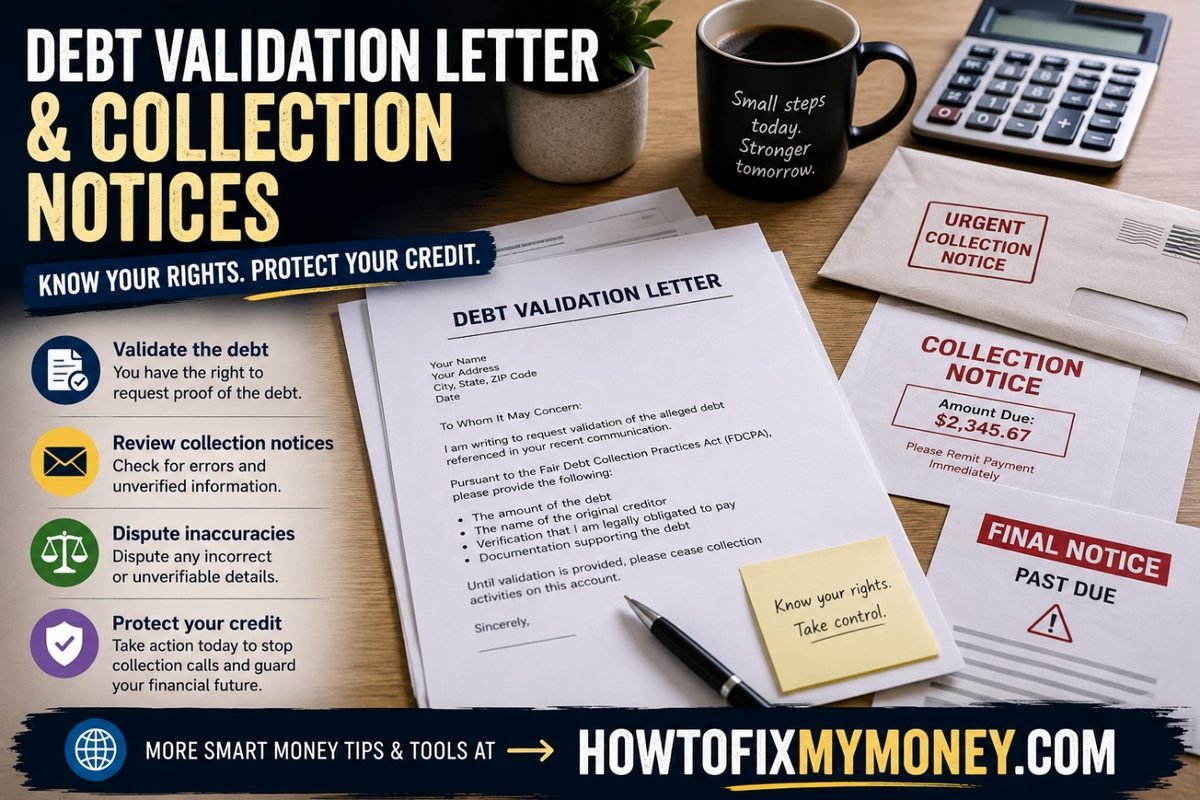
Under federal rules, when a collector first contacts you, they must provide certain information about the debt, and you have the right to dispute it and ask for verification in writing. If you make that request within the period they tell you about, they are generally required to stop collection activity until they provide what you asked for.
That single letter does two things at once. It pauses the phone calls, and it forces the collector to prove they actually have the paperwork.
How to Send a Debt Validation Letter
- Keep it short. It does not need legal language or a template you pay for.
- State clearly that you dispute the debt and are requesting validation.
- Include the account reference from their letter, plus your name and address.
- Do not admit the debt is yours, and do not offer to pay anything in the letter.
- Send it by a method that gives you proof of delivery, and keep a copy of everything you send.
- Wait for their response before you take any further action.
Send this even when you are completely certain the debt is yours. Debts get sold several times before they reach the agency contacting you, and paperwork gets lost along the way. Collectors sometimes cannot produce proper documentation, and when that happens, they are not permitted to keep collecting on it.
Dispute Anything Wrong With the Bureau
Alongside the validation letter, dispute any errors you found in month one. Do it in writing with the credit bureau rather than by phone, so there is a record. They generally have around thirty days to investigate, which is one of the reasons this plan runs across six months rather than six days.
Month 3: Negotiate Your Way Out of Collections
Keep the call short and unemotional. Say you want to resolve the account, state what you can offer, and then stop talking. Silence is a normal part of any negotiation and you do not need to fill it.
Collectors are trained to create urgency. You will hear that the offer expires today, or that this is a one-time opportunity. Almost none of that is true. There is no deadline that should push you into agreeing to something you have not thought about.
Settlement or Payment Plan: Which Is Better?
| Lump Sum Settlement | Monthly Payment Plan | |
|---|---|---|
| You pay | Less than the full balance, once | Usually closer to the full balance, over time |
| Best when | You can raise cash from savings or family | You have steady income but no lump sum |
| Main advantage | Cheaper overall, and it ends immediately | Manageable, no large sum needed |
| Main risk | You need the money up front | Missing one payment can void the deal |
| Tax note | Forgiven amounts may be taxable | Usually, no forgiven amount involved |
As a rough guide, agencies will often settle older debts for well below the full balance, precisely because they bought them cheaply. Opening at around a quarter to a third of the balance is common practice, with room to move upward. There is no guarantee, and the newer the debt, the less flexible they tend to be.
Get the Agreement in Writing Before You Pay
This is the rule that protects you, and it is not negotiable on your side. If they refuse to put it in writing, do not pay. That is not being awkward. It is the minimum standard for any transaction of this size, and a legitimate agency will not object.
- Get the agreement in writing before a single dollar moves. A verbal agreement is worth very little later.
- The letter should state the exact amount, that it resolves the account in full, and how they will report it to the credit bureaus.
- Never give a collector direct access to your bank account or a post-dated check.
- Do not pay from the account you use for rent and essential bills.
- Keep every letter, email, and receipt for at least seven years.
Month 4: Pay and Settle on the Agreed Terms
Make the payment exactly as the written agreement describes, using a method that leaves you a record. If you agreed a payment plan, set a reminder for every due date, because missing one can void the whole arrangement and put you back at the start.
- Pay on time, exactly as the agreement states.
- Keep receipts and confirmations for every single payment.
- Do not send extra money or round the amount up. Pay what was agreed.
- Request written confirmation once the final payment clears.
Month 5: Confirm the Account Was Updated Correctly
Paying is not the same as being finished, and this is where people assume they have got out of collections when the paperwork says otherwise.
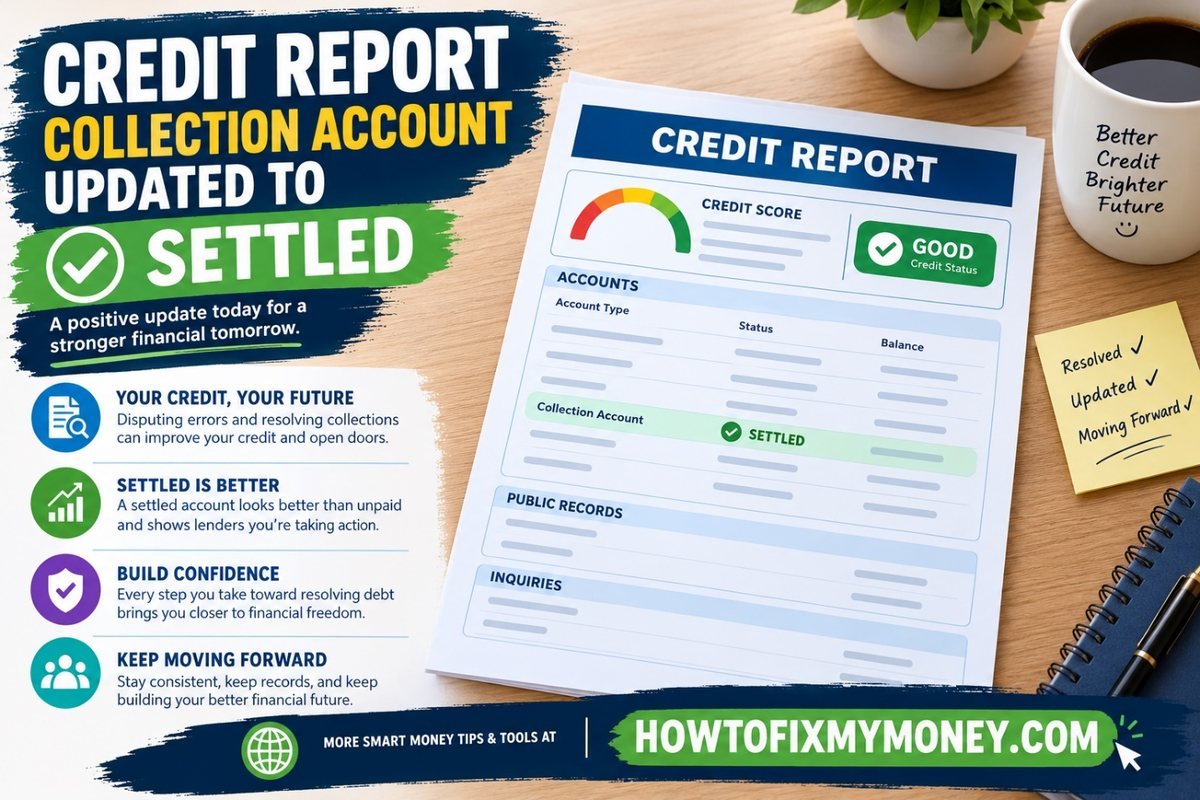
Wait about thirty days after the payment clears, then check your credit reports again. You are looking for the account to show as settled or paid, matching whatever you agreed. If it still shows an outstanding balance, send the bureau a copy of your settlement letter and dispute it. This happens often enough that you should check rather than assume it went through cleanly.
Keep the settlement letter permanently. Old debts occasionally resurface years later, sold on to a different agency that has no record of the settlement. That letter is the only thing that ends the conversation quickly.
Month 6: Rebuild After You Get Out of Collections
Once you get out of collections, the work turns to recovery. Payment history is the single largest factor in most credit scoring models, so a clean run of on-time payments from here does more for you than anything else you could do.
- Set every remaining bill to autopay for at least the minimum, so nothing slips by accident.
- Keep credit card balances low compared to their limits.
- Do not close old accounts that are in good standing, since length of history works in your favor.
- Build a small emergency fund, because a surprise expense with no buffer is what starts the cycle again.
Once you are current, a structured payoff plan keeps the momentum. Our comparison of the debt snowball and avalanche methods explains both approaches, and the free Debt Payoff Calculator will show you a realistic date for clearing what is left.
What Debt Collectors Are Not Allowed to Do
Knowing the limits changes the tone of every call. Under federal rules, a collector generally cannot do any of the following.
- Call at unusual hours, which normally means before 8am or after 9pm in your local time.
- Keep contacting you at work after you have told them not to.
- Use threats, obscene language, or repeated calls intended to harass you.
- Claim you will be arrested over the debt, or pretend to be a lawyer or a government official.
- Discuss your debt with friends, family, or your employer beyond asking for contact details.
- Add fees or interest that were not part of the original agreement or allowed by law.
If a collector breaks these rules, keep a record of dates and times and complain to the Consumer Financial Protection Bureau. The Federal Trade Commission also publishes plain-English answers about what collectors can and cannot do.
Mistakes That Stop People Getting Out of Collections
- Paying immediately to make the calls stop, without verifying the debt is real and correct.
- Making a small payment on a very old debt and accidentally restarting the statute of limitations.
- Agreeing to a monthly amount that is too high, then defaulting and losing the arrangement.
- Handing over bank details so the agency can take payments directly.
- Paying an upfront fee to a company promising to erase the debt. Charging before delivering results is not permitted under federal rules.
- Ignoring court papers. If you are served, respond even if you cannot pay, because ignoring a summons usually leads to a default judgment.
- Throwing away paperwork once the account is settled.
Where to Get Free Help
You never have to pay anyone for good information about this. Several reliable sources are free.
- The Consumer Financial Protection Bureau covers your rights, sample letters, and how to complain about an agency.
- The Federal Trade Commission explains your options and how to recognize a scam.
- USA.gov links to government help with debt and to benefits you may qualify for.
Non-profit credit counseling agencies also offer free sessions. A legitimate one will never charge you before doing any work, and will never promise to make a debt disappear.
Frequently Asked Questions
Can I get out of collections without paying the full balance?
Often, yes. Many agencies will settle for less than the full balance, especially on older debts they bought cheaply. Getting the reduced figure in writing before you pay is what makes it safe.
How long does it take to get out of collections?
Around six months is realistic to get out of collections properly, if you verify the debt, dispute any errors, negotiate carefully, and confirm the reporting afterwards. It can be faster if the debt is straightforward and you have cash available, but rushing usually costs more than it saves.
Should I pay a collection account or leave it alone?
It depends on the age of the debt and what you need next. If you are applying for a mortgage, lenders often want collections resolved. If the debt is close to falling off your report and is already time-barred, paying may create problems in some states. Check your state rules first.
Does paying a collection remove it from my credit report?
Not automatically. It usually updates the status to paid or settled, which looks better than an unpaid collection, but the entry generally stays until seven years from the original delinquency date.
Can I negotiate with a collection agency myself?
Yes. Agencies negotiate directly with consumers every day. Doing it yourself keeps the money you would otherwise pay in fees, and nobody will represent your budget better than you.
What is a pay for delete agreement?
It is an arrangement where the agency agrees to remove the entry from your report in exchange for payment. Some will and some will not, since it may conflict with their agreements with the bureaus. It costs nothing to ask, but do not build your plan around it.
Will settling a debt affect my taxes?
It can. Forgiven debt above a certain amount is sometimes treated as taxable income. The IRS explains how cancelled debt is treated, and it is worth speaking to a tax professional before settling a large balance.
Can a collector take me to court?
Yes, if the debt is still within your state’s statute of limitations. If you receive court papers, do not ignore them. Responding matters even if you cannot pay, because a default judgment can lead to wage garnishment.
What if the debt is not mine?
Send the validation request straight away and say clearly that you dispute the debt. Mixed files and mistaken identity are common, particularly with similar names. Once the agency cannot verify it, they are not permitted to keep collecting.
Final Thoughts
Collections feels frightening because the contact is designed to feel frightening. But underneath it, this is a business process with rules that apply to both sides, and those rules give you far more room than the phone calls suggest.
To get out of collections, assess before you act. Validate before you pay. Negotiate calmly and get it in writing. Confirm the reporting afterwards, then rebuild.
Six months of steady, unglamorous steps is enough for most people to get out of collections and hold a settled account with a plan for what comes next. Start with your credit reports this week.
For more on clearing what is left, read our guide to the debt snowball and avalanche methods or browse our Debt Relief section.