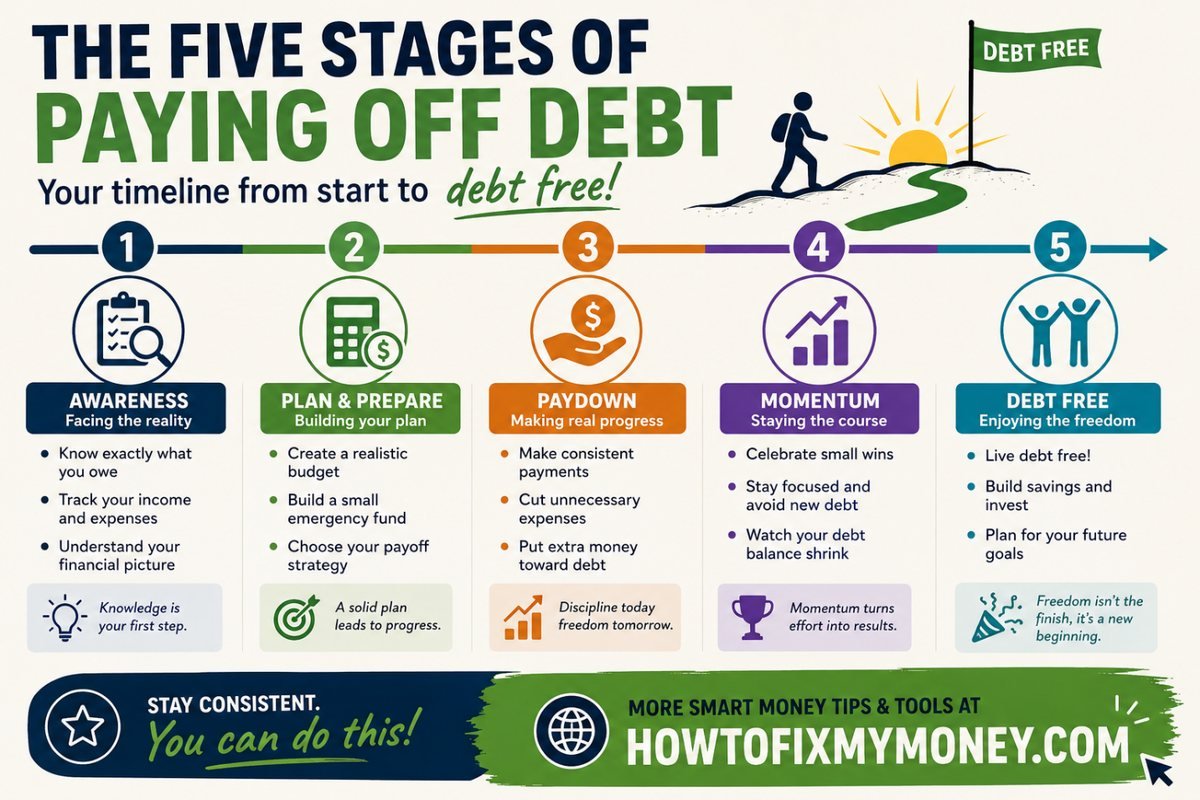
The stages of paying off debt follow a pattern, and almost nobody tells you about it before you start. You get plenty of advice about spreadsheets and interest rates, and almost none about what the process actually feels like from month one to month thirty.
That gap matters more than it sounds. Most people who abandon a payoff plan do not quit because the math stopped working. They quit because they hit a stage they were not expecting, assumed something had gone wrong, and lost confidence in the plan.
This guide walks through all five stages of paying off debt, what tends to go wrong in each one, and how to survive the part where most people give up. If you know the map before you set off, the hard sections stop feeling like failure and start feeling like the terrain.
Why the Stages of Paying Off Debt Matter More Than the Method
Nearly every article about debt argues over method. Snowball or avalanche, minimum payments or lump sums, consolidate or do not. Those arguments are worth having, but they are not what decides the outcome. The stages of paying off debt do.
What decides the outcome is whether you are still going in month eighteen.
A perfect plan abandoned at the halfway point clears less debt than a mediocre plan you finish. And the main reason people stop is not that the numbers changed. It is that the experience changed, in a way nobody warned them about, and they read that change as a sign the plan had stopped working.
So, pick your method, by all means. Our comparison of the debt snowball and avalanche approaches covers both properly. Then spend your attention on the thing that actually breaks plans, which is the shape of the journey.
The 5 Stages of Paying Off Debt at a Glance
| Stage | What It Is | Roughly When | The Main Risk |
|---|---|---|---|
| 1. Awareness | The reckoning | Weeks 1 to 4 | Panic, and giving up before starting |
| 2. Plan & prepare | The sprint | Months 1 to 4 | Cutting too hard, too fast |
| 3. Paydown | The long middle | Months 5 to 18 | Boredom and quitting |
| 4. Momentum | The turn | Months 18 to 24 | Getting overconfident |
| 5. Debt free | The finish | Final months | No plan for what comes next |
Your timeline will be different from the one in that table. Somebody clearing four thousand dollars might pass through all five stages of paying off debt within a year, while somebody clearing forty thousand could spend three years in stage three alone. The lengths change. The order does not.
Stage One: Awareness, or the Reckoning
This is the day you finally add it all up. Every card, every loan, every balance you have been avoiding, written on one page with a total at the bottom.
Almost everyone describes the same reaction. A drop in the stomach, then a strange sort of calm. The number is usually larger than the version you had been carrying around in your head, but it is also, for the first time, a fixed thing rather than a vague dread.
What Goes Wrong Here
People make the list, feel overwhelmed by the total, and quietly put it in a drawer. The figure looks impossible next to their monthly income, so the whole project feels pointless before it has begun.
There is a second version of this failure that looks like progress. Some people spend weeks researching methods, building elaborate spreadsheets, and reading about other people’s payoff journeys, without ever making a payment. Planning feels productive. It is not the same as starting.
How to Get Through Stage One
Do not look at the total. Look at the smallest debt on the list, and look at what you could put toward it this month. That is the only number that matters right now. The total is not a task. It is just a fact, and it will take care of itself if you handle the small numbers in front of you.
- Write every balance, interest rate, and minimum payment on a single page.
- Pick a method and commit to it the same week. Do not spend a month choosing.
- Make one extra payment, however small, before the week is out.
- Put a date in the calendar for a monthly check-in and keep it.
If some of your everyday bills are also behind, deal with that first. Our guide for when you are behind on every bill explains which bills to protect before you start a payoff plan. And if any account has already gone to collections, our 6-month plan to get out of collections covers that separately.
Stage Two: Plan and Prepare, or the Sprint
Motivation is at its highest point here. You cancel everything, sell things you do not use, pick up extra work, and the first debt disappears surprisingly fast. This stage feels fantastic, and it produces real, visible results.
It is also the most misleading stage of the whole process, because the pace you set here is not the pace you will hold.
What Goes Wrong Here
People treat a sprint like a marathon pace. They cut the budget to a level nobody could sustain, take on more hours than they can hold, and build a plan that quietly depends on nothing ever going wrong.
Then something goes wrong, because something always does. The car needs a repair, a birthday arrives, a bill comes in higher than expected. The budget has no room in it, the plan breaks, and breaking a plan feels like failing at the plan.
How to Get Through Stage Two
- Build a small buffer before you go all in. A few hundred dollars set aside stops one bad week from undoing three good months.
- Leave a little money in the budget for ordinary life. A plan with zero flexibility does not survive contact with reality.
- Set your extra payment at a level you could still manage in a bad month, not a good one.
- Treat the sprint energy as a bonus rather than the foundation. Anything extra you manage now is a head start on stage three, not the new normal.
Stage Three: Paydown, or the Long Middle
This is the stage nobody warns you about, and it is where most payoff plans quietly die.
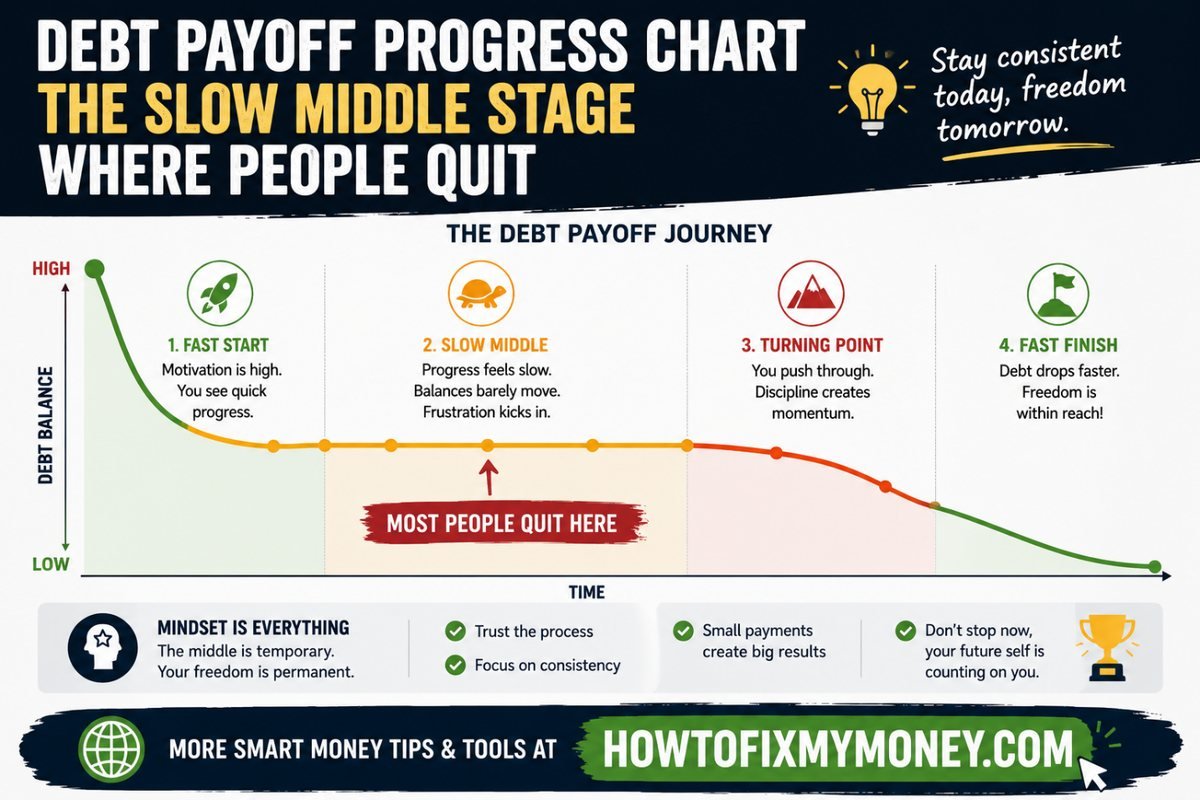
The easy debts are gone. What remains is the big balance, and it moves slowly. You are still paying the same amount every month, still not spending on things you would like, and the number at the bottom barely seems to shift. There is no next win coming for a long time.
Month twelve of a thirty-month plan is a genuinely difficult place to be. You are too far in to feel like you are starting, and too far out to feel like you are finishing. Of all five stages of paying off debt, this is the one that needs a strategy rather than willpower.
What Goes Wrong Here
Two things, usually.
Some people quietly stop. They keep the minimum payments going, but the extra payment drifts back into everyday spending, a little at a time, and six months later nothing has moved. There is rarely a decision to quit. It just erodes.
Others swing the opposite way. They decide the plan is too slow, switch methods, restart with a new spreadsheet, and feel like they are beginning again. Emotionally that resets their progress to zero, while financially nothing has changed at all.
How to Get Through Stage Three
- Change what you measure. Stop watching the balance and start tracking total paid, months remaining, or interest saved. Pick numbers that move.
- Break the big debt into chunks. A six-thousand-dollar balance is a wall. Six markers of one thousand dollars each is a staircase.
- Automate the extra payment so it leaves the account before you can think about it.
- Plan something small and cheap to look forward to every couple of months. Deprivation with no end in sight is what breaks people.
- Write down why you started, and read it on the days the plan feels pointless.
- Find one person who knows what you are doing, so the plan exists outside your own head.
If you take one thing from this article, take this. Feeling bored and flat in the long middle is not evidence that your plan is failing. It is evidence that your plan is working normally.
Stage Four: Momentum, or the Turn
Somewhere around the two thirds mark, something shifts. The rolled-up payment is now large, so the remaining balance starts dropping visibly month to month. What felt like pushing a boulder uphill starts to feel like rolling one downhill.
This is the most enjoyable stage. The end is close enough to picture, and the numbers finally move in a way that feels worth the effort.
What Goes Wrong Here
Confidence, and the particular kind of confidence that arrives just before the finish line.
People decide they have proved they are good with money now, so they take on a new commitment before the old one is cleared. A car upgrade, a holiday on a card, a bundle of subscriptions coming back. The finish line moves backwards and the momentum drains out of the whole thing.
How to Get Through Stage Four
Set a rule at the start of this stage and hold it without exception: no new debt of any kind until the last balance reads zero. If you want something, write it on a list for afterwards. Most items on that list stop mattering within a few weeks, which tells you something useful about the ones that do not.
Stage Five: Debt Free, or the Finish
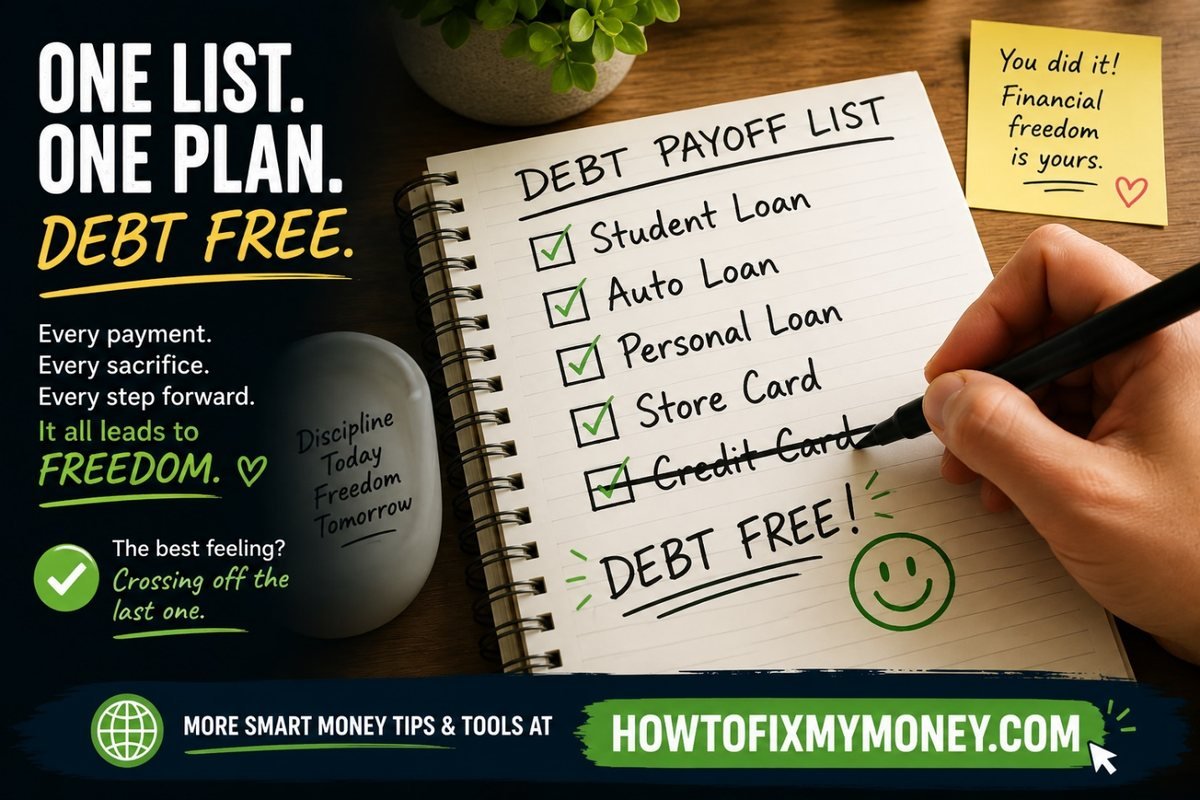
The final payment clears and the total reads zero. Almost everyone reports the same surprise here. It feels quieter than they expected.
There is relief, certainly. But the big emotional moment often does not arrive, because you have been paying this debt down for so long that the last payment is simply one more payment. That is normal, and it does not mean the achievement was smaller than you thought.
What Goes Wrong Here
The real risk in this stage is what comes next. You now have a significant amount of monthly money freed up and no plan for it. Left alone, that money reliably disappears into ordinary lifestyle spending within a few months, and the habits that got you out of debt fade along with it.
A surprising number of people end up back in debt within two years of clearing it, not because of a disaster, but because the freed-up payment was never redirected anywhere.
How to Get Through Stage Five
- Keep paying the same total amount, but send it to savings instead of debt.
- Build a full emergency fund first, because that is what stops the cycle restarting.
- Then split it between longer-term saving and a little more everyday comfort. You have earned some of both.
- Keep one habit from the payoff period. The weekly budget check is usually the one worth keeping.
How Long Do the Stages of Paying Off Debt Take?
There is no fixed answer, because it depends on the size of the debt and how much you can put toward it. But the proportions between the stages of paying off debt tend to hold, which is useful to know in advance.
| Stage | $5,000 Debt | $15,000 Debt | $40,000 Debt |
|---|---|---|---|
| 1. Awareness | 1 to 2 weeks | 2 to 4 weeks | 2 to 4 weeks |
| 2. Plan & prepare | 2 to 3 months | 3 to 4 months | 3 to 5 months |
| 3. Paydown | 3 to 5 months | 10 to 18 months | 2 to 3 years |
| 4. Momentum | 2 to 3 months | 4 to 6 months | 8 to 12 months |
| 5. Debt free | Final weeks | Final month | Final months |
Those are illustrations, not promises. To see your own figures, put your balances into the free Debt Payoff Calculator, which will give you a real date rather than an average.
Notice the pattern in that table. Of all the stages of paying off debt, stage three grows fastest as the debt gets larger. That is exactly why bigger debts feel disproportionately harder, and why people with larger balances need a plan for boredom more than a plan for interest rates.
What Every One of the Stages of Paying Off Debt Has in Common
- Progress is never even. Some months are large and some are almost nothing, and that is not a sign of failure.
- The method matters less than the consistency. A mediocre plan you finish beats a perfect plan you abandon.
- Emergencies happen during the process, not politely afterwards. Plan for them rather than hoping.
- Nobody feels motivated for two straight years. Systems and automation carry you through the stretches where motivation does not.
- Every stage has a different failure mode, so the thing that nearly derailed you in month two is not the thing that will threaten you in month twelve.
Where to Get Free Help
If you get stuck at any point, free and reliable information exists and you never need to pay for it.
- MyMoney.gov offers free budgeting tools and money basics from the U.S. government.
- The Federal Trade Commission explains your options for getting out of debt and how to recognize a scam.
- The Consumer Financial Protection Bureau covers credit reports and scores, which matter more as you rebuild in stage five.
Non-profit credit counseling agencies also offer free budget sessions. A legitimate one will never charge you before doing any work, and will never promise to make your debt disappear.
Frequently Asked Questions
What are the 5 stages of paying off debt?
Awareness, plan and prepare, paydown, momentum, and debt free. Or in plain terms: the reckoning, the sprint, the long middle, the turn, and the finish. Each one has a different feel and a different failure mode, and knowing which stage you are in tells you what to watch out for.
Which of the stages of paying off debt is hardest?
Stage three, the long middle, by a wide margin. The early wins have stopped and the finish is not yet visible, so there is no natural feedback. This is where most plans are abandoned.
Why do I feel worse in the middle than at the start?
Because motivation in stage two came from quick results, and stage three does not produce quick results. Nothing has gone wrong. This is the normal shape of the process.
Should I stop paying extra if money gets tight?
Yes, temporarily. Drop back to minimum payments, protect your essential bills, and restart the extra payment when things stabilize. Pausing is not quitting, and it is far better than missing a payment.
What if I slip and use a credit card again?
Add the amount to the plan and carry on. One slip does not undo your progress. What undoes progress is deciding the whole plan is ruined and stopping altogether.
Is it worth saving while paying off debt?
A small starter buffer is worth having, because it stops surprise costs going back onto the card. Beyond that, most of your spare money is usually better going to the debt while interest rates are high.
How do I stay motivated for two years?
You do not, and nobody does. Automate the payment so it does not depend on how you feel, track something that visibly moves, and give yourself small planned breaks. Systems beat willpower over long periods.
Do the stages of paying off debt change if I use the avalanche method?
The shape stays the same, but stage three usually arrives sooner and lasts longer, because the avalanche often starts with a large high-interest balance rather than a quick win. That is worth knowing before you choose.
Final Thoughts
The stages of paying off debt are not one long push. They are a reckoning, a sprint, a long flat middle, a turn, and a quiet finish.
If you know that in advance, stage three stops feeling like failure and starts feeling like the part of the map you were told about. That single piece of knowledge is the difference between the people who finish and the people who do not.
Wherever you are in the process right now, put your numbers into the Debt Payoff Calculator to see your real timeline, or browse more guides in our Debt Relief section.