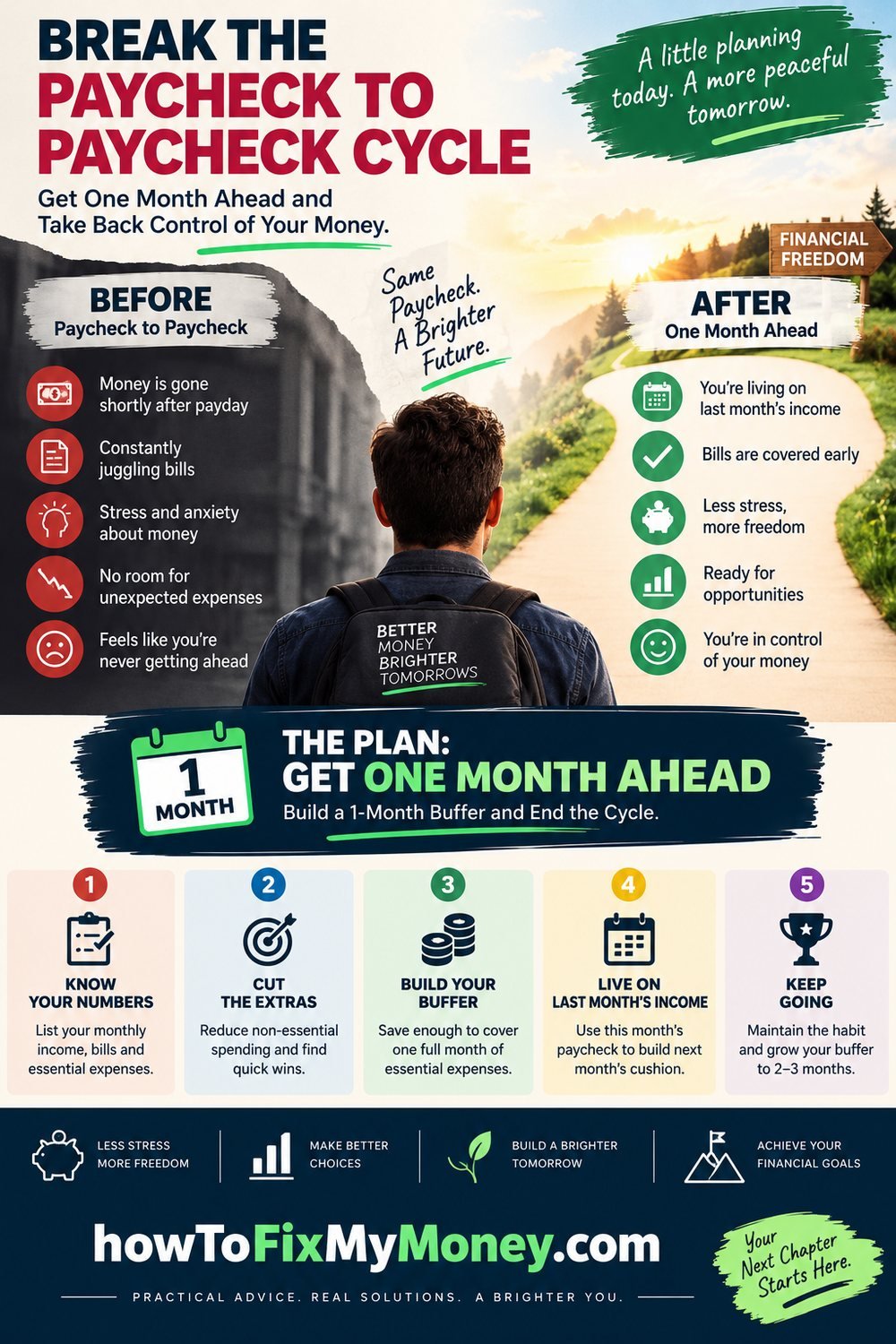
To break the paycheck to paycheck cycle, you have to stop treating it as an income problem. It’s a timing problem first, and that distinction is the reason most advice on this topic goes nowhere.
Here’s what’s actually happening. Your money arrives on the 1st and the 15th. Your bills land on the 3rd, the 8th, the 12th, the 20th, the 28th. So, you’re always spending money that only just showed up, which means there’s never a gap between earning and spending where a buffer could sit.
Fix the timing and the same income suddenly works differently. That is the whole idea behind this guide to break the paycheck to paycheck cycle, and it’s why the plan below can work even when you genuinely cannot earn another dollar this month.
Why It Is So Hard to Break the Paycheck to Paycheck Cycle
Three things keep the cycle running, and none of them are about being bad with money.
Your Bills Do Not Line Up with Your Pay
Most people have bills scattered across the whole month while pay arrives once or twice. So, one paycheck carries four bills and the next carries one, and the tight weeks feel like a personal failing rather than a calendar accident.
There Is No Buffer, So Every Surprise Goes on a Card
Without a small cushion, a dentist visit or a car repair has nowhere to go except credit. Then the minimum payment on that card becomes another bill next month, and the gap gets slightly smaller again.
Every Dollar Is Already Spoken for Before It Lands
When your income is fully committed the moment it arrives, you never get to make a decision about it. You’re just processing. That’s the part that wears people down, and it’s why this feels so much heavier than the numbers alone would suggest.
None of that is a character problem. It’s a structure problem, and structures can be changed.
The Real Goal When You Break the Paycheck to Paycheck Cycle
Most articles tell you the goal is a bigger income or a six-month emergency fund. Both are good, and both are a long way off if you’re tight right now.
The actual goal is much smaller and much closer: get one month ahead.
That means the money you earn in September pays October’s bills. You’re not earning more. You’re just spending money that’s already been sitting in your account for a few weeks, so nothing is ever urgent.
Once you’re one month ahead, a late paycheck stops being a crisis. An unexpected bill becomes annoying instead of frightening. And for most households that one change does more for daily stress than a small pay rise would.
| Living Paycheck to Paycheck | One Month Ahead |
|---|---|
| Bills paid from money that just arrived | Bills paid from money earned last month |
| A late paycheck causes real problems | A late paycheck is barely noticed |
| Surprise costs go on a credit card | Surprise costs come from the buffer |
| You check your balance constantly | You check it once a week |
| Every decision feels urgent | You have time to think |
Step 1: Know Your Numbers
Before anything else, you need one figure: what a bare month actually costs you. Not what you’d like it to cost. What it costs.
- Write down every fixed bill with its due date. Rent, utilities, phone, insurance, minimum debt payments.
- Add your real food and transport spending. Check your last two months rather than guessing, because guessing runs low every time.
- Add a line for the things that turn up a few times a year. Car registration, school costs, a birthday.
- Total it. That number is your bare month.
Now compare it to your monthly take-home pay. The gap between those two figures is what you’re working with, and it tells you which of two situations you’re in.
If your income is above your bare month, you have a timing problem and this plan will work. If your income is below it, you have a shortfall, and cutting costs or raising income has to come before anything else.
If the second one is you and bills are already slipping, start with our guide for when you are behind on every bill. It covers which bills to protect and in what order, which matters more than budgeting when you’re behind.
Align Your Bills with Your Paycheck First
Before you move on to step two, do this one thing. It’s free, it takes about an hour, and almost nobody mentions it.
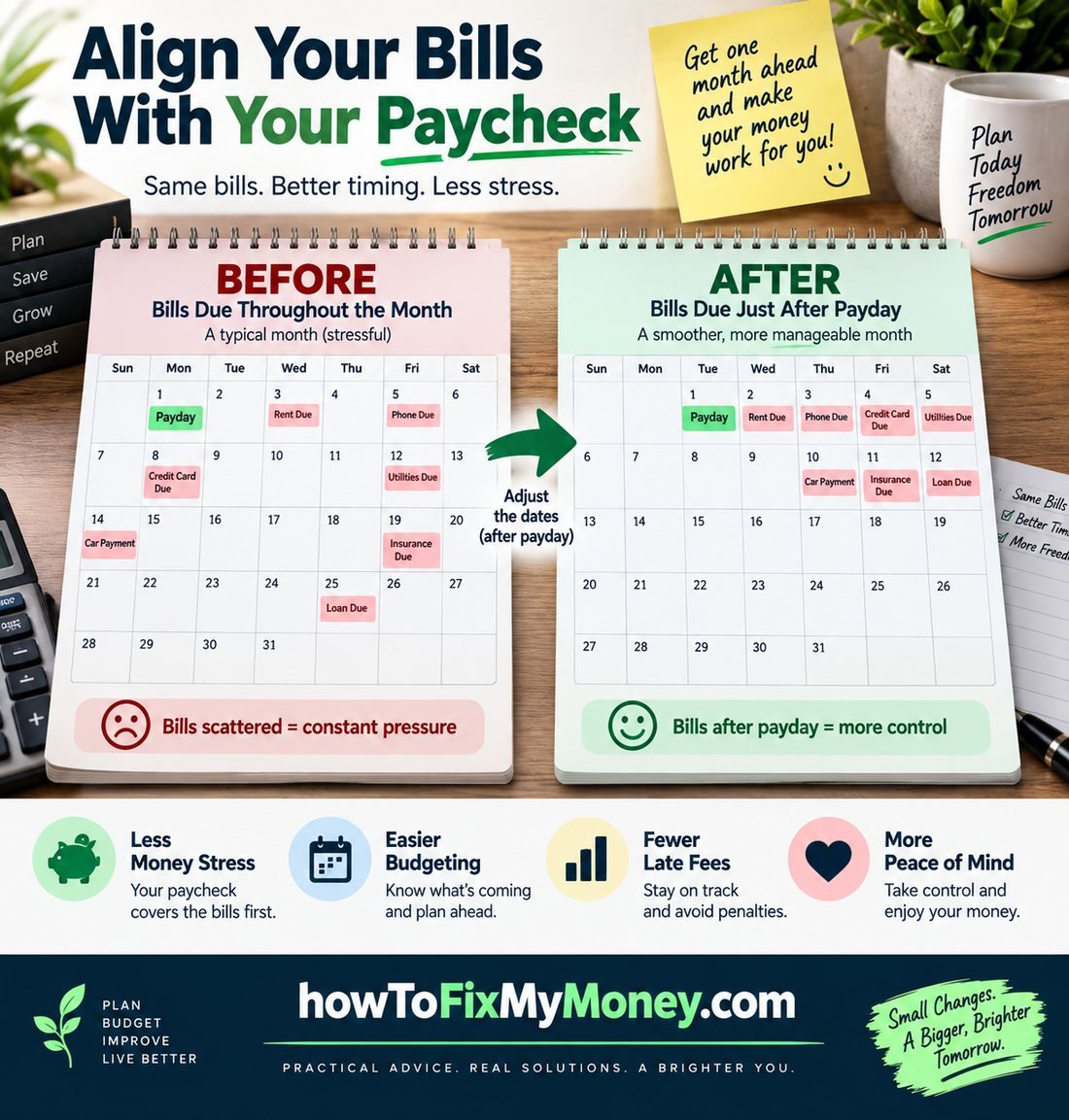
Call each company and ask to change your due date. Most utilities, phone providers, insurers, and credit card issuers will do it, and plenty let you do it in the app without speaking to anyone.
What you’re aiming for is simple. Every bill lands two or three days after a paycheck, not two or three days before the next one.
| Bill | Before | After |
|---|---|---|
| Rent | 1st | 1st (leave it) |
| Electricity | 28th | 5th |
| Phone | 26th | 6th |
| Car insurance | 24th | 18th |
| Credit card | 30th | 19th |
| Result | Everything due before payday | Everything due just after payday |
The money is identical. The stress is not. Most people find one or two genuinely tight weeks a month simply disappear once the calendar is fixed.
Do this before you try to save anything. Every step that follows gets easier once your bills stop arriving at the wrong moment.
Step 2: Cut the Extras
When money is tight the instinct is to cancel the small things. Coffee, a takeout, a streaming service. Those add up slowly and they cost you something every time you say no.
Fixed bills are better targets. One phone call, and the saving repeats every month for years without you thinking about it again.
- Phone plan. Check what data you actually use, then ask what plan fits it.
- Internet. Ask what a new customer would pay, and ask them to match it.
- Insurance. Get three quotes before your renewal rather than after.
- Subscriptions. Go through three months of statements line by line. Everyone finds something.
- Bank fees. Many accounts waive the monthly fee on request, or there’s a free account nobody told you about.
Our full guide on how to cut $300 a month without touching your rent walks through each of these with typical savings and how long each one takes.
Step 3: Build Your Buffer

Not three months of expenses. Not even one, yet. Somewhere between two and five hundred dollars, sitting in a separate account you don’t carry a card for.
This feels too small to bother with. It isn’t. A few hundred dollars covers the overwhelming majority of the surprises that currently go straight onto a credit card, and stopping that one leak is what lets everything else start working.
- Keep it in a separate account so it doesn’t blend into your spending money.
- Don’t invest it. You need it the same day you need it.
- Use it only for genuine surprises, not for things you could have seen coming.
- Rebuild it immediately after you use it, before doing anything else.
Where does it come from when there’s nothing spare? Usually from selling one thing you own and don’t use, or from a month of the savings you found in step two. It doesn’t have to arrive all at once.
Step 4: Live on Last Month’s Income
Now the actual mechanism, and the step that finally lets you break the paycheck to paycheck cycle. You’re going to build one full month of expenses and then stop touching it.
You don’t do this in one go. You do it a slice at a time.
- Take whatever you freed up in the bill dates and step two, plus anything else you can add.
- Move it to a separate account the day after payday, before you see it.
- Keep going until that account holds one bare month of expenses.
- Then move the whole amount into checking at the start of a month, and pay that month’s bills from it.
- From then on, this month’s income refills the account for next month.
That final step is the moment you break the paycheck to paycheck cycle for good. Your income stops being the money you’re currently spending and becomes the money you’ll spend next month.
How Long This Takes
Depends entirely on how much you can set aside. Here’s the rough arithmetic on a bare month of $2,000.
| You Set Aside | Time to One Month Ahead | Realistic For |
|---|---|---|
| $500 a month | About 4 months | Freed up a lot in the earlier steps |
| $350 a month | About 6 months | A solid, common outcome |
| $200 a month | About 10 months | Tight budgets |
| $100 a month | About 20 months | Very tight, but it still works |
Even the bottom row gets there. Twenty months feels long, but you’d be twenty months further along than if you’d never started, and the buffer grows the whole way.
Step 5: Keep Going After You Break the Paycheck to Paycheck Cycle
Getting a month ahead is the hard part. Once you break the paycheck to paycheck cycle, staying out of it is mostly about not undoing your own work.
- Leave the automatic transfer running. It refills next month’s money without you having to decide anything.
- When your income rises, don’t raise your spending to match straight away. Give the increase a job first.
- Check in once a month, not once a day.
- If you dip into the buffer, rebuild it before anything else. Most people use theirs two or three times along the way, and that’s the buffer working rather than the plan failing.
After two or three months of living this way, it stops feeling like a system and starts feeling normal. That’s the point where it sticks.
What to Do If Your Income Is Irregular
Shift work, gig work, commission, self-employment. The plan still works, with one change.
Budget on your lowest recent month rather than your average. Cover your essentials and minimum payments from that baseline, and treat everything above it as buffer money.
- Look back at the last six months and find the worst one. That’s your planning number.
- In good months, the extra goes to the buffer account, not into spending.
- Never let a good month set your new normal. That’s the trap that keeps irregular earners stuck.
- Once you’re a month ahead, irregular income matters far less, because you’re spending money that already arrived.
Irregular earners often find it easier to break the paycheck to paycheck cycle than steady earners do, precisely because the unevenness is the problem and a buffer smooths it out.
What Stops People Who Try to Break the Paycheck to Paycheck Cycle
- Starting with an emergency fund target that’s far too big. Three to six months is the long-term goal, not the first step.
- Skipping the bill dates because it sounds too small to matter. It’s usually the highest-value hour in the whole plan.
- Spending the buffer on something predictable. A buffer that pays for Christmas isn’t a buffer.
- Treating one good month as the new baseline and raising spending to match.
- Canceling every small pleasure at once. Plans built on misery don’t survive past week six.
- Adding new debt while building the buffer. The new minimum payment cancels out the progress.
That last one matters most. If debt payments are eating your income, the buffer will always feel out of reach. Our comparison of the debt snowball and avalanche methods explains how to attack it, and the free Debt Payoff Calculator shows how long yours would take to clear.
Where to Get Free Help
You never need to pay anyone for solid information about this. Several government sources cover it well.
- MyMoney.gov has free budgeting worksheets and money basics from the U.S. government.
- The Federal Trade Commission publishes plain-English guidance on building a budget and sticking to it.
- USA.gov links to government help with debt and to benefits you may qualify for but aren’t claiming.
Non-profit credit counseling agencies also offer free budget sessions. A legitimate one won’t charge you before doing any work, and won’t promise to make your debt disappear.
Frequently Asked Questions
How long does it take to break the paycheck to paycheck cycle?
Usually four to ten months, depending on how much you can set aside each month. Fixing your bill dates helps within weeks, but building a full month ahead takes longer. Very tight budgets can take a year and a half and still get there.
Can you break the paycheck to paycheck cycle on a low income?
Yes, as long as your income covers your bare month. It takes longer on a low income, but the method is identical. If your income does not cover your essentials, the first job is closing that gap rather than building a buffer.
How much money do I need to stop living paycheck to paycheck?
One month of bare expenses in the bank, held and not spent. For many households that’s somewhere between $1,500 and $3,000. Start with a few hundred as a buffer, then build toward the full month.
Should I pay off debt or build a buffer first?
Build a small buffer of a few hundred dollars first, then focus on debt. Without a buffer, the next surprise goes on a card and the debt grows back faster than you’re clearing it.
Does changing my bill due dates hurt my credit score?
No. Changing a due date has no effect on your credit score. Missing a payment does, which is exactly what better-timed due dates help you avoid.
What if I get paid weekly instead of monthly?
The same plan works. Aim each bill for a few days after one of your paychecks, and build your buffer weekly instead of monthly. Weekly pay actually makes the timing easier to arrange.
Is a budgeting app worth it?
Only if you’ll open it. Plenty of people do better with one sheet of paper listing bills and dates. Do not pay for an app while you’re trying to free up money, because a paid subscription is the opposite of what you need right now.
What if an emergency wipes out my buffer?
Rebuild it before you do anything else, including extra debt payments. That’s the buffer doing its job rather than the plan failing. Most people use theirs two or three times on the way to being a month ahead.
Final Thoughts
You don’t need a bigger income to break the paycheck to paycheck cycle. You need a gap between when money arrives and when it leaves, and that gap can be built out of a few phone calls and a small amount set aside each month.
Start with the bill dates this week. It costs nothing, takes about an hour, and it is the step people always skip when they try to break the paycheck to paycheck cycle. Then build the small buffer, then work toward the full month.
Nobody gets there in one jump. But the month you first pay October’s bills with September’s money, the whole thing feels different, and it stays different.
Once you’re a month ahead and ready to clear what you owe, our 12 months to debt free plan gives you the next step, or browse more guides in our Money Fixes section.