You have already decided this year costs less. The hard part starts now, because cutting Christmas badly ruins the day and cutting it well barely shows.
Most households that set out to cut Christmas spending get the order wrong. They cancel the small visible things first, the decorations and the cards, feel the loss immediately, and never touch the line that holds most of the money.
This article ranks every way to cut Christmas spending by one measure: dollars saved against the number of people who notice. Work down the list and stop the moment you hit your number.
Before You Cut Christmas Spending, Find Out Where the Money Actually Sits

The National Retail Federation surveys 8,247 adults every October. For the 2025 season it put planned holiday spending at $890.49 a person, split two ways: $627.93 on gifts for family and friends, and $262.56 on food, candy, decorations, and greeting cards.
Gifts take 70.5% of the total. Everything else takes 29.5%.
That ratio decides your cut order. A household setting out to cut Christmas spending usually attacks the 29.5% first, because decorations and cards feel optional in a way presents do not. Then they wonder why the total barely moved.
NRF does not break the $262.56 into separate lines, so treat the dollar ranges below as typical household figures rather than survey results. The ranking holds either way.
The One Rule That Decides Where to Cut Christmas Spending First
Rank each line on two things: how much it saves, and how many people would notice it gone.
Gifts for adults who already have what they need score high on savings and near zero on notice. A seven-year-old’s main present scores the reverse. Everything else falls somewhere between.
That single comparison does more to cut Christmas spending than any list of frugal tips, and it explains why the eight cuts below sit in this order rather than some other one.
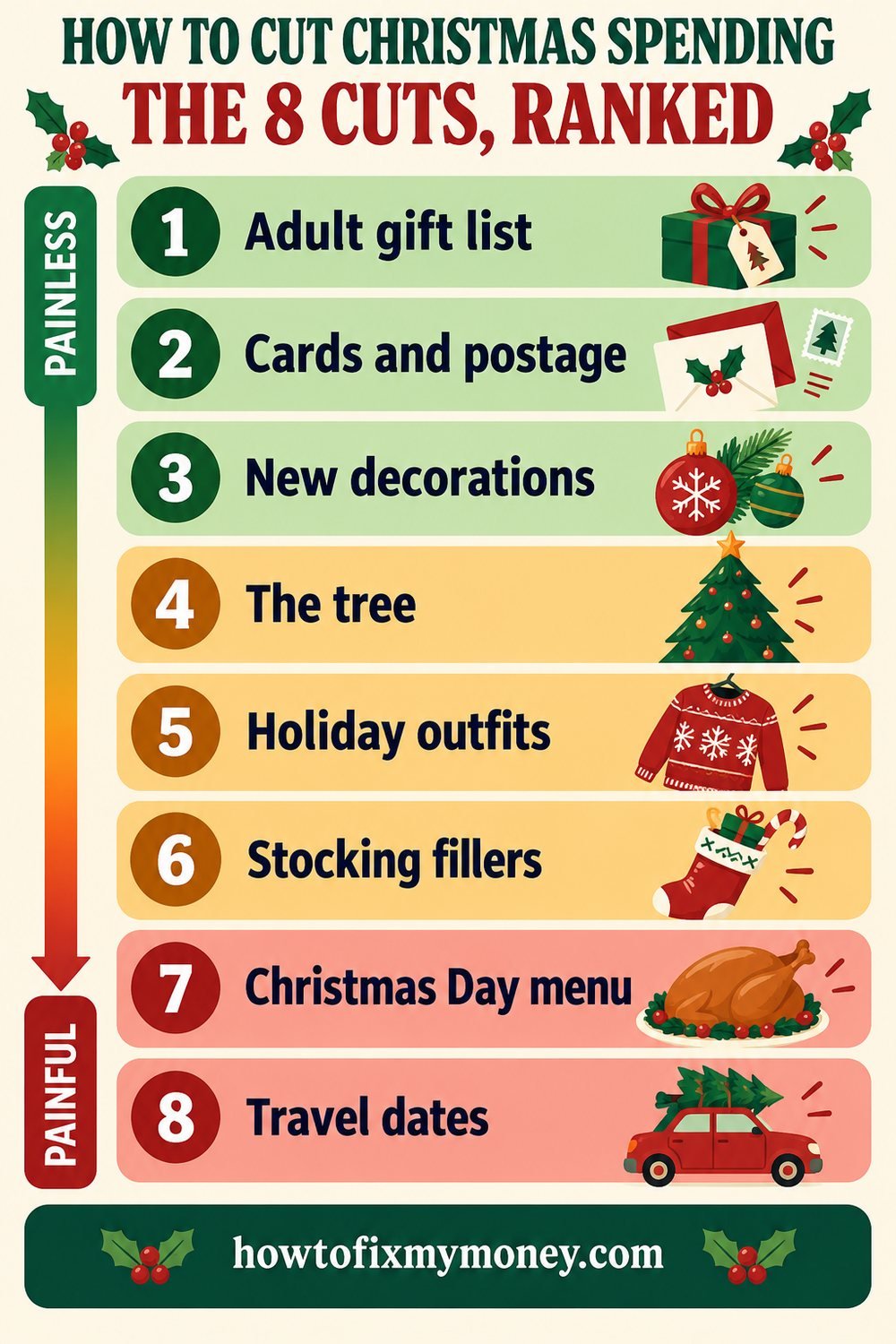
The Eight Ways to Cut Christmas Spending, Ranked From Painless to Painful
| # | The Cut | Typical Saving | Who Actually Notices |
|---|---|---|---|
| 1 | Trim the adult gift list | $150 to $300 | Almost nobody, and several people feel relieved |
| 2 | Cards and postage | $50 to $200 | A handful of older relatives, so call them instead |
| 3 | New decorations and ornaments | $40 to $120 | Nobody, once the boxes come down from the attic |
| 4 | The tree | $80 to $100 | Children, if you remove it entirely rather than downgrade it |
| 5 | Matching outfits and holiday clothes | $80 to $160 | Whoever planned the photo |
| 6 | Stocking fillers | $40 to $100 | Children, within about four minutes of opening |
| 7 | The Christmas Day menu | $40 to $80 | Everyone, if you cut the wrong dish |
| 8 | Travel dates | $100 to $400 | The people you travel to see |
Start at one and work down. Stop as soon as the budget balances, and leave everything below that point alone. The Christmas budget calculator shows the exact point it balances as you trim each line.
Cut 1: Trim the Adult Gift List Before You Touch Anything Else
One decision cuts Christmas spending further than the other seven combined.
Suggest drawing names, or a $20 cap, or kids only. In a family of eight adults, drawing names takes each person from seven gifts to one. At $25 a gift that saves $150 per household without a single person going without.
Send the message in October or early November. A proposal made early reads as organized. The same words on December 15th read as a family member in trouble, which is exactly why nobody says them and everyone keeps buying.
Four sentences cover it: we’re drawing names this year, the cap is $25, here is who you have, and the kids still get presents from everyone. Send that to the group chat and the largest line in your Christmas spending drops by two thirds before November starts.
Expect at least one relative to reply within the hour saying they had wanted to suggest the same thing. That reply arrives more often than it does not.
Cut 2: Cards and Postage, Which Cost More Than Anyone Expects
Forty cards at the current $0.78 Forever stamp costs $31.20 in postage before you buy a single card. Boxed cards push the total past $70. Individually chosen cards at $5 each take it past $200.
Cards stay the cheapest large win available when you cut Christmas spending. Keep five for the people who still display them, and text or call the rest. Few lines cut Christmas spending this fast for this little loss. Most recipients cannot tell you who sent them a card last year.
Cut 3: New Decorations, Which Nobody Remembers Buying
You already own decorations, which makes this the easiest way to cut Christmas spending on the whole list. Buy nothing new this year and the house looks the same as it did last December, because last December you also thought it looked fine.
If a room genuinely needs something, make it rather than buy it, and cut Christmas spending to nothing in this category. Paper chains and strung popcorn cost almost nothing and children remember making them far longer than they remember a store-bought garland.
Cut 4: Downgrade the Tree Rather Than Removing It
The tree looks like an obvious place to cut Christmas spending, so price it properly first. The American Christmas Tree Association put real trees at roughly $80 to over $100 in 2025, depending on size and type. Artificial trees run anywhere from $64 to several hundred, and most owners keep one for about ten years, which brings a $150 tree down to $15 a year.
So reuse the artificial tree you own, buy a smaller real one, or take a cut-your-own permit where your state offers them. Removing the tree altogether sits far below this on the list, because children notice an empty corner the moment they walk in, and no plan to cut Christmas spending should cost you that.
Cut 5: Skip the Matching Outfits
Clothing bought for one December cuts Christmas spending the moment you stop buying it. Matching pajamas photograph beautifully and cost $25 to $35 a person. A family of four spends $100 to $140 on clothing everyone outgrows before next December.
Take the photo in what people already own. The picture ages exactly as well, and you cut Christmas spending by $140 without losing anything you can name.
Cut 6: Halve the Stocking, and Fill It With Things You Use
Stockings turn into a pile of small plastic items that survive until roughly New Year, which makes them an easy place to cut Christmas spending. Cut the count in half and put in things the household buys anyway: socks, toothbrushes, the good chocolate, a comic.
Children open a stocking fast and judge it by volume rather than value, which works in your favor here.
Cut 7: Trim the Menu, Not the Meal
You can cut Christmas spending at the table without anyone putting their fork down. Most tables carry two or three dishes nobody asks for and one that defines the day. Cut the extras and keep the one.
Ask each person to name the single dish they would miss. The answers overlap more than you expect, and the list you end up cooking gets shorter and cheaper on its own.
Cut 8: Move the Travel Dates Instead of Canceling the Trip
Travel sits last because it carries the highest emotional cost of the eight. Missing a grandparent’s Christmas is not a budget decision you can undo next year.
Shift the dates instead, and cut Christmas spending without cutting the visit. Traveling on the 23rd or the 27th rather than the 24th routinely costs far less, and arriving a day late beats not arriving.
What It Looks Like to Cut Christmas Spending, in Running Totals
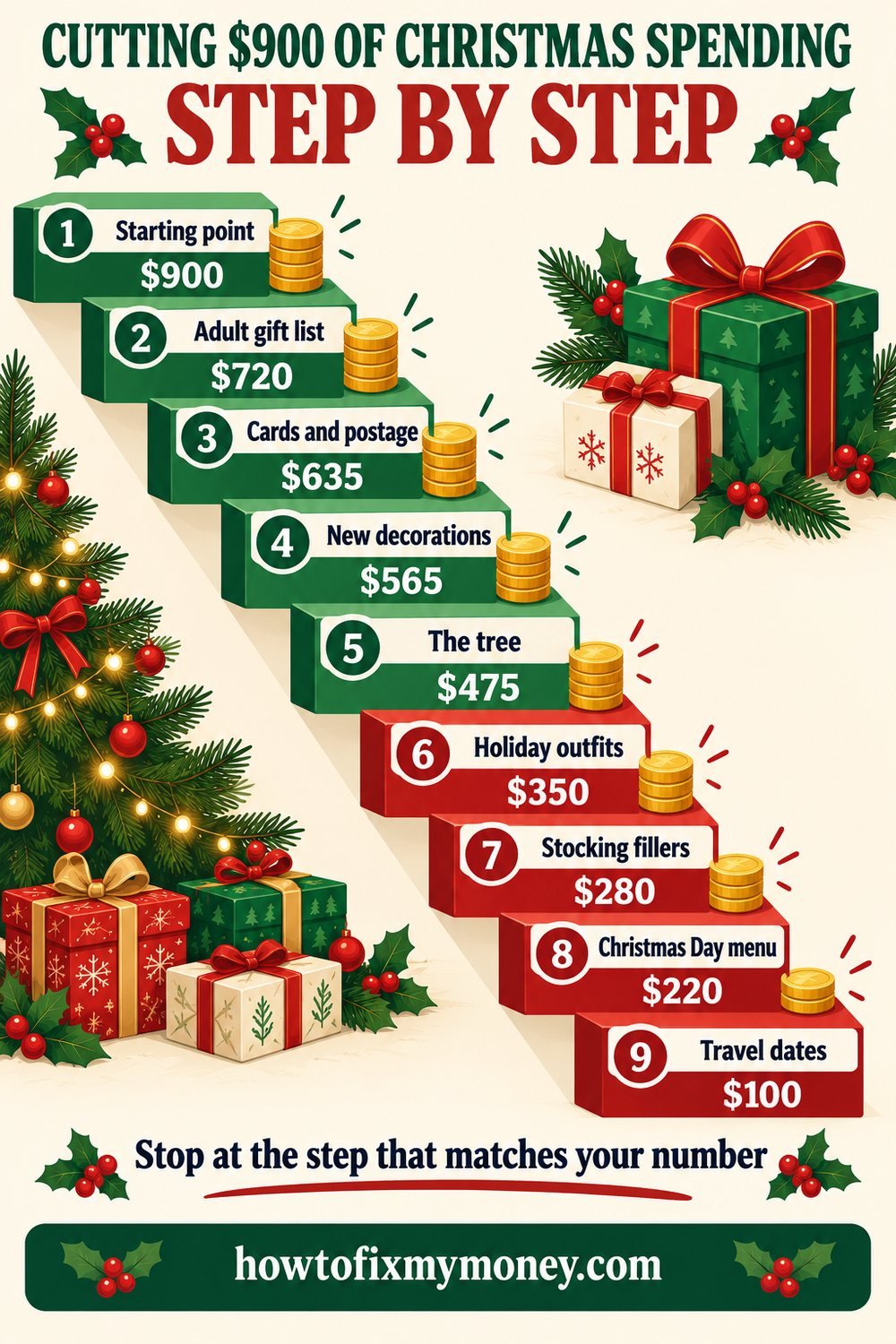
Here is the ladder applied to a household that planned on $900 and has to cut Christmas spending to a smaller number.
| After This Cut | Saves | Budget Now | Running Saving |
|---|---|---|---|
| Starting point | — | $900 | — |
| 1. Adult gift list | $180 | $720 | $180 |
| 2. Cards and postage | $85 | $635 | $265 |
| 3. New decorations | $70 | $565 | $335 |
| 4. The tree | $90 | $475 | $425 |
| 5. Holiday outfits | $125 | $350 | $550 |
| 6. Stocking fillers | $70 | $280 | $620 |
| 7. Christmas Day menu | $60 | $220 | $680 |
| 8. Travel dates | $120 | $100 | $800 |
Four cuts take $900 of Christmas spending down to $475 and nobody in the house notices any of them. Six cuts reach $280 and the only visible change sits in the stockings.
Find your number in the third column and stop there. Nothing obliges you to cut Christmas spending all the way to row eight.
Cut Christmas Spending on the Calendar Too, Not Just the Shopping List
Those eight cuts handle the shopping. They miss the other half of December, which arrives as a stream of small obligations nobody writes into a budget.
Count them for a normal household: a work Secret Santa, two teacher gifts, a school fair, a holiday concert ticket, a neighbor’s cookie exchange, a bottle for whoever hosts the family meal, a night out with friends, and a charity collection at the office. Each one costs between $10 and $40, and together they routinely run past $200.
They slip through because they arrive one at a time, each too small to question. Most households that try to cut Christmas spending fail on exactly this kind of money, not on the big decisions people agonize over in October.
Write the whole of December on one page in the first week of November. Every event, every obligation, every gift attached to each one. Then make three decisions about the list.
- Decline two events outright. Not the ones you want to attend. The two you accept out of habit and leave early from.
- Convert three gifts into something you make or bake. Teachers in particular receive a startling volume of candles, and a tin of something homemade lands better than the fourth one.
- Set one figure for the whole month’s events and carry cash to each. A number you can see in your hand stops the slow drift far better than a mental limit.
That page usually cuts Christmas spending further than rows three through six combined, and nobody at any of those events notices a thing.
The Three Things You Protect Until Everything Else Has Gone

You can cut Christmas spending right up to the point where the day stops feeling like Christmas. Three things sit above that line.
First, the one tradition your household names without thinking. The drive to see the lights, the film on Christmas Eve, the particular breakfast. Ask people what it is rather than guessing, because the answer surprises most parents and it usually costs very little.
Second, the food that defines the meal. Trim the supporting dishes as hard as you like and leave the center of the table alone.
Third, the gift someone actually asked for. One real present beats four substitutes, and substitutes cost more in total while satisfying nobody. If a child named one thing in October, buy that thing and cut elsewhere.
Where People Cut Christmas Spending and Regret It Within a Week
Nearly every household that cuts Christmas spending keeps one regret from it. These five come up most often.
- Replacing the asked-for gift with a cheaper version of the same thing. You spend 60% of the money and deliver 10% of the result, then buy the real one in January anyway.
- Cutting the tradition instead of the spending around it. The drive to see the lights costs gas. The gift shop on the way costs the rest, and only one of those two matters.
- Canceling travel to save $200 when the relationship on the other end has a limited number of Christmases left in it.
- Stripping the food so far that the meal feels thin. The day runs on about four hours of eating, and $40 saved there buys you a memory nobody wanted.
- Announcing every cut. Nobody needs a running commentary on the budget, and children who hear it tend to worry rather than adjust.
If the Number Still Does Not Work, Do Not Reach for Credit
Sometimes all eight cuts land and the total still sits above what you actually have. The temptation at that point runs toward a store card at the register or a buy now, pay later plan at checkout.
Price that decision first. The Federal Reserve’s G.19 release put the average rate on credit card accounts assessed interest at 22.36% in August 2026. Carrying $450 across the first half of next year costs roughly $29, and carrying it at minimum payments costs several times that.
Cut Christmas spending deeper instead, and put the difference where it goes furthest. A gift card to somewhere the person genuinely shops beats a bigger pile of things they did not choose, and the FTC’s guidance on gift card scams takes two minutes: buy from the store itself, check the packaging, keep the receipt and the card number.
If a card already carries last year’s holiday balance, read how to have a debt-free Christmas on a tight budget alongside this one. That article covers funding the number. This one covers shrinking it.
How to Tell People You Plan to Cut Christmas Spending Before They Work It Out
Most of the awkwardness around a decision to cut Christmas spending comes from silence rather than money.
Say it once, early, and frame the decision to cut Christmas spending as a plan instead of an apology. “We’re drawing names this year” lands completely differently from “we can’t really afford gifts.” Both sentences describe the same decision.
Give people an alternative in the same message. A $20 cap, a kids-only rule, everyone bringing a dish. A specific proposal gets agreement. A vague retreat gets questions.
And tell children what stays rather than what goes. “We’re doing the lights drive and the Christmas Eve film” gives them the shape of the day. A list of cancellations gives them something to worry about.
The fastest cut happens before the sales start. Decide how much Black Friday money you can safely spend now, and the weekend can’t quietly double your Christmas costs.
Questions People Actually Ask About How to Cut Christmas Spending
Where should I cut Christmas spending first?
The adult gift list, every time. It holds the largest share of the money and costs the least in disappointment, especially once you suggest drawing names or a spending cap. Decorations and cards feel easier to cut, but they sit inside the 29.5% rather than the 70.5%.
How much should a family spend on Christmas?
Whatever the household can pay in cash before December 25th. The national average runs at $890.49 a person, but that figure includes households earning several times the median, so treat it as information rather than a target. A $300 Christmas paid in cash beats a $900 one financed at 22%.
Is it rude to ask family to stop exchanging gifts?
No, and most families contain at least two people waiting for someone else to raise it. It also remains the single fastest way to cut Christmas spending, which is why it sits at number one. Propose a specific replacement rather than simply opting out: drawing names, a $20 limit, kids only, or everyone bringing food instead of presents.
What is the cheapest way to do Christmas with children?
Buy the one thing they named, cut the stocking in half, and spend the saved money on an experience rather than more objects. Children rank the day by what happened in it, so you can cut Christmas spending hard here as long as one named tradition survives.
Should I cancel Christmas travel to save money?
Move the dates before you cancel the trip. Departing on the 23rd or the 27th rather than Christmas Eve usually drops the cost substantially. Cancel only when the gap between those options stays unaffordable, because this is the one cut on the list you cannot repeat next year.
How do I stop overspending once I am in the store?
Shop from a written list with a dollar figure beside each name, and finish buying by the second week of December. Almost all overspending happens in the final seven days, when time runs out and paying more feels like the only fix available.
Are homemade gifts actually cheaper?
Only when you already own the materials or the skill. A craft project you start from scratch frequently costs more than a modest bought gift once you add supplies and three evenings. Baking, framed photographs, and a jar of something you already make well stay genuinely cheap.
When should I start cutting?
Early November, or as soon as you know the number. Cut Christmas spending before anyone has bought anything and the change costs you nothing to make. Cuts made in mid-December mean returning things, breaking arrangements, and explaining yourself, which is why most households leave it too late and give up.
Do I tell the children we are spending less?
Tell them what stays rather than what goes. Children take their reading of the situation from your tone, so “we’re doing the lights drive and the Christmas Eve film” gives them a shape for the day, while a list of cancellations gives them something to worry about. Older children can handle the real reason, and often handle it better than adults expect.
What do I do if I have already overspent?
Stop adding to the total today, return anything unopened inside the window, and pay the balance down fast rather than at the minimum. January hands you more ways to find money than any other month of the year.
The Version of Christmas That Survives Every Cut
Cut Christmas spending across eight categories and the day itself barely changes, which tells you something useful about where the money went in the first place.
People remember who sat at the table, the one thing they unwrapped and wanted, and whatever your household does that no other household does. They do not remember the card, the garland, or the third side dish.
Cut Christmas spending in that order and you reach January with the same day behind you and none of the bill in front of you.
Work out what you can genuinely pay in cash with the free Debt Payoff Calculator, find the monthly room with how to cut $300 a month, or browse more guides in our Money Fixes section.

Bilal founded HowToFixMyMoney.com in 2026 to make US personal finance decisions easier to work through without a financial background. Every figure published here traces back to a primary source — the Bureau of Labor Statistics, the Federal Reserve, the IRS, the CFPB — and each article links to the data it relies on. He is not a licensed financial advisor, and nothing on this site is personalized advice.