You have a small Christmas budget of $100 and nine people who expect a gift from it. That is roughly eleven dollars each, which feels like an insult until you look at what the alternatives actually cost.
A small Christmas budget is less unusual than it feels. YouGov surveyed US gift givers and found they spent $368 on average, with 35% spending under $200. More than a third of the country is already working in the same territory you are, quietly, without announcing it.
This article will not ask you to cut the number. You have already set your small Christmas budget. It is about dividing it, which is a different problem with a mathematical answer most people never work out. To test a split as you read, add each name to our Christmas budget calculator and it shows the average per person.
On a Small Christmas Budget, the Number of Names Beats the Price of Any Gift
Start here, because this one piece of arithmetic does more for a small Christmas budget than every bargain you will find between now and Christmas.
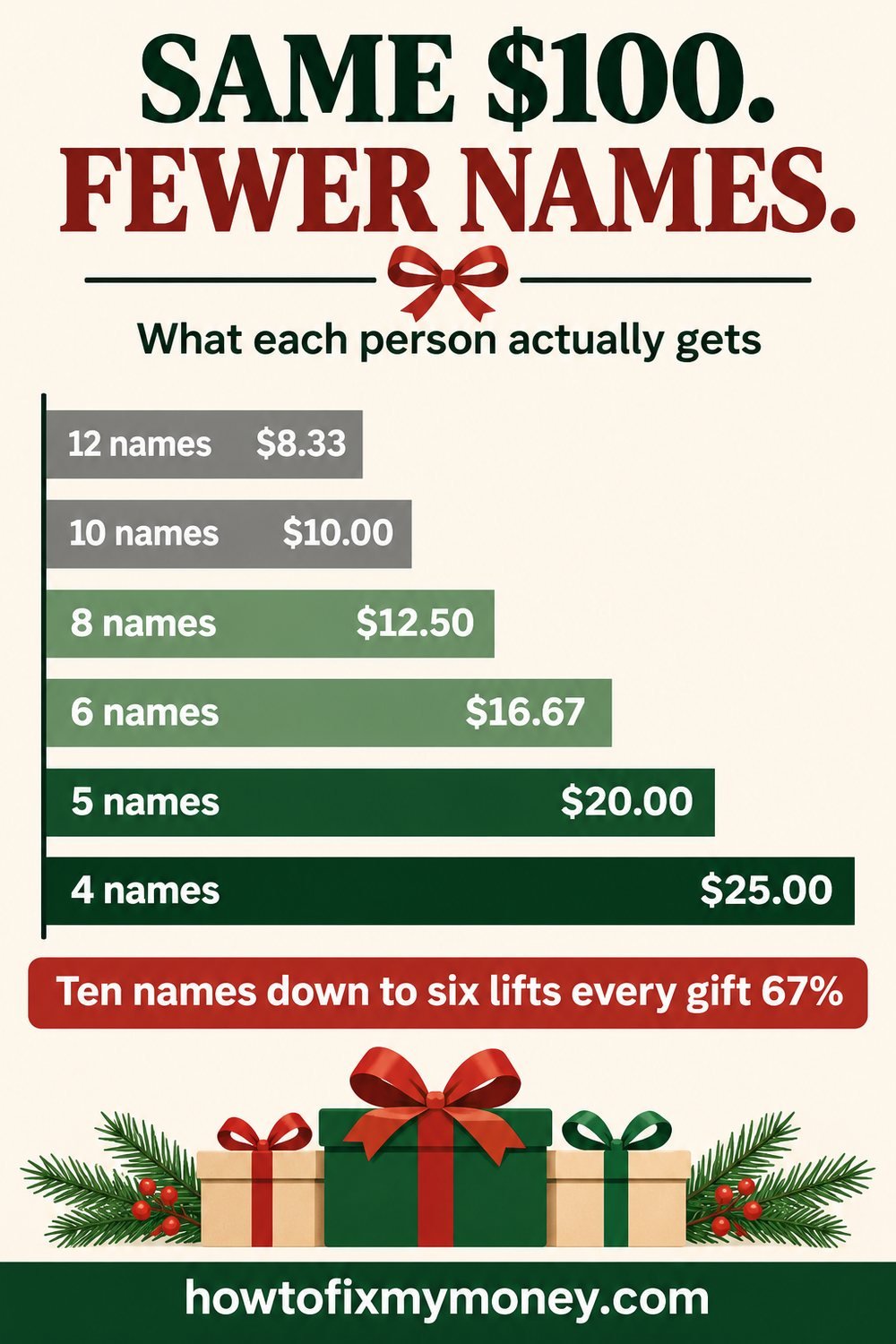
A small Christmas budget has two levers: how much you spend, and how many people you spend it across. The second one is far more powerful, and almost nobody treats it that way.
| Names on Your List | Each Person Gets | Change | What That Buys |
|---|---|---|---|
| 12 people | $8.33 | Starting point | A token |
| 10 people | $10.00 | +20% each | A small token |
| 8 people | $12.50 | +25% each | Something chosen |
| 6 people | $16.67 | +33% each | A real gift |
| 5 people | $20.00 | +20% each | A good gift |
| 4 people | $25.00 | +25% each | A memorable one |
Moving from ten names to six raises every single gift by 67%, on exactly the same small Christmas budget.
Now compare that to shopping harder. Adobe tracks the deepest discount of the entire season at 30% for electronics and 18% for furniture. The very best discount available anywhere, on the best category, cannot match what removing four names from your list does for free.
That is the whole argument for treating the size of your list as a decision rather than an inheritance, because on a small Christmas budget the denominator does the heavy lifting. Most lists grow by accretion, one name at a time over years, and nobody ever reviews them.
Deciding who comes off the list is its own conversation, and we covered how to have it without hurting anyone in our guide to a debt-free Christmas on a tight budget. The rest of this article assumes you have settled the names and now need to divide the money.
What $100 Looks Like Split Flat, and Why Flat Fails
The instinct with a small Christmas budget is to divide evenly. Nine people, $100, eleven dollars each, everybody equal and nobody offended.
Flat division fails a small Christmas budget for a reason that has nothing to do with fairness. At eleven dollars, every gift lands in the same category: slightly too cheap to be meaningful, slightly too expensive to be a stocking filler. You spend the entire budget and produce nine forgettable objects.
Worse, flat division ignores that the people on your list do not have equal expectations. A seven-year-old and a work colleague both receiving an eleven-dollar gift produces one disappointed child and one baffled adult.
A small Christmas budget works when it is deliberately unequal. Concentrate it where it registers, and reduce it to nearly nothing where nobody is counting.
The Tier System That Makes a Small Christmas Budget Work
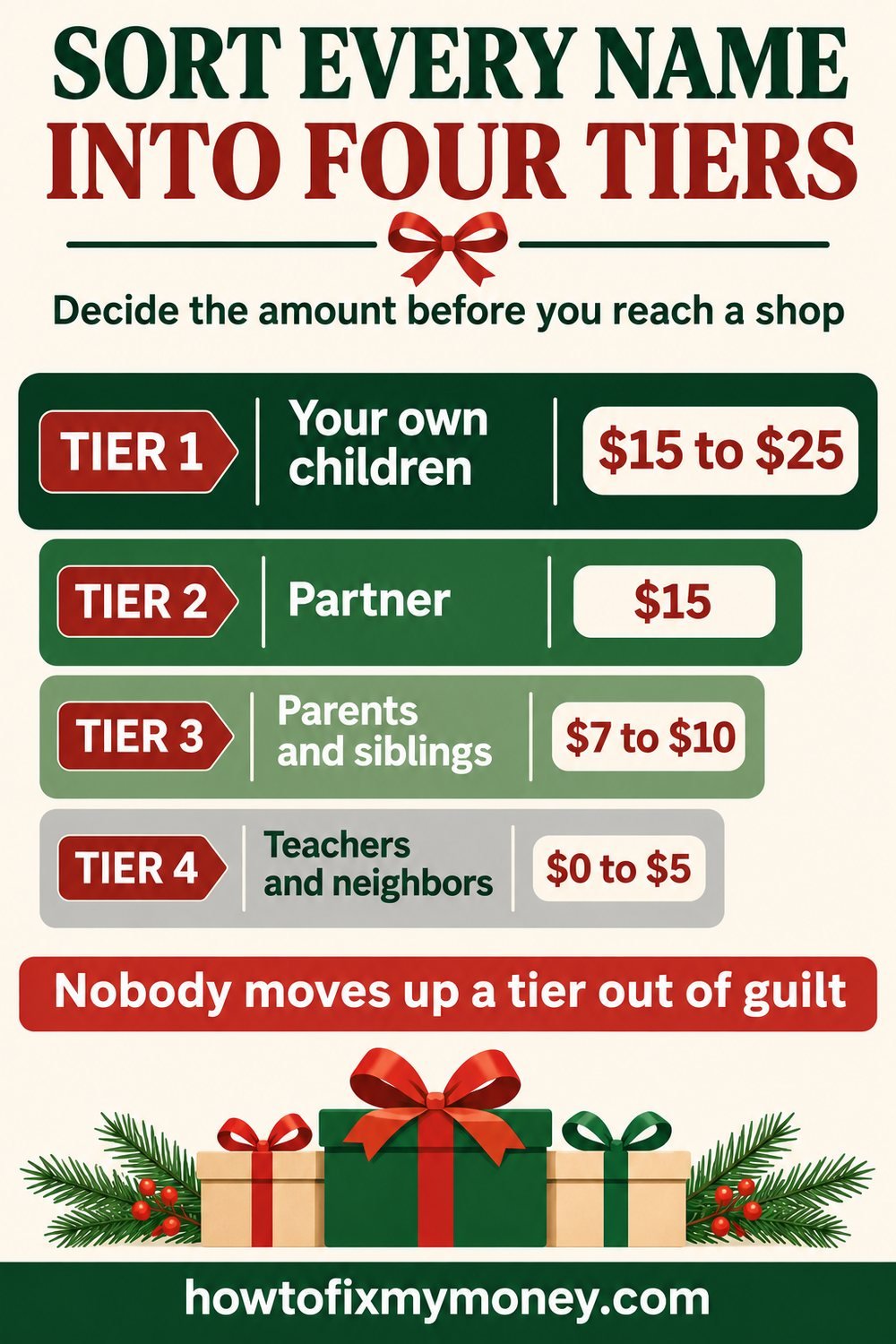
Sort every name into one of four tiers before your small Christmas budget leaves your account. The tier decides the amount, which stops you deciding it in a shop with a basket in your hand.
| Tier | Who Belongs Here | Share of Budget | Typical Amount |
|---|---|---|---|
| Tier 1 | Children in your own household | 40% to 50% | $15 to $25 each |
| Tier 2 | Partner, or one person who matters most | 15% | $15 |
| Tier 3 | Parents, siblings, closest family | 20% | $7 to $10 each |
| Tier 4 | Teachers, neighbors, colleagues, hosts | 10% or $0 | $0 to $5 each |
The percentages are a starting point rather than a rule. A household with four children shifts almost everything into tier 1 and gives tier 3 a single family gift. A household with no children can afford to flatten the whole thing considerably.
A Worked Split for Nine People on $100

Here is a small Christmas budget worked through in full, for a fairly typical list: two children, a partner, two parents, two siblings, a teacher and a neighbor.
| Who | How Many | Each | Subtotal |
|---|---|---|---|
| Children | 2 | $20.00 | $40.00 |
| Partner | 1 | $15.00 | $15.00 |
| Parents | 2 | $10.00 | $20.00 |
| Siblings | 2 | $7.50 | $15.00 |
| Teacher and neighbor | 2 | $5.00 | $10.00 |
| Total | 9 people | $100.00 |
Split flat, each of those nine people receives $11.11. Under the tiers, the children receive $20, which is 1.8 times what the flat version gives them, and the outer ring receives $5, which is what that relationship actually calls for.
The small Christmas budget did not change. Only the distribution did, and the distribution is the part you control once the number is fixed.
Write your own version on paper before you buy anything. A small Christmas budget that exists only in your head gets spent in the first shop you walk into.
The Same $100 Across a Different Family Shape
That first split assumes a partner and two children. Plenty of households look nothing like it, so here is the same small Christmas budget divided for a single parent with three children, two parents of their own, and one close friend.
| Who | How Many | Each | Subtotal |
|---|---|---|---|
| Children | 3 | $21.00 | $63.00 |
| Own parents, one joint gift | 1 gift | $22.00 | $22.00 |
| Close friend | 1 | $10.00 | $10.00 |
| Reserve for the late addition | 1 | $5.00 | $5.00 |
| Total | 6 gifts | $100.00 |
Three things changed. The children absorb 63% of the budget rather than 40%, because with no partner in tier 2 that money has somewhere better to go. The two parents receive one joint gift rather than two separate ones, which buys something considerably better for the same money. And a reserve sits in the plan from the start.
Build your own version the same way. The tiers stay fixed, the percentages move to match who is actually in your house, and the total lands on your small Christmas budget exactly.
Buy in Tier Order, Not in the Order You Find Things
Sequence matters more than people expect, because on a small Christmas budget whatever you buy first sets the standard you unconsciously match afterward.
Buy tier 1 first, while the whole budget is still intact and you can judge what $20 genuinely buys. Buy tier 4 last, by which point you know precisely what remains and will not overspend on a neighbor out of momentum.
Most people do this backwards. They buy the easy, cheap, outer-ring gifts first because those decisions feel simple, spend more than planned on each because the budget still looks healthy, then reach the children with a quarter of the money gone on people who would not have noticed.
One more sequencing rule. Buy nothing in the first shop you enter on the first day you go out, because the first item always sets an anchor you spend the rest of the day comparing against.
One Group Gift Beats Four Small Ones Every Time
When a whole household sits in tier 3, a small Christmas budget stretches much further if you stop buying individually. Four people at $10 each produces $40 of forgettable items. The same $40 spent once, on something the household uses together, arrives as a real present.
Board games, a decent food hamper you assemble yourself, a film-night bundle, something for the kitchen. The category matters less than the arithmetic: one $40 gift reads as generous, four $10 gifts read as an obligation discharged.
The same logic rescues extended family entirely. A single gift addressed to a household of five removes five names from your list in one move, which, by the table above, raises everything else considerably.
What Each Tier Genuinely Buys
Dollar amounts mean nothing without knowing what they actually cover, so here is the honest version at each level.
- Around $5: consumables and small practical items. Good chocolate, a nice candle, seeds, a proper pair of socks. These work precisely because nobody expects more, and they fail the moment they pretend to be a bigger gift.
- Around $10: one decent thing rather than three cheap things. A single well-chosen item beats a bundle at this level every time, because the bundle advertises its own budget.
- Around $15 to $20: this is where a gift stops apologizing. A book somebody actually wants, a game, a quality version of something ordinary they already use.
- $0: time, skill or a handwritten note. Not a consolation prize. For a neighbor, a teacher or a colleague, a specific written thank-you frequently outlasts anything you could buy at $5.
- Pooled with others: for a parent or grandparent, joining with siblings turns four small budgets into one real gift, and nobody involved spends more.
Notice what is missing from that list. No tier rewards buying more items, and chasing quantity remains the single most common mistake on a small Christmas budget.
Three Things That Quietly Drain a Small Christmas Budget
A small Christmas budget rarely dies on gifts. It dies on everything attached to them.
- Wrapping, cards and postage. These scale with the number of recipients rather than the value of the gifts, so a long list costs more to wrap than a short list costs to fill. Plain paper and a good ribbon looks better than cheap printed paper anyway.
- Shipping charges on small orders. Four separate online orders at $6 shipping each removes a quarter of a $100 budget before a single gift arrives. Consolidate orders or buy locally.
- The late addition. Somebody appears who was not on the list, and the gift bought in the last week always costs more than the ones you planned. Keep two $5 items in reserve from the start and the problem disappears.
Plan for those three at the beginning rather than absorbing them at the end. On a small Christmas budget of $100 they routinely take $15 to $20 that nobody allocated.
What the Outer Ring of Your Small Christmas Budget Actually Expects
Tier 4 causes more anxiety on a small Christmas budget than every other tier combined, and almost always without cause.
A teacher receiving twenty-five small gifts does not need a twenty-sixth. A colleague in an office gift exchange has already agreed a price cap. A neighbor who took in your parcels wanted the favor returned, not purchased.
So for this tier, pick one approach and apply it to everyone in it. Either a single consumable at around $5, or a written note, or nothing at all with a word said in person. Consistency protects you from the comparison that makes people uncomfortable.
If a workplace exchange sets a $20 cap and your tier 4 allowance is $5, say so before the draw rather than after. Groups adjust caps far more readily than people expect, and somebody else in that room is relieved you raised it.
Check the number before you divide it
Put your real income and bills into the free Budget Planner and confirm what this season can genuinely support. A tier plan built on a figure you cannot actually spare fails in the second week of December.
If the Tiers Still Do Not Fit
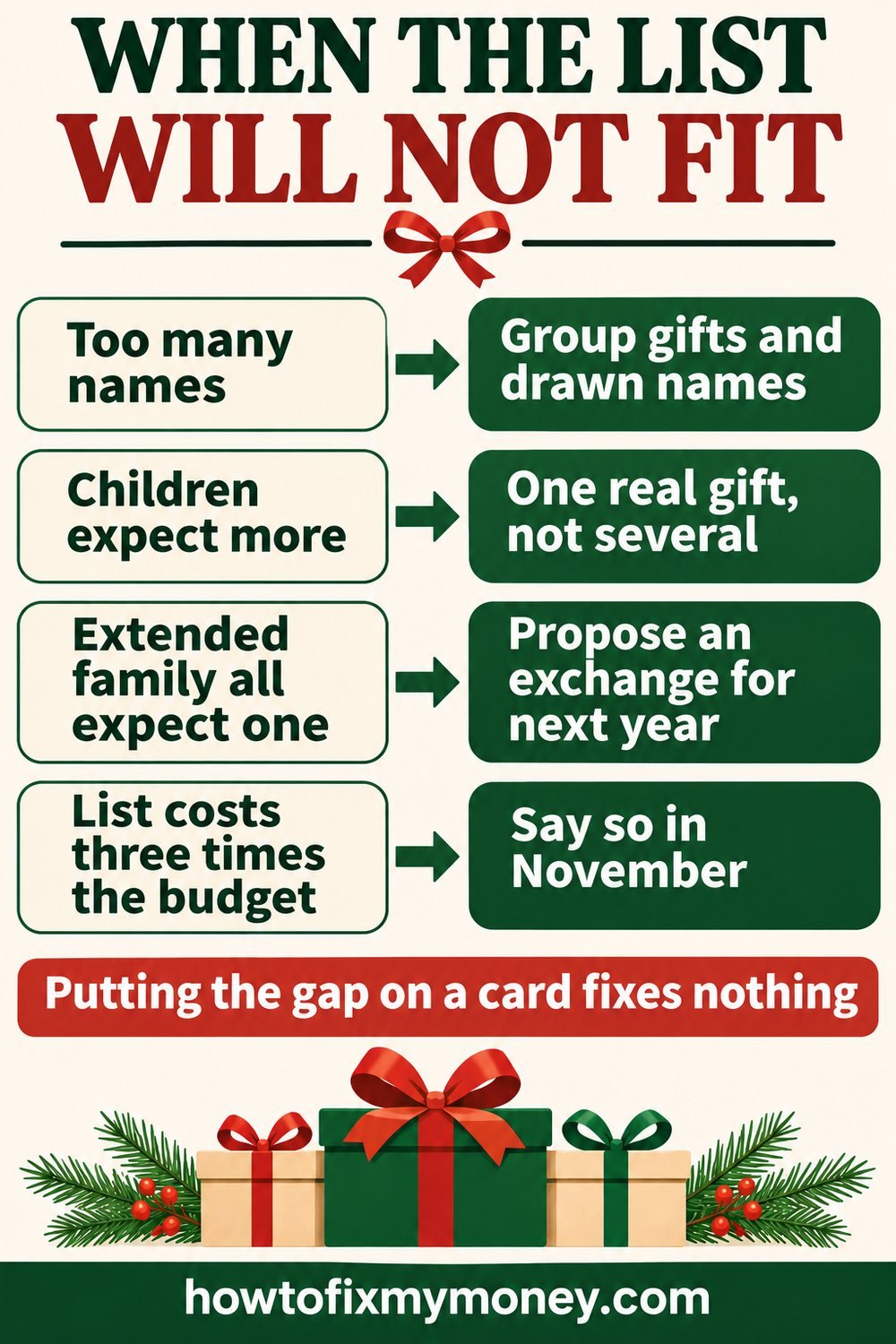
Sometimes the arithmetic refuses to work. Fourteen names against a small Christmas budget of $100 leaves $7.14 each, and no amount of tiering rescues that.
| The Problem | What Actually Fixes It | What Does Not |
|---|---|---|
| Too many names for the money | Group gifts and a drawn-name exchange | Buying cheaper versions of everything |
| Children expect more than $20 buys | One real gift instead of several small ones | Spreading the same money thinner |
| Extended family all expect gifts | Propose a family exchange for next year | Quietly dropping people with no warning |
| The budget is $100 and the list is $300 | Say so in November, not on the day | Putting the difference on a card |
That last row deserves emphasis. A $200 shortfall on a credit card at the Federal Reserve’s average rate of 22.36% is not a solved problem, it is a deferred one with interest attached, and it arrives in February when nobody remembers what was bought.
A drawn-name exchange is the single most effective fix available to a small Christmas budget. One name each, an agreed cap, and a list of fourteen becomes a list of one. Propose it in November and most families agree with visible relief.
Questions People Ask About a Small Christmas Budget
Is a small Christmas budget of $100 really enough for a whole family?
A small Christmas budget of $100 works if you divide it deliberately and reduce the number of separate gifts. It is not enough if you buy one item per person across a long list, because at that point every gift falls below the level where it registers. The tiers above are what make the difference.
How do I decide who goes in which tier?
Ask who would notice the absence of a gift, and who would only notice its presence. Children and a partner notice absence. Colleagues, neighbors and distant relatives generally notice presence, which means a note or a small consumable does the same work as a purchase.
Should I tell people my budget is small this year?
Tell the adults your small Christmas budget in November, in one sentence and without apology. Most people respond with relief rather than judgment, because a surprising number of them are managing the same thing. Children do not need the figure, only a clear sense of what to expect.
Are homemade gifts actually cheaper?
Often not, once you count materials and your time, and a half-finished project in mid-December creates more stress than it saves money. Homemade works when you already have the skill and the supplies. Treat it as a choice rather than a budget strategy.
What about gift cards?
They solve the choosing problem and advertise the amount, which is exactly the wrong trade on a small Christmas budget. A $10 card says ten dollars. A $10 object chosen with some thought says you paid attention. Keep cards for people whose preferences you genuinely do not know.
How do I handle children comparing gifts with cousins?
Set the expectation before the day rather than managing the reaction after it. Tell them the number of gifts and roughly what they are, which removes the surprise that causes the comparison. Children handle a known smaller Christmas considerably better than an unexpected one.
Is it better to buy one big gift or several small ones?
One, in almost every case, and especially for children. Several small gifts on a tight budget produce a pile that looks generous and disappoints individually. A single gift at $20 is remembered, where four at $5 are not.
What if someone gives me something far more expensive?
Nothing is owed in return, and the only person tracking the difference is usually you. Say thank you properly and leave it there. Matching a gift you cannot afford is how a $100 Christmas becomes a $250 one in a single afternoon.
Your Next Three Moves
Write every name your small Christmas budget has to cover on one sheet tonight, then count them. That number, not the hundred dollars, is what decides how this goes.
Sort each name into one of the four tiers, write the dollar figure beside it, and add the column. If the total exceeds $100, move names down a tier or merge a household into a single gift until it does not.
Then set aside $15 of the $100 before you start for wrapping, postage and the person who appears late. Shop the list, buy nothing that is not on it, and stop when the sheet is finished.
Work out what your season can genuinely support with our free Budget Planner. If the number itself still needs to come down, what to cut first when Christmas costs too much ranks the options, and the Black Friday budget rules keep the sales from taking the whole hundred in one weekend. More guides sit in our Saving Money section.
Sources
- YouGov, US Christmas gifting trends report – $368 average spend among US gift givers, 35% spending under $200.
- Adobe Analytics, 2026 holiday shopping forecast – peak seasonal discounts of 30% on electronics and 18% on furniture.
- Federal Reserve, G.19 Consumer Credit, August 2026 – 22.36% average rate on cards carrying a balance.
- Per-person figures, percentage changes and both worked splits calculated by How To Fix My Money. Each split sums to exactly $100.

Bilal founded HowToFixMyMoney.com in 2026 to make US personal finance decisions easier to work through without a financial background. Every figure published here traces back to a primary source — the Bureau of Labor Statistics, the Federal Reserve, the IRS, the CFPB — and each article links to the data it relies on. He is not a licensed financial advisor, and nothing on this site is personalized advice.