
Your credit score after debt settlement almost never falls off a cliff on the day you settle. That surprises people, because settling feels like the moment everything goes wrong. Most of the damage actually happened months earlier, and the settlement is closer to the end of the story than the start of it.
This guide covers what really happens to your score, how long recovery takes, and the handful of things that genuinely speed it up. No repair-service pitch, and no promises about point totals nobody can guarantee.
One thing worth saying plainly before we go further. Nobody can tell you exactly how many points you’ll lose or gain. The scoring models are private, and two people with identical settlements can end up in very different places depending on what else sits on their reports. What can be described honestly is the shape of the recovery, and that shape is fairly consistent.
What Happens to Your Credit Score After Debt Settlement
Three separate things land on your credit report, and people tend to blur them together when they think about their credit score after debt settlement.
- The missed payments. Reported at 30, 60, 90, 120 days late and onward. Each one is a mark of its own.
- The charge-off, if the lender wrote the debt off before settling. That’s a serious negative in its own right.
- The settlement notation, usually shown as settled, settled for less than the full amount, or paid settled.
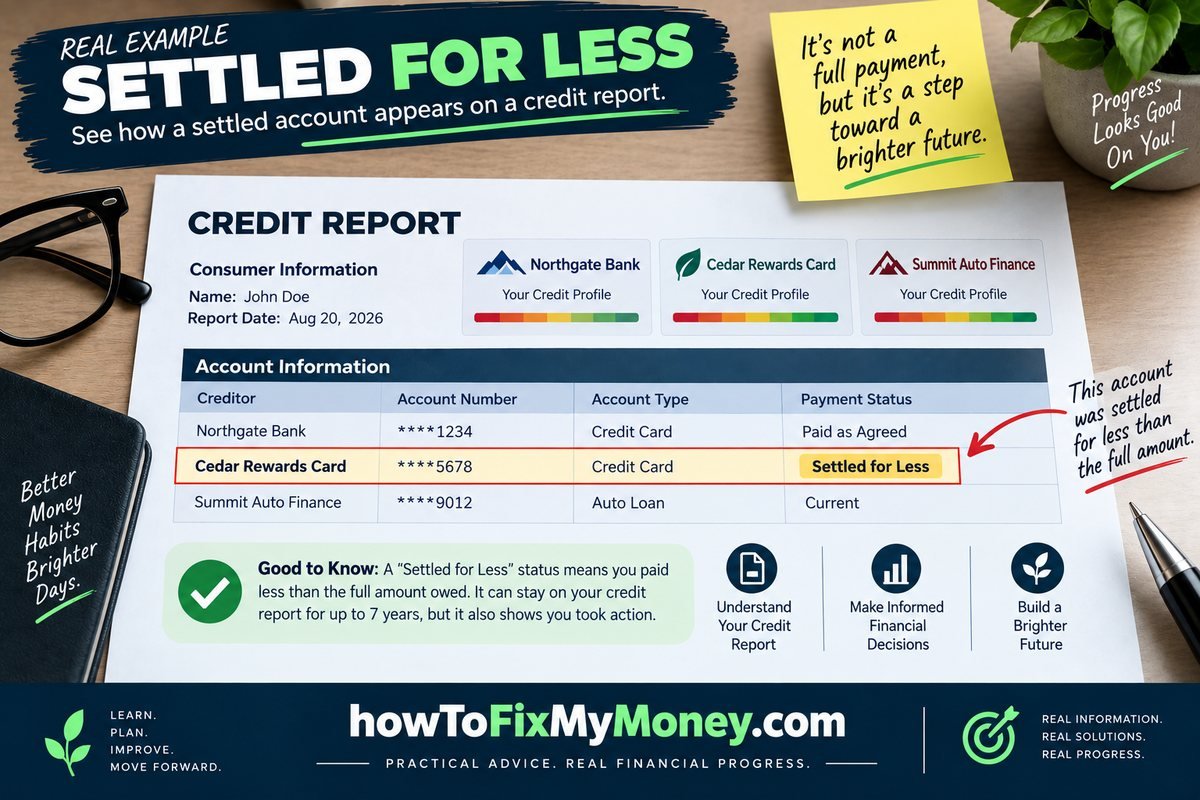
By the time you reach a settlement, the first two are already sitting on your report. The third is what you’re adding. It’s a negative mark, but it’s rarely the biggest of the three.
There’s also something quietly positive in a settlement that nobody mentions. The balance goes to zero. How much you owe is a major factor in most scoring models, so clearing a balance helps that part of the calculation even while the settlement notation hurts a different part.
Those two effects pull against each other. That’s why some people see a small drop after settling, and others see almost nothing at all.
Why Your Credit Score After Debt Settlement Was Already Falling
Almost nobody settles a debt they were paying on time. The road there runs through several missed payments first, and each of those hits your report separately.
| Stage | What Gets Reported | Effect on Your Score |
|---|---|---|
| 30 days late | First late payment | First real drop, often a steep one |
| 60 to 90 days late | Further late payments | Damage deepens |
| 120 to 180 days | Charge-off by the lender | Serious negative mark |
| Sent to collections | Collection account appears | Another separate negative |
| You settle | Balance to zero, marked settled | Small further hit, balance improves |
Look at where the heavy damage sits in that table. Most of what hurts your credit score after debt settlement is concentrated in the first four rows, before settling is even on the table.
That changes how you should think about the decision. If your account is already charged off, the question isn’t whether settling will wreck your score. It’s whether settling gets you to zero faster than the alternatives, because your score has taken the hit either way.
If your account has gone to a collection agency, read our 6-month plan to get out of collections before you agree to anything. Verifying the debt comes first, and getting the settlement in writing comes before you send a single dollar.
The Realistic Recovery Timeline for Your Credit Score After Debt Settlement
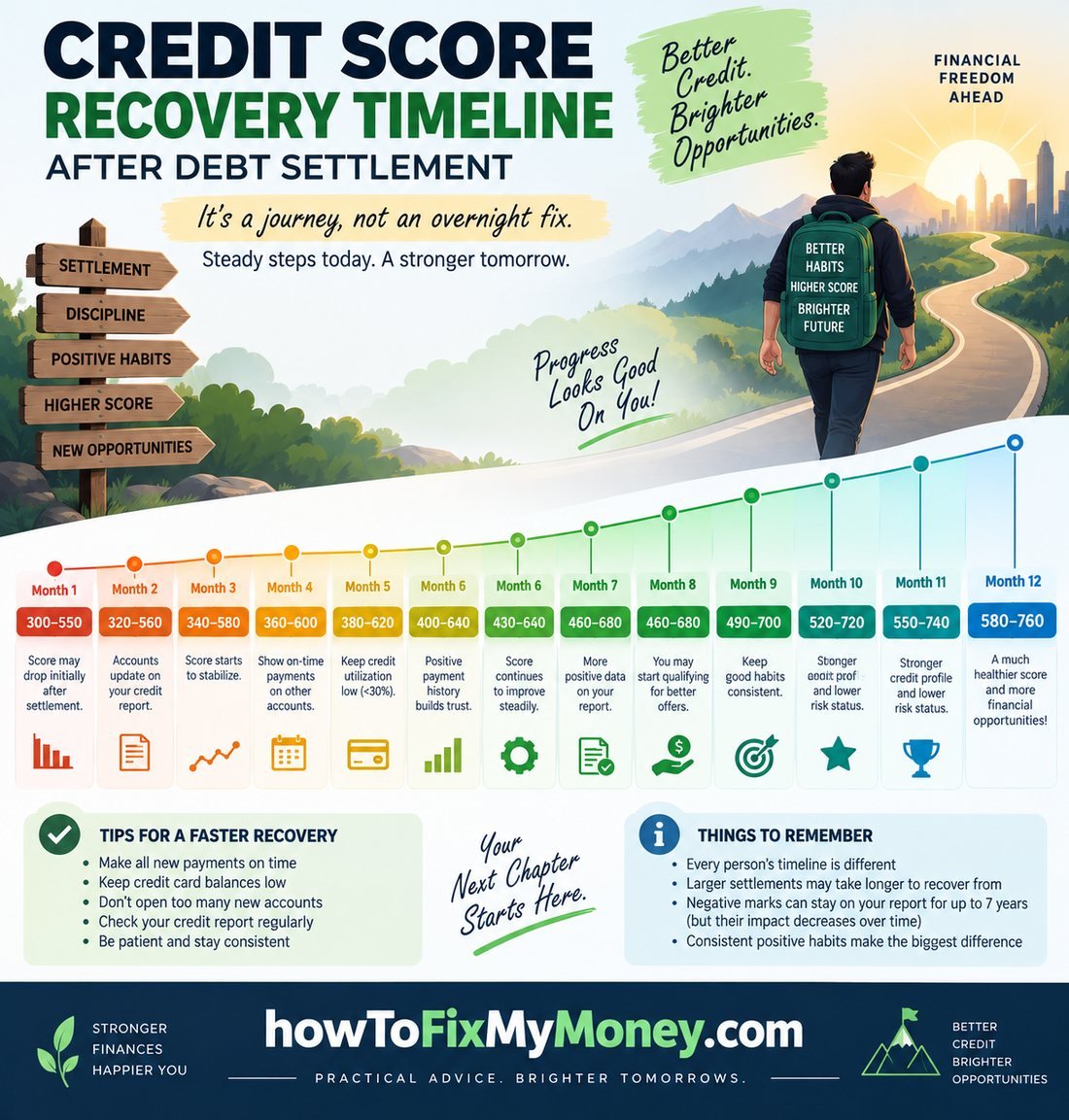
Your credit score after debt settlement recovers gradually rather than suddenly. Negative marks carry less weight as they age, so the same settlement that stings badly in month one matters far less by year three.
Here’s the general shape, assuming you keep everything else current from the settlement date onward.
| Time Since Settling | What Is Happening | What You Will Notice |
|---|---|---|
| Month 0 to 3 | Settlement reported, balance hits zero | Small dip, or a small rise if the balance was large |
| Month 3 to 6 | On-time payments start building | Slow, steady movement upward |
| Month 6 to 12 | Negative marks begin to age | Clearer improvement if nothing new goes wrong |
| Year 1 to 2 | Older negatives carry less weight | Meaningful recovery for most people |
| Year 2 to 4 | Positive history outweighs old damage | Many return to a usable score range |
| Year 7 | Negative marks drop off the report | The last of the damage clears |
Two things decide where your credit score after debt settlement lands inside those ranges. First, whether anything else on your report is still going wrong. Second, how thin or thick your credit file is, because one negative weighs far more heavily on a file with three accounts than on a file with fifteen.
Be skeptical of promises. If anyone guarantees you a specific number of points by a specific date, they’re guessing. Nobody outside the scoring companies knows, and the honest answer is always a range.
When the Seven-Year Clock Actually Starts
This is the most misunderstood part of the whole subject, and getting it wrong costs people real money.
Negative information generally stays on your credit report for about seven years. The clock doesn’t start on the day you settle. It runs from the original delinquency, meaning roughly the date you first fell behind and never caught up.
Sit with the consequence of that for a second. Settling doesn’t restart the seven years, and neither does a collection agency buying your debt. If you first went delinquent in March 2023 and you settle in 2026, the mark still falls off around 2030. Not 2033.
Check the Date on Your Report
Pull your reports and find the date of first delinquency on the account. If it looks more recent than when you actually fell behind, dispute it in writing with the credit bureau.
A re-aged account keeps damage on your file longer than the law allows, and it happens more often than you’d hope. Nobody is going to catch it for you.
You’re entitled to free copies of your credit reports. The Federal Trade Commission explains how to get them and what to do if something on them is wrong.
What Speeds Up Credit Score Recovery After Debt Settlement
Nothing erases an accurate negative mark, and any company claiming otherwise is selling something. What you can do is build enough positive history that the old damage stops dominating the calculation. That’s the whole job of rebuilding your credit score after debt settlement.
Pay Everything Else on Time, Without Exception
Payment history is the heaviest factor in most scoring models. A clean run of on-time payments from the settlement date forward does more for you than anything else on this list, and it costs nothing.
Put every remaining bill on autopay for at least the minimum. One forgotten due date can undo several months of progress.
Keep Your Card Balances Low
How much of your available credit you’re using is the second heaviest factor. If you still have an open card, keeping the balance well below the limit helps. Paying it before the statement date helps more than paying it after, since the statement balance is usually what gets reported.
Leave Old Accounts Open
Closing a card you’ve held for years shortens your credit history and cuts your available credit at the same time. Both of those push the wrong way. If an old account is in good standing and costs you nothing to keep, leave it open and stop using it.
Add One New Positive Account, Carefully
A thin file recovers slowly because there’s nothing positive to outweigh the negative. A secured card or a credit builder account can help, used carefully and paid in full every month.
Two cautions. Apply once rather than shopping around, because each application leaves a mark. And read the fees before you sign anything, since products aimed at people rebuilding credit are often where the worst fees live.
Check Your Reports Every Few Months
Errors are common, and a settled account still showing a balance is one of the most common of all. Dispute anything wrong in writing, keep your settlement letter permanently, and check again after thirty days to confirm it was actually fixed.
What Slows the Recovery Down
- Missing a payment on something else while you focus on the settled account. One new late payment resets much of your progress.
- Applying for several credit products at once to rebuild faster. It has the opposite effect.
- Closing paid-off cards. It shortens your history and reduces your available credit in one move.
- Paying an upfront fee to a credit repair company. Charging before delivering results is not permitted under federal rules.
- Leaving errors unchallenged because the report looks official. Reports contain mistakes, and disputing them is free.
- Settling one account while three others quietly fall behind. Recovery only starts once the bleeding stops.
That last point catches most people. If other bills are slipping, fix that first. Our guide for when you are behind on every bill sets out which bills to protect and in what order.
Settlement Compared with the Alternatives
Settling is one option among several. Which one is kindest to your credit score after debt settlement depends on where you already are, not on which sounds best on paper.
| Option | Effect on Your Score | Cost to You | Best When |
|---|---|---|---|
| Pay in full | Best outcome available | Highest | You can afford the full balance |
| Payment plan | Good, if you never miss one | Full balance, over time | Income is steady |
| Settle for less | Negative mark, balance clears | Less than you owe | Already delinquent or charged off |
| Do nothing | Damage continues, possible lawsuit | Can end up highest | Almost never |
Doing nothing is the option people choose by accident, and it’s usually the worst of the four. Interest keeps running, the account can be sold on, and in some cases a creditor can take you to court while the debt is still inside your state’s time limit.
If you can still clear the balance yourself, that’s almost always the better route. Our comparison of the debt snowball and avalanche methods shows how to attack it, and the free Debt Payoff Calculator will tell you how long it would take.
The Tax Side Nobody Mentions
Here’s the part that catches people the following spring. When a creditor forgives part of what you owed, that forgiven amount can be treated as taxable income, and you may receive a form reporting it.
There are exceptions, including in cases of insolvency, and they can be significant. But April is a bad time to find out.
The IRS explains how canceled debt is treated. Speak to a tax professional before settling a large balance, and put something aside if it looks like tax will be due.
Where to Get Free Help
You never need to pay anyone for reliable information about this. Several government sources cover it properly.
- The Consumer Financial Protection Bureau explains credit reports and scores and how to dispute errors.
- The CFPB also has a plain-English page on what debt settlement is and what to watch out for.
- The Federal Trade Commission covers settling credit card debt and how to spot a scam.
Non-profit credit counseling agencies also offer free sessions. A legitimate one will never charge you before doing any work, and will never promise to remove accurate information from your credit report.
Frequently Asked Questions
How much does your credit score drop after debt settlement?
It varies, and nobody can promise a number. What is consistent is that most of the drop comes from the missed payments and any charge-off before the settlement, rather than from the settlement notation itself. If your account was already seriously delinquent, the additional hit is often modest.
How long does it take to rebuild your credit score after debt settlement?
Most people see meaningful improvement within one to two years of consistent on-time payments, with fuller recovery over three to four years. The negative marks themselves generally fall off around seven years from the original delinquency.
Is settling better than not paying at all?
Usually yes. Doing nothing leaves an unpaid balance growing on your report, and the creditor may still pursue it. A settled account shows a zero balance, which looks better to a future lender than an unpaid one.
Does settling a debt remove it from my credit report?
No. It changes the status to settled or paid rather than outstanding. The entry itself stays until roughly seven years from the date you first fell behind.
Will a settled debt stop me getting a mortgage?
Not automatically, though it makes things harder in the short term. Many lenders look at how recent the settlement is and what your payment history has looked like since. Two clean years afterwards puts you in a much stronger position than two months.
Should I settle or pay the full balance?
Pay in full if you genuinely can. It is the better outcome for your credit score, and it avoids the tax question entirely. Settling makes sense when paying in full is not realistic and the account is already damaged.
Can I negotiate a settlement myself?
Yes. Creditors and collection agencies negotiate directly with people every day, and doing it yourself keeps the money you would otherwise pay in fees. Always get the agreement in writing before you pay anything.
Does a pay for delete agreement work?
Sometimes. It is an arrangement where the creditor agrees to remove the entry in exchange for payment. Some will do it and some will not, since it may conflict with their agreements with the credit bureaus. It costs nothing to ask, but do not build your plan around it.
Final Thoughts
The honest summary is that your credit score after debt settlement recovers slowly, steadily, and mostly through boring consistency rather than any clever trick.
The settlement isn’t the disaster people expect. The missed payments before it did most of the damage, and the clock on those started running long before you signed anything.
So do the unglamorous things. Pay everything else on time, keep balances low, leave old accounts open, and check your reports for errors. Two years of that moves most people further than any repair service ever could.
For more on clearing what is left, read our guide to the 5 stages of paying off debt or browse our Debt Relief section.