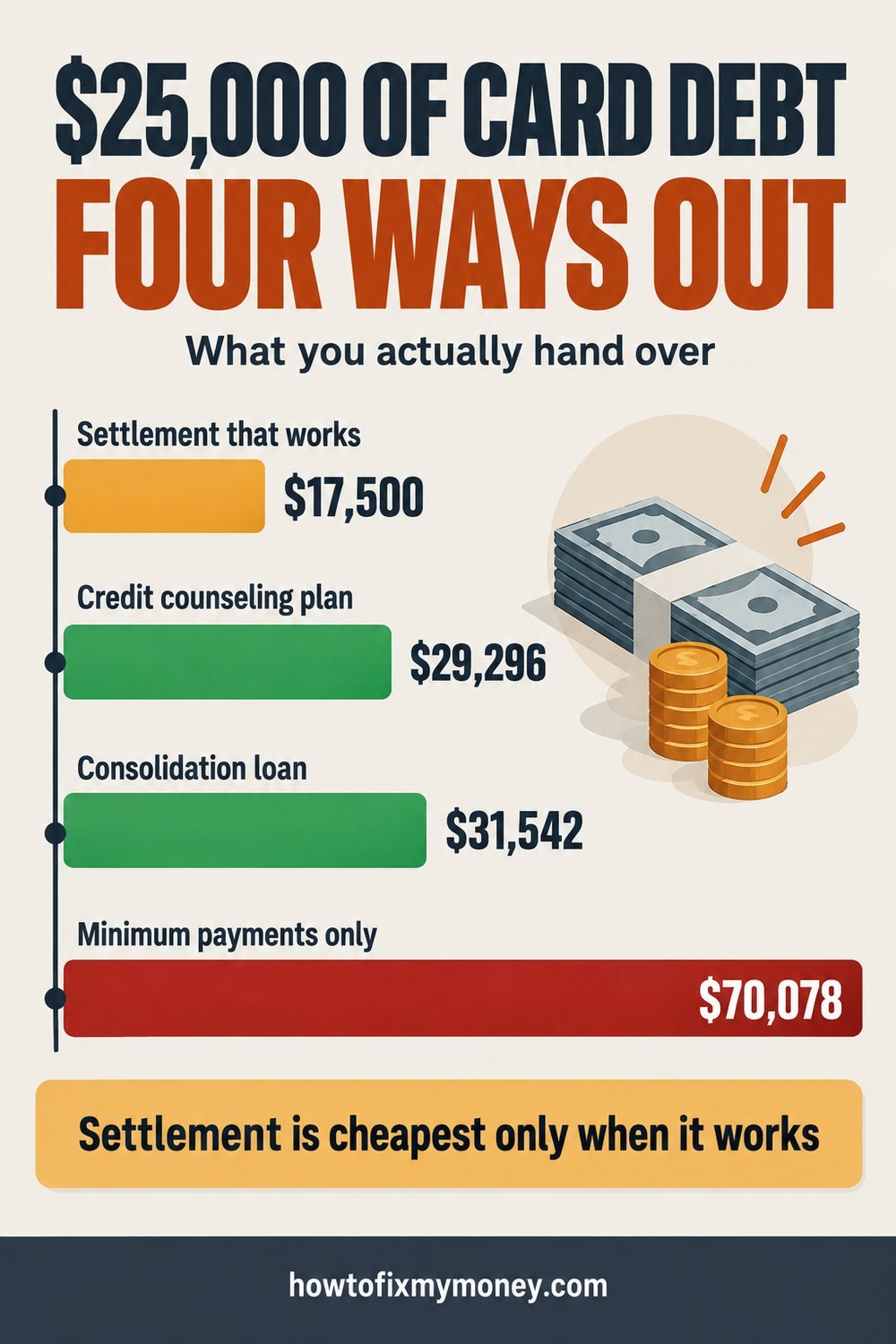
Run the arithmetic on $25,000 of credit card debt and debt settlement wins. Settling at half the balance with a 20% fee costs about $20,250. A consolidation loan at the current average rate costs $31,542 over four years. On paper it is not close.
Almost nobody prints that, because the companies selling debt settlement oversell it and everyone else warns you off it. Both camps skip the actual question, which is not whether settlement is cheaper when it works. It is whether debt settlement will work for you.
Five debt settlement risks decide that, and four of them never appear in the sales call. This article prices each one, then shows which option fits which situation.
What Debt Settlement Does to a Balance, and What Consolidating Does Instead
Debt settlement means you stop paying a creditor, let the account fall badly behind, save money in a separate account, and eventually offer a lump sum to close the debt for less than you owe. A company usually runs this for you and charges a fee.
Consolidation does the opposite. You borrow the full amount at a lower rate, pay every creditor in full, and repay one loan on a fixed schedule. Nobody forgives anything, so nothing dramatic happens to your credit. Our debt consolidation calculator shows what a loan would cost against your current payments.
A third option sits between them. A debt management plan through a nonprofit credit counseling agency lowers your interest rate rather than your balance, and you repay the full amount over three to five years.
So the three paths differ on one axis above all. Debt settlement cuts the principal and damages you. Consolidation and counseling keep the principal and protect you. Everything below prices that trade.
The Four-Way Comparison on $25,000, With Every Cost Counted
These figures use the Federal Reserve’s G.19 report for August 2026, which puts cards carrying a balance at 22.36% and the average 24-month personal loan at 11.90%. The debt settlement line assumes a creditor accepts 50% and the company charges 20% of enrolled debt.
| How You Handle the $25,000 | What You Pay | Time | Credit Impact |
|---|---|---|---|
| Settlement that works, and you qualify as insolvent | $17,500 | 2 to 4 years | Severe, about 7 years |
| Settlement that works, taxed in the 22% bracket | $20,250 | 2 to 4 years | Severe, about 7 years |
| Credit counseling plan at about 8% | $29,296 | 4 years | Mild |
| Consolidation loan at 11.90% | $31,542 | 4 years | Mild, brief dip |
| Minimum payments on the card | $70,078 | 29.8 years | None if you never miss |
Two things jump out. Minimum payments cost nearly three times the original balance and take almost thirty years, which rules that out as a strategy rather than a default. And debt settlement genuinely is the cheapest option when it works.
That last clause carries all the weight. Every one of the debt settlement risks below attacks the word “when.”
Debt Settlement Risk One: A Tax Bill on Money You Never Received
The IRS treats forgiven debt as income. Settle $25,000 for $12,500 and the creditor writes off $12,500, which generally lands on your tax return as ordinary income the following year. You receive a Form 1099-C and owe tax on money that never reached your bank account.
| Your Tax Bracket | Forgiven Amount | Tax You Owe | When |
|---|---|---|---|
| 12% | $12,500 | $1,500 | The following April |
| 22% | $12,500 | $2,750 | The following April |
| 24% | $12,500 | $3,000 | The following April |
That bill arrives in a single lump, months after you finished the program and spent your savings on the settlement. Households that budgeted precisely enough to finish often cannot pay it, which starts a fresh debt to a creditor that garnishes wages without suing first.
Most debt settlement sales calls mention this in passing, if at all. Price it before you enroll, not after.
The Insolvency Test That Can Erase That Tax Bill Completely
Here is the provision that changes the entire calculation, and it goes unmentioned almost everywhere.
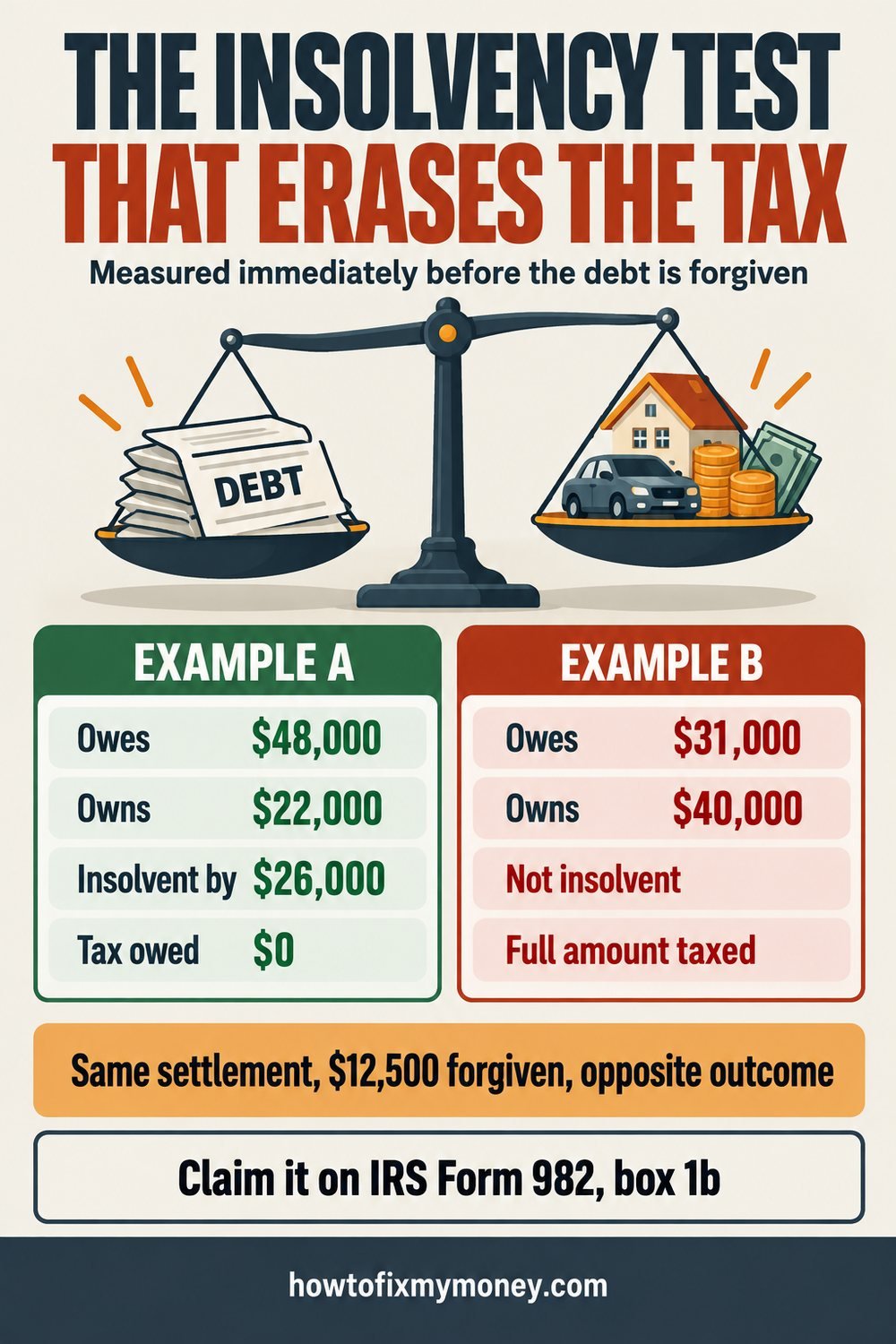
If your total liabilities exceeded the fair market value of everything you own immediately before the cancellation, the IRS counts you as insolvent, and you exclude the forgiven amount from income up to the amount by which you were insolvent.
Count every asset, including retirement accounts and exempt property, and every debt. Subtract one from the other. If liabilities win, you were insolvent by that difference.
| Immediately Before Settling | Example A | Example B | Counts As |
|---|---|---|---|
| Total liabilities | $48,000 | $31,000 | Everything you owe |
| Fair market value of assets | $22,000 | $40,000 | Everything you own |
| Insolvent by | $26,000 | Not insolvent | Liabilities minus assets |
| Tax on $12,500 forgiven | $0 | Full amount taxable | Excluded up to the shortfall |
Example A excludes the whole $12,500, because the insolvency of $26,000 exceeds it. Example B owes tax on all of it. Same settlement, same forgiven amount, completely different outcome.
So work out your insolvency position before you decide anything. Someone deeply insolvent faces a materially cheaper debt settlement than someone with home equity or a funded retirement account, and that single number can flip the whole comparison.
Debt Settlement Risk Two: You Stop Paying, and Everything Gets Worse First
Debt settlement only works because creditors settle with people who look likely to default. So companies typically tell you to stop paying. The CFPB warns that doing so can increase the fees and interest you owe, damage your credit further, and expose you to more collection activity and lawsuits.
Picture the middle of a program. You stopped paying eighteen months ago. Late fees and penalty interest pushed the balance above where it started. Collectors call daily. Your credit report carries a string of missed payments and a charge-off, and no debt settlement has happened yet.
During that window a creditor can sue. A judgment can lead to wage garnishment or a bank levy depending on your state, and no debt settlement company can stop that. This exposure is the most underrated of the debt settlement risks, because the sales call describes the destination and never the journey.
Risk Three: Nobody Can Promise That a Creditor Will Settle
No law requires a creditor to accept any offer. Some settle readily, some settle late, and some refuse entirely and sue instead.
The CFPB states plainly that debt settlement companies usually cannot get better terms than you could negotiate yourself, and that they cannot guarantee the savings, the timing, or that your creditors will resolve your debts at all.
Completion data is genuinely contested, and you deserve the honest version rather than either side’s. The industry’s own trade association told the FTC in 2009 that 65.6% of enrollees terminated before completing, with 24.6% completing. Those figures predate the 2010 federal fee reforms described below, so treat them as a warning about the shape of the risk rather than today’s precise odds. Industry-funded studies since then report better outcomes, and consumer advocates dispute them.
What nobody disputes: a substantial share of people who enroll do not finish, and leaving halfway is the worst outcome available. You carry the credit damage, the larger balance, the fees already paid, and none of the forgiveness.
Risk Four: The Credit Damage Outlasts the Program by Years
The CFPB explains that credit reporting companies generally report most negative information for seven years, and bankruptcies for up to ten.
| Path | What Lands on Your Report | How Long | Borrowing After |
|---|---|---|---|
| Debt settlement | Missed payments, charge-offs, settled accounts | About 7 years | Hard and expensive |
| Credit counseling plan | A notation on accounts in the plan | Through the plan | Largely unaffected |
| Consolidation loan | One hard inquiry and a new account | Inquiry about 2 years | Usually improves |
| Doing nothing, paying minimums | Nothing, while you never miss | No damage | Unaffected |
Seven years is long enough to cover a mortgage application, a car purchase and a rental approval. Price that before debt settlement tempts you. A mortgage rate penalty across those years can cost more than the debt settlement saved, which is why homeowners and would-be buyers should treat debt settlement as a last resort rather than a clever shortcut.
Debt Settlement Risk Five: Fees Charged on Your Debt, Not Your Savings
Read any debt settlement fee quote carefully, because the base matters more than the percentage.
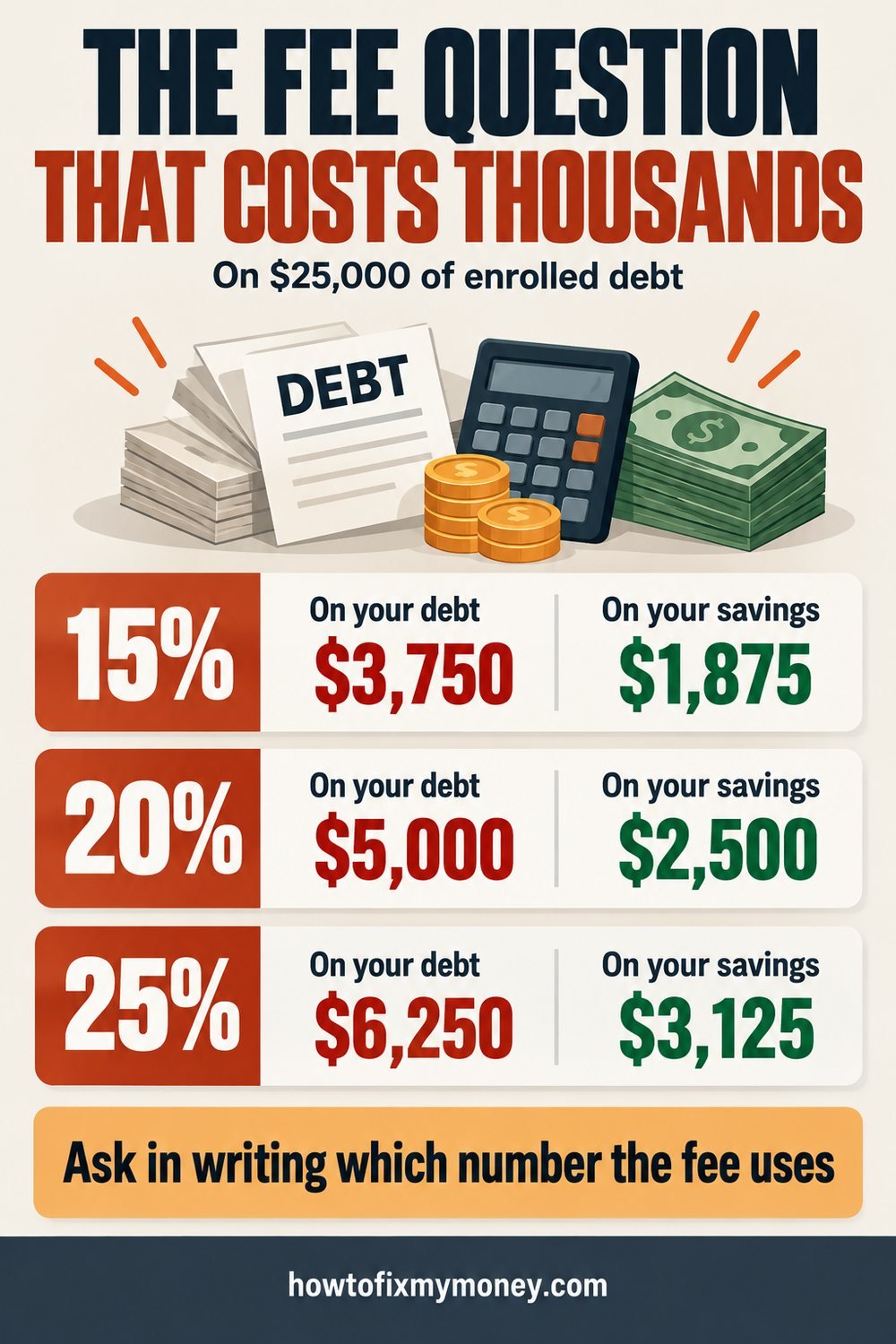
Companies commonly charge 15% to 25% of the enrolled debt rather than 15% to 25% of what they save you. On $25,000 that difference is large:
| Fee Quoted | Charged on Enrolled Debt | Charged on Savings Instead | Difference |
|---|---|---|---|
| 15% | $3,750 | $1,875 | $1,875 |
| 20% | $5,000 | $2,500 | $2,500 |
| 25% | $6,250 | $3,125 | $3,125 |
Ask one question in writing: is the percentage calculated on the debt I enroll or on the amount you actually save me? The answer changes the cost by thousands, and a company that will not answer in writing has told you what you need to know.
Note too that fees apply to each settled debt. Enroll five accounts, settle three, and you still pay on those three while two remain unresolved.
The Federal Rule That Makes an Upfront Fee Illegal
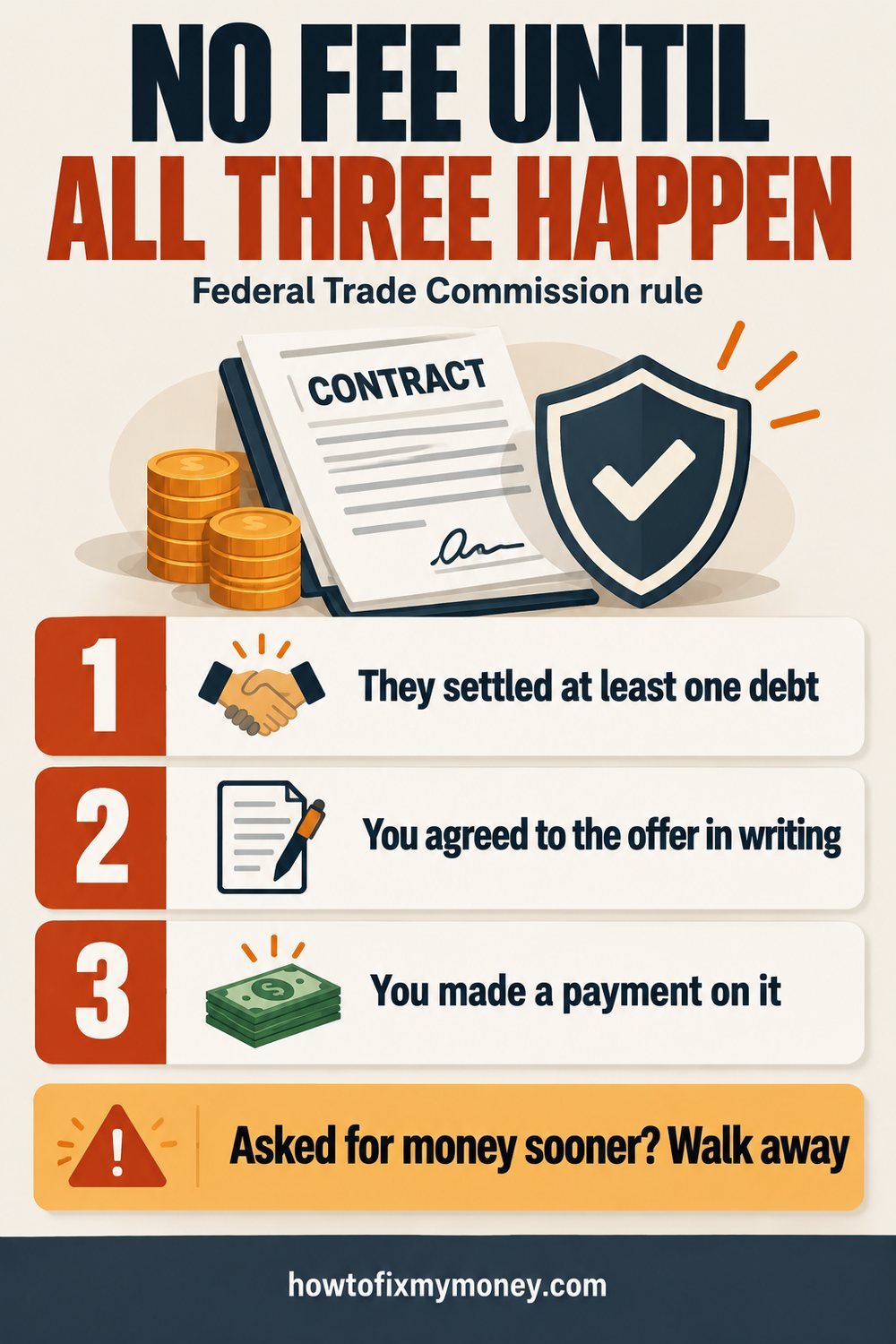
Federal law protects you here, and knowing the rule lets you spot a bad operator in one sentence. Under the FTC’s Telemarketing Sales Rule, a company selling debt relief over the phone cannot collect any fee until three things have happened.
- The company has settled or otherwise resolved at least one of your debts.
- You have agreed to the creditor’s offer under an agreement you signed.
- You have made at least one payment toward that debt under that agreement.
The rule also stops companies front-loading fees across multiple debts, and it allows them to require that your savings go into a dedicated account at an independent, insured financial institution. That money remains yours, and the CFPB confirms you can withdraw it without penalty.
So anyone asking for money before settling a single account is either breaking the rule or operating outside it. Walk away and report them to the FTC.
Which Option Actually Fits Your Situation
The right answer depends on three things: whether you can qualify for a loan, whether you can keep paying, and whether you are insolvent.
| Your Situation | Usually the Best Fit | Why |
|---|---|---|
| Good credit, steady income | Consolidation loan | A lower rate on the full balance, no credit damage |
| Cannot qualify for a decent rate, but can pay | Credit counseling plan | Cuts the rate without the damage settlement causes |
| Cannot pay, deeply insolvent, no home equity | Debt settlement worth pricing | The tax exclusion applies and you have little left to protect |
| Cannot pay, own a home or plan to buy soon | Counseling or an attorney | Seven years of damage can cost more than the saving |
| Debt exceeds what you could repay in five years | Talk to a bankruptcy attorney | Often faster, cheaper and more final than settlement |
That last row deserves emphasis. People reach for debt settlement to avoid bankruptcy, and sometimes bankruptcy is genuinely the cheaper and shorter path. A consultation usually costs nothing and tells you where you stand.
What to Do Before You Sign Anything With Anyone
Four steps, in order, and all of them cost nothing.
- Work out your insolvency position. List every debt and the market value of everything you own. The difference decides whether a debt settlement carries a tax bill, which can swing the comparison by thousands.
- Call your creditors yourself first. Ask for a hardship program or a reduced rate. Issuers run them, rarely advertise them, and the call involves no fee and no credit inquiry.
- Get a free review from a nonprofit credit counseling agency. Look for a member of the National Foundation for Credit Counseling, and compare their plan against both other options.
- Price your own rate through a soft inquiry before assuming you cannot consolidate. Plenty of people who expect a decline receive an offer below their break-even rate.
Only after those four should debt settlement enter the conversation, and then only with the five debt settlement risks priced in writing.
Price your own numbers before anyone prices them for you
Put your balances and rates into the free Debt Payoff Calculator. The total it gives you is the figure every settlement pitch and every loan offer has to beat, and knowing it changes how the sales call goes.
Questions People Ask About Debt Settlement Risks
Does settled debt really count as income?
Yes, generally. The IRS treats forgiven debt you were personally liable for as ordinary income, and the creditor reports it on Form 1099-C. You can exclude it if you were insolvent immediately before the cancellation, or if the debt was discharged in bankruptcy. Claim the insolvency exclusion on Form 982.
Can I negotiate a settlement myself?
Yes, and the CFPB notes that companies usually cannot get better terms than you could negotiate yourself. Doing it directly saves the entire fee, which runs into thousands on a mid-sized balance. Get any agreement in writing, stating the balance as settled in full, before you send money.
How much do creditors usually accept?
No fixed figure exists, and anyone quoting one with confidence is guessing. Outcomes vary by creditor, by how far behind the account is, by the age of the debt and by who currently owns it. Build your comparison on a range rather than a promise, and treat any guaranteed percentage as a warning sign.
Will a creditor sue me during a settlement program?
They can, and some do. Stopping payments is what makes settlement possible and also what creates the exposure. A judgment can lead to wage garnishment or a bank levy depending on your state. Never ignore a court summons, because a default judgment hands the creditor everything it asked for.
Is debt consolidation always safer than debt settlement?
Safer for your credit, yes. Cheaper, not always. Consolidating repays the full balance plus interest, so it costs more in raw dollars than a settlement that succeeds. The trade is certainty and a clean credit file against a lower total, with real chances that the debt settlement fails.
What is the difference between a debt management plan and debt settlement?
A debt management plan reduces your interest rate while you repay the full balance through a nonprofit agency, with mild credit impact. Debt settlement reduces the balance itself, requires you to fall behind, and damages your credit for years. They solve different problems and are not interchangeable.
Can I settle debt that already went to collections?
Often yes, and sometimes on better terms, since collection agencies frequently bought the debt for a fraction of face value. Ask the collector to validate the debt in writing first, check it against your state’s statute of limitations, and get any debt settlement agreement in writing before paying.
How do I check a company before enrolling?
Confirm it never asks for a fee before settling an account, which federal law prohibits. Ask in writing whether the fee applies to enrolled debt or to savings. Check your state attorney general and the FTC for actions against it, and treat guaranteed outcomes as a reason to walk away.
Your Next Three Moves
Work out your insolvency position tonight. Every debt on one side, the market value of everything you own on the other. That single number decides whether a debt settlement costs you a tax bill, and it takes half an hour.
Then make two free calls this week: one to each creditor asking for a hardship program, and one to a nonprofit credit counseling agency for a review. Both cost nothing and neither touches your credit.
Only then price debt settlement, with the fee basis in writing and the tax position already known. The debt settlement risks on this page are manageable once you have priced them, and ruinous when you have not.
Run the numbers for yourself with our free Debt Payoff Calculator. If consolidating looks possible, the break-even rate that decides if a consolidation loan saves you money shows exactly when it pays. If you are not sure the problem is that serious yet, the warning signs you need debt relief help covers that, and more guides sit in our Debt Relief section.
Sources
- IRS, Publication 4681, Canceled Debts – forgiven debt as income, the insolvency exclusion, and Form 982.
- FTC, Debt Relief Services and the Telemarketing Sales Rule – the three conditions before any fee may be charged.
- CFPB, credit counseling, settlement, consolidation and repair compared – warnings on stopped payments, fees and taxes.
- CFPB, how long information stays on a credit report – seven years for most negative items.
- Federal Reserve, G.19 Consumer Credit, August 2026 – 22.36% on cards carrying a balance, 11.90% on 24-month personal loans.
- Completion figures reported by the industry’s trade association to the FTC in 2009, which predate the 2010 federal fee reforms.
- Payoff totals, settlement costs and tax figures calculated by How To Fix My Money using standard amortization and a minimum payment of 1% of the balance plus interest.

Bilal founded HowToFixMyMoney.com in 2026 to make US personal finance decisions easier to work through without a financial background. Every figure published here traces back to a primary source — the Bureau of Labor Statistics, the Federal Reserve, the IRS, the CFPB — and each article links to the data it relies on. He is not a licensed financial advisor, and nothing on this site is personalized advice.