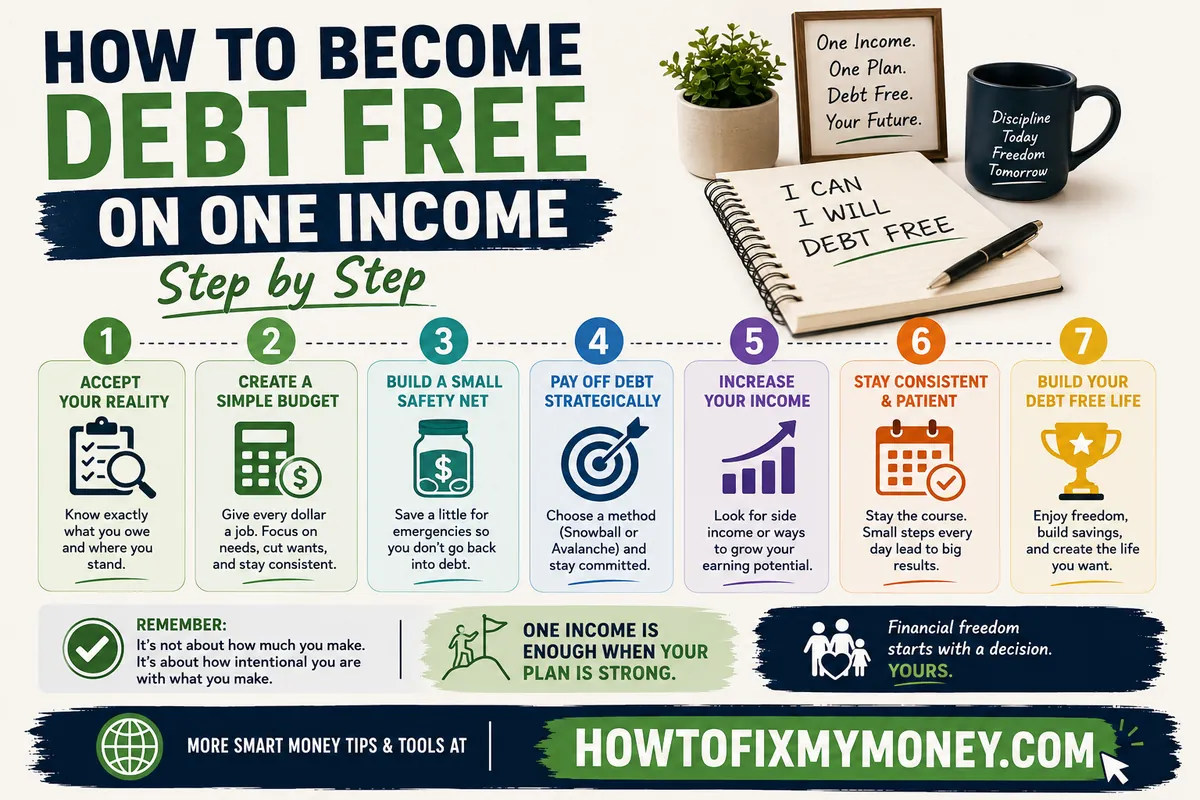
Living on one paycheck is hard. When a single income has to cover rent, food, fuel, insurance, and childcare, debt can feel like a weight you will never put down. But here is the truth: thousands of families become debt free on one income every year. They are not rich. They do not have a secret. They follow a simple plan and stay with it long enough to see it work.
This guide shows you exactly how to become debt free on one income, one step at a time. You will learn how to list what you owe, build a single-income budget that holds up in real life, choose the right payoff method, and free up extra cash every month. No confusing terms. No complicated math. Just a clear path you can start today.
Why Paying Off Debt on One Income Feels Harder
In a two-income home, there is a cushion. One paycheck covers the bills while the other attacks the balances. On a single income, every dollar already has a job before it lands in your account.
A few things make single-income debt payoff tougher:
- There is no backup. If your one paycheck stops, everything stops with it.
- There is less margin. After the basics are paid, very little is left over.
- Progress feels slow. Sending $150 a month toward a $9,000 balance can feel endless.
- The stress sits on one person. That pressure is real, and it wears people down.
None of this means you cannot win. It means your plan has to be tighter and more consistent. Speed matters less than direction. A family paying an extra $100 a month with a clear plan will beat a family paying $400 a month with no plan at all, because the second family keeps borrowing the money back.
Step 1: Write Down Every Single Debt You Owe
You cannot pay off a debt you have never measured. Most people guess their total, and the guess is almost always wrong. It is usually too low.
Build Your Full Debt List
Pull out your last statements or log in to each account. For every debt, write down four things: who you owe, the current balance, the interest rate (APR), and the minimum monthly payment.
Include everything. Credit cards, store cards, personal loans, car loans, medical bills, buy now pay later plans, student loans, and money you borrowed from family. Leaving one out is how people stay stuck.
Here is what a real debt list looks like for a household earning one income:
| Debt | Balance | APR | Minimum Payment |
|---|---|---|---|
| Store credit card | $850 | 26.99% | $35 |
| Main credit card | $3,200 | 22.99% | $96 |
| Medical bill | $1,150 | 0% | $50 |
| Personal loan | $5,400 | 14.50% | $178 |
| Car loan | $9,800 | 7.25% | $312 |
| Total owed | $20,400 | — | $671 |
Seeing the real number stings for about ten minutes. After that it becomes useful. A vague worry has turned into a problem with a size, and problems with a size can be solved.
Check Your Credit Report While You Are at It
You can pull your credit reports for free from all three bureaus. Look for accounts you do not recognize, balances that seem wrong, and old debts that should have dropped off. Reporting errors are common, and fixing one can raise your score without you paying a cent.
If a collection agency is contacting you about an old balance, know your rights first. The Consumer Financial Protection Bureau explains what collectors can and cannot do in its official debt collection guide. Reading it before you answer the phone puts you in a much stronger position.
Step 2: Build a One-Income Budget That Actually Works
A budget is not a punishment. It is simply a plan you write before the month starts, so your money does not disappear without your permission.
Start With Your Real Take-Home Pay
Use the amount that actually hits your bank account after taxes, insurance, and retirement deductions. Never budget with your gross salary. If your pay changes from month to month, use the lowest of your last three months. If you earn more than that, treat the extra as a bonus and throw it at debt.
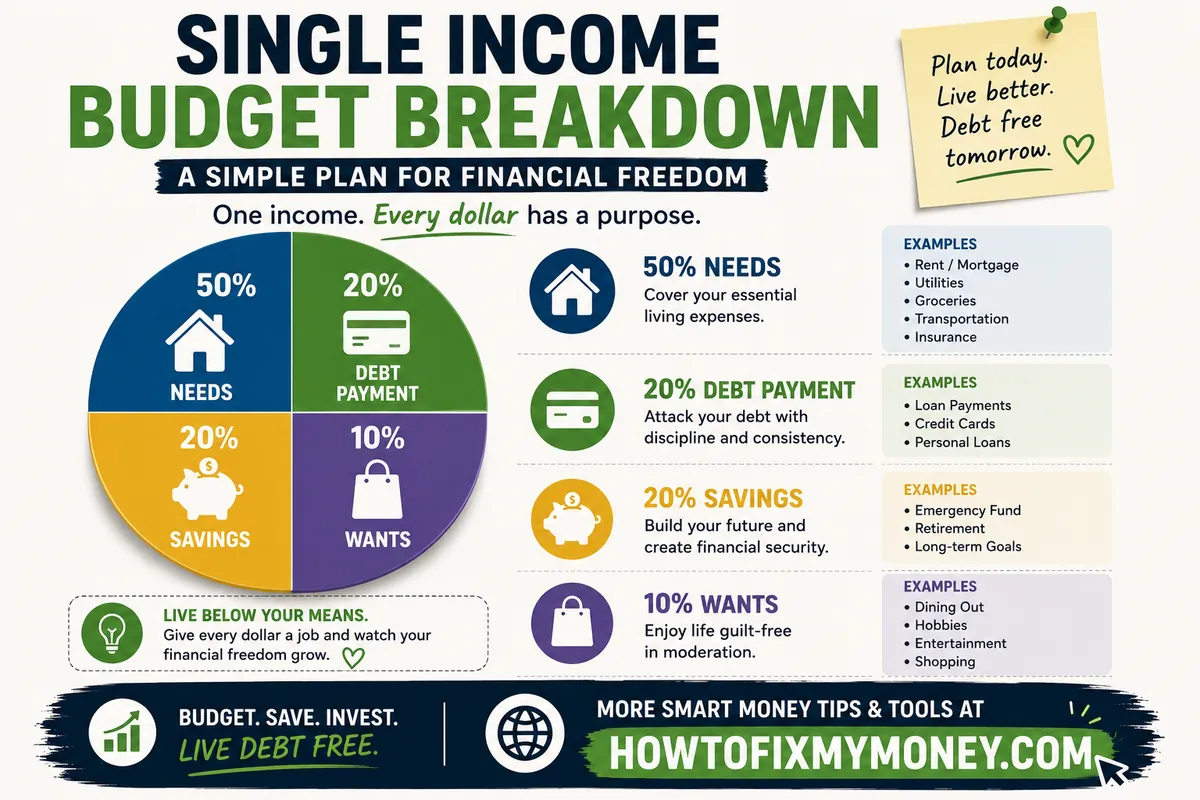
Split Your Money into Four Simple Buckets
On one income, the classic 50/30/20 split is often too tight. Try this instead:
- Needs (55% to 65%): housing, utilities, groceries, transport, insurance, minimum debt payments.
- Extra debt payments (10% to 20%): this is the money that actually makes you debt free.
- Savings (5% to 10%): your emergency fund and any sinking funds for car repairs or school costs.
- Wants (10%): eating out, hobbies, streaming, small treats. Do not set this to zero.
That last line matters more than people think. A single-income budget with no fun in it lasts about six weeks. Then someone snaps and spends $300 in one afternoon. A small, planned amount of fun money protects the whole plan.
Do a 15-Minute Weekly Check-In
Pick one quiet time each week, open your bank app, and compare what you planned with what you actually spent. Fifteen minutes is enough. This one habit is the difference between a budget that lives on paper and a budget that changes your life.
Step 3: Choose a Debt Payoff Method and Stick to It
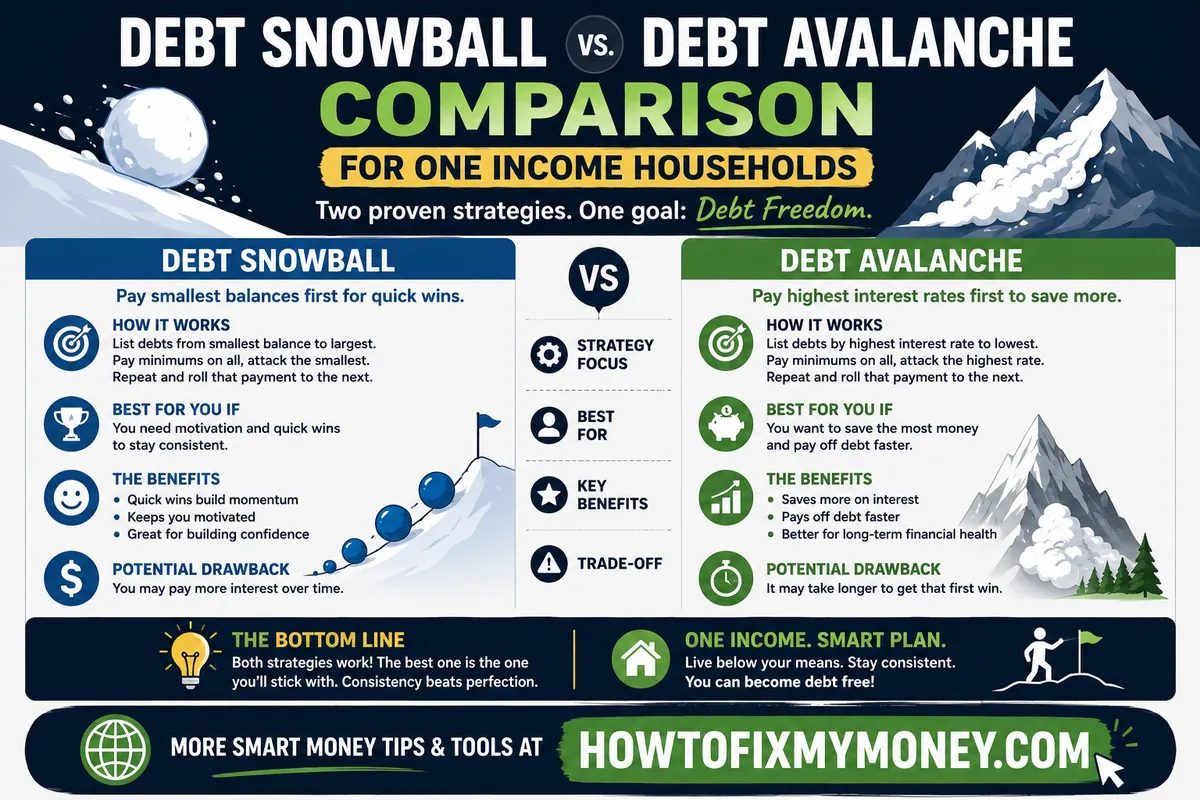
Once you know what you owe and how much extra you can send each month, you need an order of attack. There are two proven methods, and both work. What matters is picking one and refusing to switch every few weeks.
The Debt Snowball Method
Pay the minimum on every debt, then throw every extra dollar at the smallest balance. When that debt is gone, roll its entire payment into the next smallest. Your payment grows like a snowball rolling downhill.
Using the table above, you would kill the $850 store card first. Once it is paid, the $35 minimum plus your extra money moves to the $1,150 medical bill, and so on.
The Debt Avalanche Method
Pay the minimum on every debt, then send every extra dollar to the debt with the highest interest rate. In the example above, that is the store card at 26.99%, then the main credit card at 22.99%. The avalanche always saves the most money in interest.
Snowball or Avalanche on a Single Income?
Here is a side-by-side look so you can pick quickly. For a deeper breakdown with a full worked example, read our guide to the debt snowball vs avalanche methods.
| Debt Snowball | Debt Avalanche | |
|---|---|---|
| You pay first | Smallest balance | Highest interest rate |
| Main benefit | Fast, visible wins | Lowest total interest paid |
| Best for | People who need motivation | People who love the math |
| Risk | Costs a little more interest | Feels slow at the start |
| Our pick for one income | Recommended | Use if rates vary a lot |
For most single-income households, the snowball wins. On one paycheck, the hardest part is not the math, it is staying motivated for two or three years. Closing an account in the first eight weeks proves the plan works and keeps you going.
Choose the avalanche if the gap between your rates is large, for example a card at 29% next to a car loan at 6%. In that case the interest savings are big enough to be worth the slower start.
Not sure which order saves you more? Run both scenarios through our free Debt Payoff Calculator and compare the payoff dates and total interest side by side before you commit.
Step 4: Free Up Extra Money Every Month
Your payoff date is decided by one number: how much extra you send above the minimums. On one income, finding that money takes some work, but it is almost always there.
Trim Costs Without Feeling Broke
Do not try to cut everything at once. Pick the five biggest wins and leave the rest alone:
- Call your internet and phone providers and ask for the new-customer rate. A 10-minute call often saves $20 to $40 a month.
- Re-shop your car and home insurance once a year. Loyalty is rarely rewarded.
- Cancel subscriptions you have not opened in 30 days. Most families find two or three.
- Plan seven dinners before you shop and stick to the list. This alone often saves $150 a month.
- Refinance or trade down an expensive car payment if it is eating more than 15% of your take-home pay.
Add those up and many households free $250 to $400 a month without changing where they live or what they drive.
Add a Small Amount of Extra Income
Cutting costs has a floor. Income does not. You do not need a second full-time job, and on one income you may not have the hours anyway. You need a few hundred dollars a month:
- Sell items you no longer use. Most homes hold $500 to $1,500 in resale value.
- Take on 5 to 8 hours a week of freelance, delivery, tutoring, or weekend work.
- Ask for a raise with a written list of what you have delivered this year.
- Turn a skill you already have, such as baking, repairs, or bookkeeping, into a small side service.
Send 100% of that extra income to your target debt. Because it never enters your normal budget, you will not miss it.
Use Windfalls the Smart Way
Tax refunds, bonuses, gift money, and insurance rebates are the fastest way to become debt free on one income. Split them 90/10: send 90% to debt and let yourself enjoy 10%. That small reward keeps the plan human and stops the all-or-nothing thinking that ruins so many budgets.
Step 5: Lower Your Interest Rates So More of Your Payment Counts
Every dollar of interest you avoid is a dollar that goes straight to your balance. Three moves can cut your rate, and all three are worth trying.
Simply Call and Ask
Card companies would rather keep you than lose you. Call the number on the back of your card and say: I have been a customer for three years, I always pay on time, and I am considering moving this balance. Can you lower my APR? A surprising number of people get a lower rate for one phone call. It costs nothing to ask.
Balance Transfer Credit Cards
If your credit score is fair or better, a 0% balance transfer card can pause interest for 12 to 21 months. Watch two things: the transfer fee, usually 3% to 5%, and the date the promotional rate ends. A transfer only helps if you have a realistic plan to clear the balance before that date. Otherwise you are just moving the problem.
Debt Consolidation Loans
A consolidation loan rolls several high-rate balances into one fixed monthly payment, usually at a lower rate. It is not the same thing as settlement, where you pay less than you owe and take a credit hit for it. Our guide on debt consolidation vs debt settlement explains the credit and tax differences. For a single-income household, the simplicity is often as valuable as the savings. One due date is much easier to manage than six.
It only works if two rules hold. The new rate must be clearly lower than your current average rate, and you must stop using the cards you just paid off. Consolidating and then re-running the balances is the most common way people double their debt.
Before you apply, check what the monthly payment and total interest would actually be with our Personal Loan Calculator. You can also compare options in our personal loans guides to see which type of loan fits your credit profile.
Step 6: Keep a Small Emergency Fund While You Pay Off Debt
This step feels backwards, but skip it and you will restart your plan three times.
On one income, there is no second paycheck to absorb a surprise. A blown tire, a broken tooth, or a sick child goes straight onto a credit card unless you have cash set aside. That is how people pay off $4,000 and then watch it come right back.
Save a starter emergency fund of $1,000 to $2,000 before you go hard at the debt, then keep it topped up. Yes, holding cash while paying 22% interest costs you a little. It is cheap insurance for the plan itself. Once you are debt free, grow that fund to cover three to six months of expenses.
Step 7: Protect Your Progress and Stay Motivated
Becoming debt free on one income usually takes 18 months to 4 years. Motivation carries you through the first month. Systems carry you through the rest.
- Automate every payment the day after payday so the money leaves before you can spend it.
- Track your total debt on a chart on the fridge and update it monthly. Watching the line fall is powerful.
- Freeze or remove your cards from online shopping accounts. Friction helps.
- Celebrate cheaply every time a debt is closed. A $15 celebration is enough to mark the win.
- Tell one trusted person your goal so someone else is watching with you.
If you live with a partner who is not earning, keep them fully involved. A plan that only one adult understands will fail. Sit down together every month and review the numbers as a team.
A Real Example: Debt Free on $3,400 a Month
Meet a household with one earner bringing home $3,400 a month, two children, and the $20,400 of debt from the table above. Their minimum payments are $671.
They cut $180 a month from insurance, subscriptions, and grocery waste. The earner picks up six hours of weekend work for another $320. That gives them $500 extra each month, so they now send $1,171 toward debt.
Using the snowball, the $850 store card is gone in under a month. The $1,150 medical bill clears by month three. By month eight the $3,200 credit card is finished, and the rolled-up payment is now large enough to crush the personal loan. With a $2,100 tax refund in year two, the family is completely debt free in about 20 months.
Nothing dramatic happened. No lottery win, no huge promotion. They found $500 a month and refused to quit. That is the whole formula.
Mistakes That Slow People Down
- Paying only the minimums. On a $3,200 card at 22.99%, minimum payments can take over 15 years and cost more in interest than the original balance.
- Switching methods every month. Snowball in January, avalanche in February, something new in March. Pick one and stay put.
- Skipping the emergency fund. The single biggest cause of restarting from zero.
- Cutting the budget to the bone. Extreme budgets collapse. Leave a little room to breathe.
- Ignoring old collections. They do not disappear, and unopened mail turns into court letters.
- Borrowing to feel better. A new card during a stressful month can undo a year of work.
When You Should Get Professional Help
Sometimes a budget is not enough, and that is not a personal failure. Consider outside help if any of these are true:
- Your minimum payments are more than half your take-home pay.
- You are using credit cards to buy groceries or pay other cards.
- You are behind on rent, mortgage, or utilities.
- Collectors are calling and you cannot see a way forward.
A nonprofit credit counseling agency can review your whole situation for free or for a small fee and may be able to set up a debt management plan with reduced rates. The CFPB explains how these agencies work and how to spot a bad one in its guide to credit counseling. Always choose a nonprofit agency, and never pay large fees up front.
You can also read more strategies in our debt relief section and find everyday savings ideas in our money fixes articles.
Frequently Asked Questions
How long does it take to become debt free on one income?
Most households take 18 months to 4 years, depending on how much they owe and how much extra they can pay each month. If you can send an extra $300 to $500 a month against $20,000 of debt, two years is a realistic target.
Should I save money or pay off debt first on a single income?
Do both, in order. Build a starter emergency fund of $1,000 to $2,000 first, then focus hard on the debt while keeping that cushion untouched. After the debt is gone, grow the fund to three to six months of expenses.
Is debt consolidation a good idea for one-income families?
It can be, if the new interest rate is clearly lower than your current average and you stop using the old accounts. One fixed payment is much easier to manage on a single paycheck. If your credit score is low, the rate offered may not be worth it.
Can I become debt free on one income with a low salary?
Yes, but the timeline stretches. On a lower income the priority shifts toward raising income, since there is only so much left to cut. Even an extra $150 a month makes a real difference over two years.
Will paying off debt hurt my credit score?
Paying down balances usually helps your score because it lowers your credit utilization. Closing a very old credit card can slightly shorten your credit history, so many people keep their oldest card open with a zero balance instead of closing it.
What if my one income stops?
Contact your lenders straight away and ask about hardship programs. Many offer reduced payments or a short pause. Reaching out before you miss a payment gives you far more options than calling after.
Final Thoughts
Becoming debt free on one income is not about being perfect with money. It is about being consistent with a plan that fits your real life. Write down what you owe. Build a budget with a little breathing room. Pick snowball or avalanche and stay with it. Free up a few hundred dollars a month. Keep a small emergency fund so one bad week does not undo a good year.
Pick one step today, not all seven. Make your debt list this evening. That single page turns a worry you carry around into a plan with an end date, and an end date is what makes the whole thing possible.