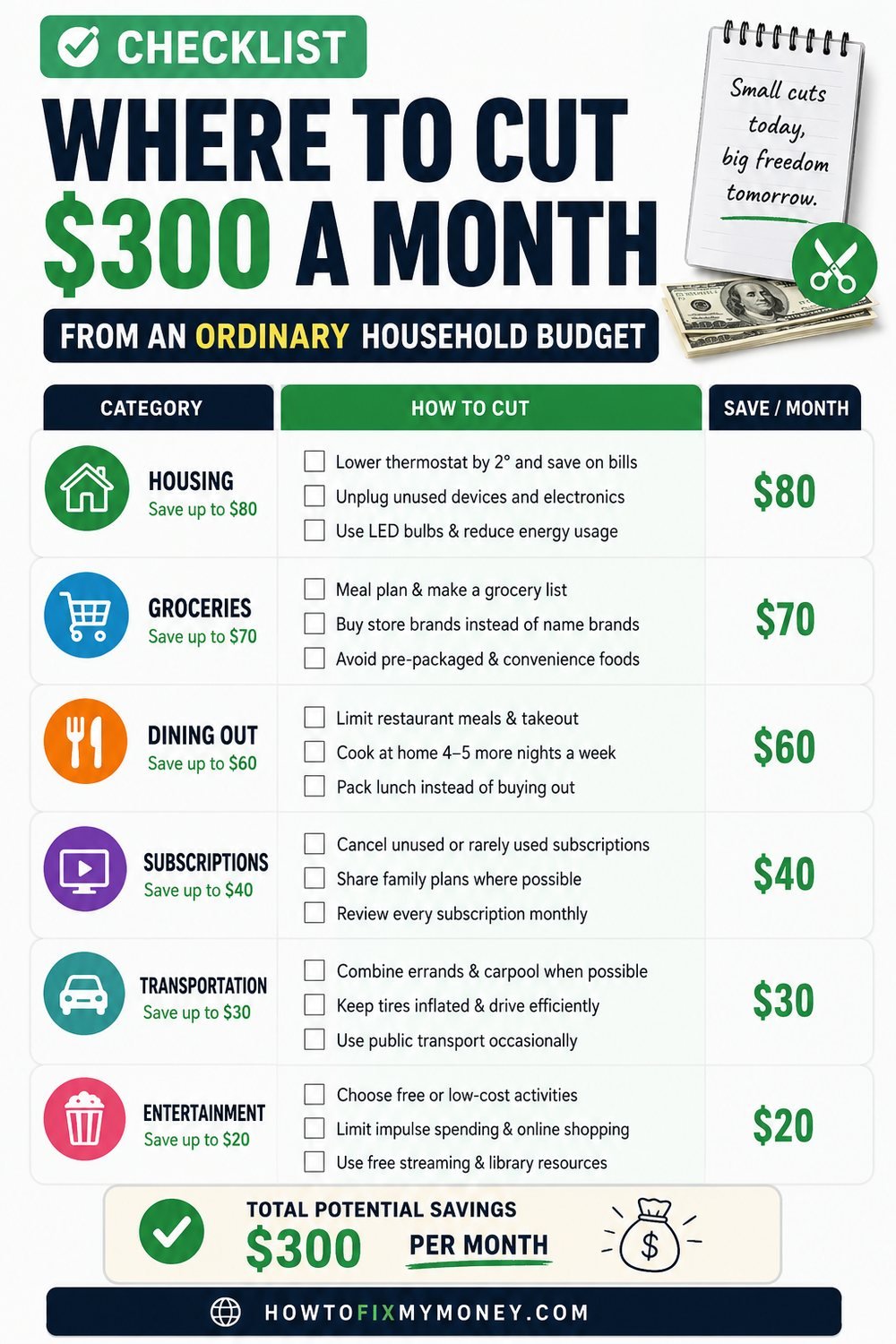
You can cut $300 a month out of an ordinary household budget without moving house, without giving up your car, and without living on rice and beans. Most people assume the only way to save real money is to change something big. It is not true, and the math is on your side.
Rent or mortgage is usually the largest line in any budget, which is exactly why it is the worst place to start. Moving costs money, takes months, and disrupts your job and your children’s schooling. Meanwhile the money you actually need is spread across eight or nine smaller bills that almost nobody looks at properly.
This guide shows you where that money hides, how much each area is typically worth, and how long each change takes. Work through it once and $300 a month is a realistic target for most households.
Why It Is Easier to Cut $300 a Month Than People Expect
Three hundred dollars sounds like a lot in one lump. Split across your whole budget it is much smaller than it looks.
If you have ten recurring costs, you only need to save thirty dollars on each. That is one phone call per bill. Nobody has to give up anything they love. You are not cutting your life; you are cutting the price you pay for the same life.
There is a second reason this works better than heroic budgeting. These are permanent cuts. Skipping coffee saves money on the days you remember to skip it. Renegotiating your phone plan saves money every single month for years without you thinking about it again. One afternoon of work, then it runs on its own.
Where the $300 Actually Hides
Here is the honest map of where the money is, roughly what each area is worth, and how hard it is to get.
| Area | Typical Monthly Saving | Effort | How Fast |
|---|---|---|---|
| Phone plan | $20 to $45 | One call | Same month |
| Internet and TV | $25 to $60 | One call | Same month |
| Car insurance | $20 to $70 | One hour | Next renewal |
| Forgotten subscriptions | $15 to $50 | Thirty minutes | Same week |
| Groceries | $40 to $100 | Ongoing habit | 2 to 4 weeks |
| Home energy use | $15 to $40 | One afternoon | 1 to 2 months |
| Bank and card fees | $10 to $35 | One call | Same month |
| Fuel and transport | $20 to $50 | Ongoing habit | Same month |
Add the low end of every row and you are already past the target. That is how you cut $300 a month without touching the biggest bill you have.
Start With the Big Three: Phone, Internet, and Insurance

If you only do one section of this article, do this one. These three are where the fastest money is, and they get you a third of the way to cutting $300 a month in about an hour.
Your Phone Plan
Phone companies price for people who do not check. Loyalty is punished, not rewarded. If you have been on the same plan for more than two years, you are very likely paying for data you do not use at a rate no new customer would accept.
- Check your actual data use in your phone’s settings for the last three months. Most people use far less than they pay for.
- Call and ask what plans are available for your usage. Say plainly that you are considering switching.
- Ask specifically about the retention or loyalty department. That is where the real offers are.
- Look at smaller carriers that run on the same networks. The coverage is identical and the price is often half.
- If you are on a low income, check whether you qualify for a federal discount program before you do anything else.
The FCC’s Lifeline program offers a monthly discount on phone or internet service for households that qualify. It is a genuine government program and it costs nothing to check.
Internet and TV
Introductory rates expire quietly. Most people never notice the month their bill went up, and once it has gone up it stays up until somebody complains.
Call and ask two questions. What promotional rates are available to me right now, and what would I pay as a new customer. If the second number is lower than what you are paying, say so directly and ask them to match it. Cancellation departments have far more authority than the general line, so ask to be transferred there if the first person cannot help.
Also check your speed. Many households pay for a package far faster than they need. If nobody in the house is gaming competitively or working with large video files, a cheaper tier usually makes no noticeable difference.
Car and Home Insurance
Insurance is the single most reliable place to find money, because the industry depends on people renewing without checking. Premiums often creep up every year for customers who never shop around.
- Get three quotes before your renewal date, not after.
- Take the best quote back to your current insurer and ask them to match it.
- Check whether bundling home and auto together is cheaper, and check whether it is cheaper apart. It varies more than people expect.
- Raise your deductible only if you have savings to cover it. Otherwise, you are trading a small monthly saving for a large risk.
Cut Subscriptions You Forgot You Were Paying For
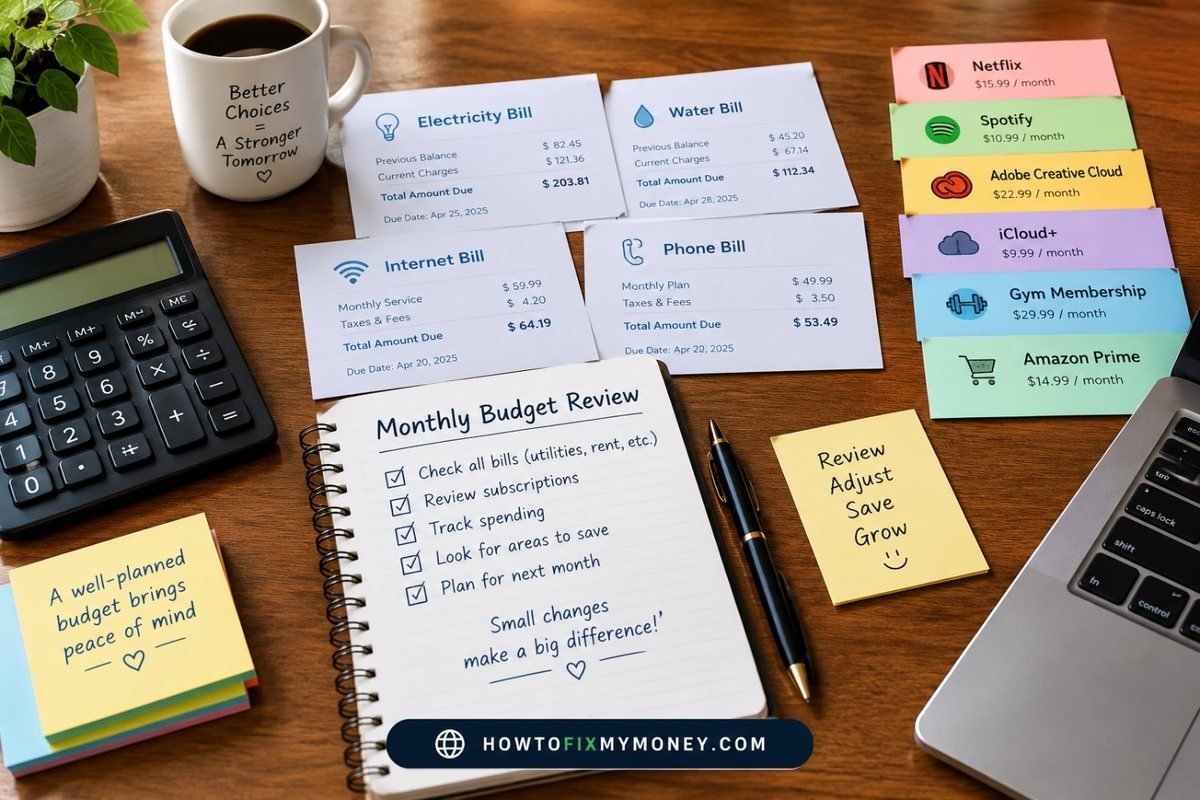
This is the fastest money in the entire article, and it is the easiest place to start if you want to cut $300 a month without any negotiating.
Open your bank statement and your card statement for the last three months. Go line by line. Write down every recurring charge. Almost everybody finds at least one thing they had completely forgotten, and many people find three or four.
- Streaming services nobody in the house has opened in months.
- Apps that quietly converted from a free trial to a paid plan.
- Gym memberships from a January that did not stick.
- Cloud storage on a tier far larger than you use.
- Old software subscriptions and website tools.
- Delivery memberships that made sense when you ordered weekly and no longer do.
For the ones you actually use, keep them. This is not about misery. It is about not paying for things that give you nothing.
One trick that works well for streaming: keep one service at a time rather than four, and rotate. Watch what you want on one, cancel it, move to the next. Nothing is lost and the saving is immediate.
Groceries: The Biggest Variable Cost in Most Homes
Food is where most households have the largest gap between what they spend and what they need to spend. It is also the area where advice usually turns preachy, so here are only the changes that actually move the number.
- Plan meals for the week before you shop, and shop from the list. This alone often cuts a bill by a fifth.
- Never shop hungry. It is a cliché because it is true and measurable.
- Check the unit price on the shelf label rather than the headline price. Larger is not always cheaper.
- Buy store brands for staples like flour, rice, pasta, canned goods, and cleaning products. The difference is usually the packaging.
- Cook once, eat twice. Doubling a recipe costs a fraction more and removes the day you would have ordered delivery.
- Keep a simple emergency meal in the cupboard for tired evenings. Delivery is what happens when there is nothing to cook.
Track your grocery spending for four weeks before you judge whether this is working. Food bills swing week to week, so a single week tells you nothing.
Energy, Water, and Everyday Utilities
Energy savings are smaller per change but they add up, and once made they last for years without any further effort.
- Wash clothes in cold water. Heating the water is most of the cost of a wash.
- Switch your most-used bulbs to LED. They cost a little now and less every month afterwards.
- Turn the water heater down slightly. Most are set higher than anyone needs.
- Add weatherstripping to doors and seal obvious gaps around windows.
- Check whether your provider offers budget billing, which spreads the yearly cost evenly and stops seasonal spikes.
The U.S. Department of Energy publishes free, practical guidance at Energy Saver, including which changes actually pay for themselves and how quickly.
Bank Fees, Card Fees, and Interest
This one is invisible to most people because the money never appears as a bill. It just quietly leaves.
- Check your account for monthly maintenance fees. Many banks waive them on request or offer a free account you were never told about.
- Overdraft and returned payment fees are worth eliminating entirely by moving your bill dates to just after payday.
- Card annual fees are worth paying only if you use the benefits. Most people do not.
- If you carry a balance, the interest is often the biggest fee of all. Reducing it is worth more than any other change on this list.
If interest is eating a large part of your budget, the order you pay debts in matters. Our comparison of the debt snowball and avalanche methods explains how to choose, and the free Debt Payoff Calculator shows what each approach would cost you.
Fuel and Getting Around
- Combine errands into one trip rather than several. Short cold journeys use disproportionately more fuel.
- Keep your tires properly inflated. Under-inflated tires cost you fuel on every journey.
- Use a fuel price app rather than filling up wherever you happen to be.
- If two people in the house drive the same route, share it even two days a week.
- Check whether your employer offers a transit benefit. Many do and never mention it.
A Sample Plan to Cut $300 a Month
Here is what a realistic version looks like for an ordinary household. Nothing dramatic, nothing that requires moving house.
| Change | Monthly Saving | How Long It Took |
|---|---|---|
| Switched phone plan | $35 | One 15-minute call |
| Renegotiated internet | $30 | One 20-minute call |
| Reshopped car insurance | $45 | One hour, three quotes |
| Cancelled four subscriptions | $38 | Thirty minutes |
| Meal planning and store brands | $80 | Ongoing habit |
| Cold washes and LED bulbs | $22 | One afternoon |
| Moved to a fee-free bank account | $12 | One visit |
| Combined errands, fuel app | $38 | Ongoing habit |
| Total | $300 | About one weekend of effort |
That is one way to cut $300 a month, and your own version will look different. Some of these will not apply to you and others will be worth more than shown. The point is the shape of it: eight small changes, not one heroic sacrifice.
What to Do with the Money Once You Cut $300 a Month
This is the step people skip, and skipping it is how the money quietly disappears into ordinary spending within two months.
Decide where it goes before you free it up, and automate the transfer for the day after payday so it moves before you see it.
- Build a small starter emergency fund first, so one surprise does not put the whole plan back on a credit card.
- Then send it to debt, where it does the most work while interest rates are high.
- Once you are debt free, redirect the same amount to savings rather than letting it dissolve into lifestyle spending.
Three hundred dollars a month is not a small amount when it is aimed at something. Put against debt, it is the difference between a plan that takes five years and one that takes two.
If some of your bills are currently behind, deal with that before you redirect anything. Our guide for when you are behind on every bill explains which bills to protect first.
Mistakes People Make When They Try to Cut $300 a Month
- Cutting everything at once. A budget with no flexibility breaks within weeks. Make permanent structural cuts, not heroic ones.
- Focusing only on small treats. Cancelling coffee while overpaying eighty dollars on insurance is effort in the wrong place.
- Not writing down what you saved. If the money is not tracked and moved, it gets absorbed by everyday spending.
- Cancelling insurance cover rather than reshopping it. Cheaper is only better if you are still properly covered.
- Using a balance transfer or a new card to feel like you have saved money. That moves a cost, it does not remove one.
- Giving up because the first call did not work. The second company usually says yes.
Where to Get Free Help
- MyMoney.gov has free budgeting worksheets and money basics from the U.S. government.
- The Federal Trade Commission publishes plain-English guidance on building and keeping a budget.
- The U.S. Department of Energy explains which home energy changes are actually worth making.
Non-profit credit counseling agencies also offer free budget reviews. A legitimate one will never charge you before doing any work.
Frequently Asked Questions
Is it realistic to cut $300 a month?
For most households with several recurring bills, yes. It usually comes from six to eight small changes rather than one large one. Households already on a very tight budget may find less, but even a hundred dollars is worth having.
What is the fastest way to cut $300 a month?
Start with subscriptions, then phone, then internet, then insurance. Those four can often be done in a single afternoon and typically account for more than half the target.
How do I cut $300 a month if I am already frugal?
Look at fixed costs rather than spending habits. Insurance, phone, internet, and interest rates are where careful people usually still overpay, because those bills are set once and forgotten.
Should I cancel my insurance to save money?
No. Reshop it instead. Cutting cover to save twenty dollars a month is a bad trade if it leaves you exposed to a bill you could not pay. Compare quotes for the same level of cover.
How long does it take to cut $300 a month?
Subscriptions and phone plans show up in the same billing cycle. Insurance usually applies at renewal. Grocery and fuel changes take three or four weeks to show clearly, because those bills vary week to week.
What should I do with the money I save?
Automate it out of your account the day after payday. Build a small emergency buffer first, then put the rest toward debt. Money that stays in your checking account gets spent.
Will cutting bills hurt my credit score?
No. Cancelling subscriptions and switching providers has no effect on your credit score. Closing a long-held credit card can affect it, so leave old cards open even if you stop using them.
Final Thoughts
You do not need a bigger income or a cheaper house to cut $300 a month. You need one afternoon, a list of your recurring bills, and a willingness to make eight phone calls.
Start with the subscription audit today, because it takes thirty minutes and needs nobody’s permission. Then work down the list one bill at a time. Each change you make keeps paying you every month afterwards, without any further effort.
Once the money is freed up, put it to work. See what it does to your timeline with the Debt Payoff Calculator, or read more guides in our Money Fixes section.