
Being behind on every bill is a completely different problem from ordinary budgeting, and it needs a different plan. Most budgeting advice assumes you start the month with enough money and just need to organize it. That advice is useless when the rent is late, two cards are past due, and the phone keeps ringing.
This guide is written for the other situation. It does not assume you have spare money. It assumes you have less money than bills, and it walks you through what to pay, what to delay, and how to get back to a normal month.
The first thing to understand is that being behind is a cash flow problem before it is a budgeting problem. You can’t organize your way out of a shortfall. You have to decide, on purpose, which bills get paid and which ones wait. Doing that deliberately is far better than letting it happen by accident.
Here are six important steps that will help you budget when you’re already behind on every bill.
Step One: Write Down Every Bill You Are Behind On
You cannot make good decisions with a list in your head. Sit down with one page and write out three things.
- Every bill you owe, how much it is, and how far behind you are.
- Every dollar coming in this month, and the exact date it arrives.
- The absolute minimum you need to survive: food, transport to work, and any medication.
This will feel awful for about ten minutes. Do it anyway. Almost everyone finds the total is smaller than the version they had been carrying around in their head. Fear grows in the dark, and a written list turns a vague dread into a set of numbers you can work with.
Step Two: Sort Your Bills into Four Groups
Not all bills carry the same consequence for being late. This is the part most people get wrong. They pay whoever shouts loudest, which is usually the credit card company, while the bills that actually matter slide. Sort them like this.
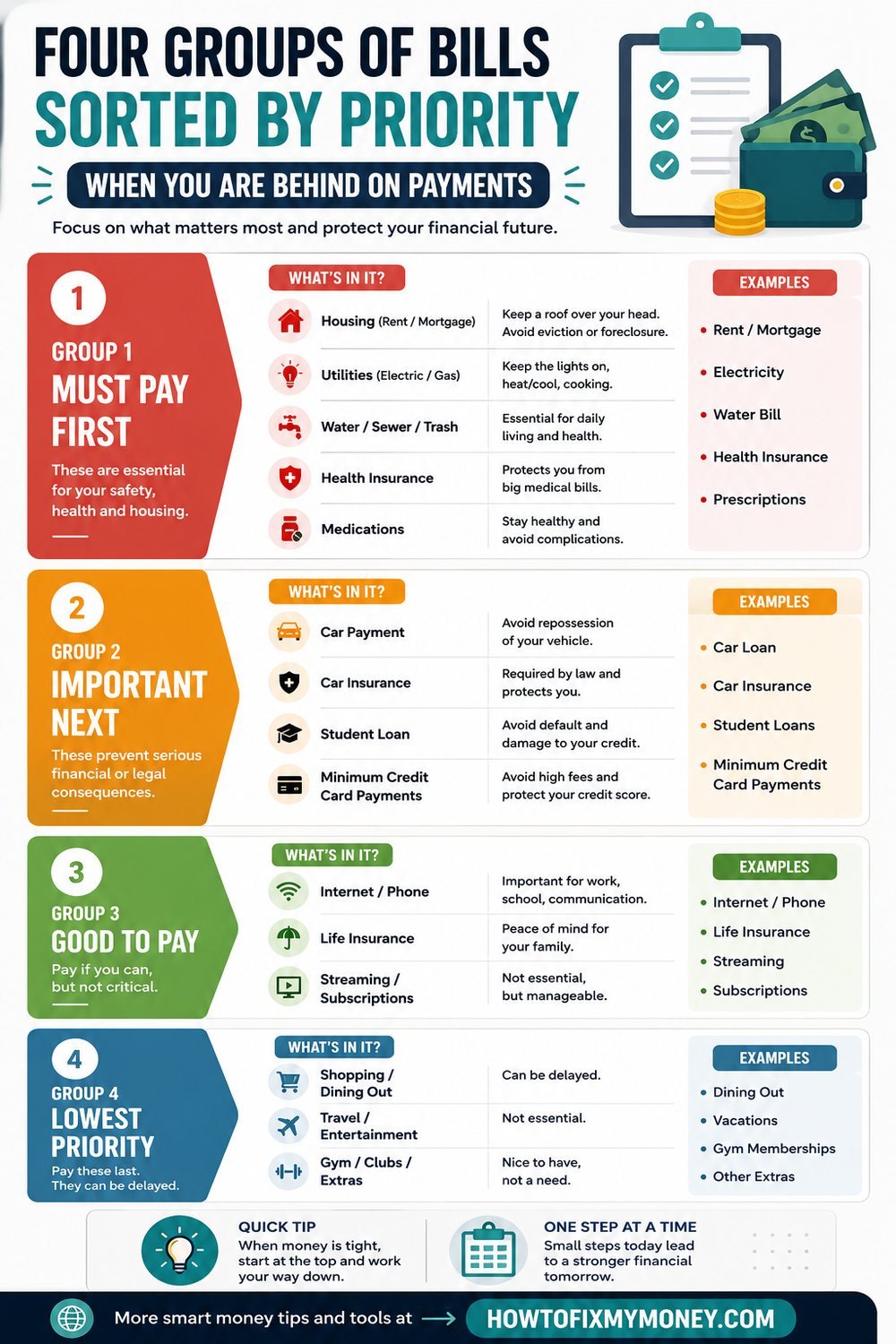
| Priority | What Goes In It | Why It Matters |
|---|---|---|
| Group 1 — Must pay first | Housing, electricity and gas, water, health insurance, medications, food, transport to work | Missing these costs you your home, your health, or your job |
| Group 2 — Important next | Car payment, car insurance, child support, court fines, taxes, minimum credit card payments | Repossession, legal action, wage garnishment, or heavy fees |
| Group 3 — Good to pay | Internet and phone, life insurance, streaming and subscriptions | Important for work and family, but not survival |
| Group 4 — Lowest priority | Shopping, dining out, travel, entertainment, gym and clubs | Nice to have, not a need. Pause these entirely for now |
Pay them in that order. Group one first, every time, even if it means a credit card goes another month unpaid. A damaged credit score is repairable. An eviction is much harder to come back from.
This ordering feels wrong at first, because unsecured lenders are the ones who call you. That is exactly why they sit lower down. The lenders with the least power usually make the most noise.
A Note on Medical Bills
Medical bills are usually one of the safest things to delay. They generally carry no interest, hospitals are often willing to set up very small payment plans, and medical debt is treated differently from other debt on your credit report. Call the billing department and ask about a payment plan or financial assistance before you pay anything else on it.
Step Three: Build a Bare Bones Budget
A bare bones budget is not a normal budget with a few things trimmed. It is the smallest version of your life that still works, run on purpose for a short period until you are current again.
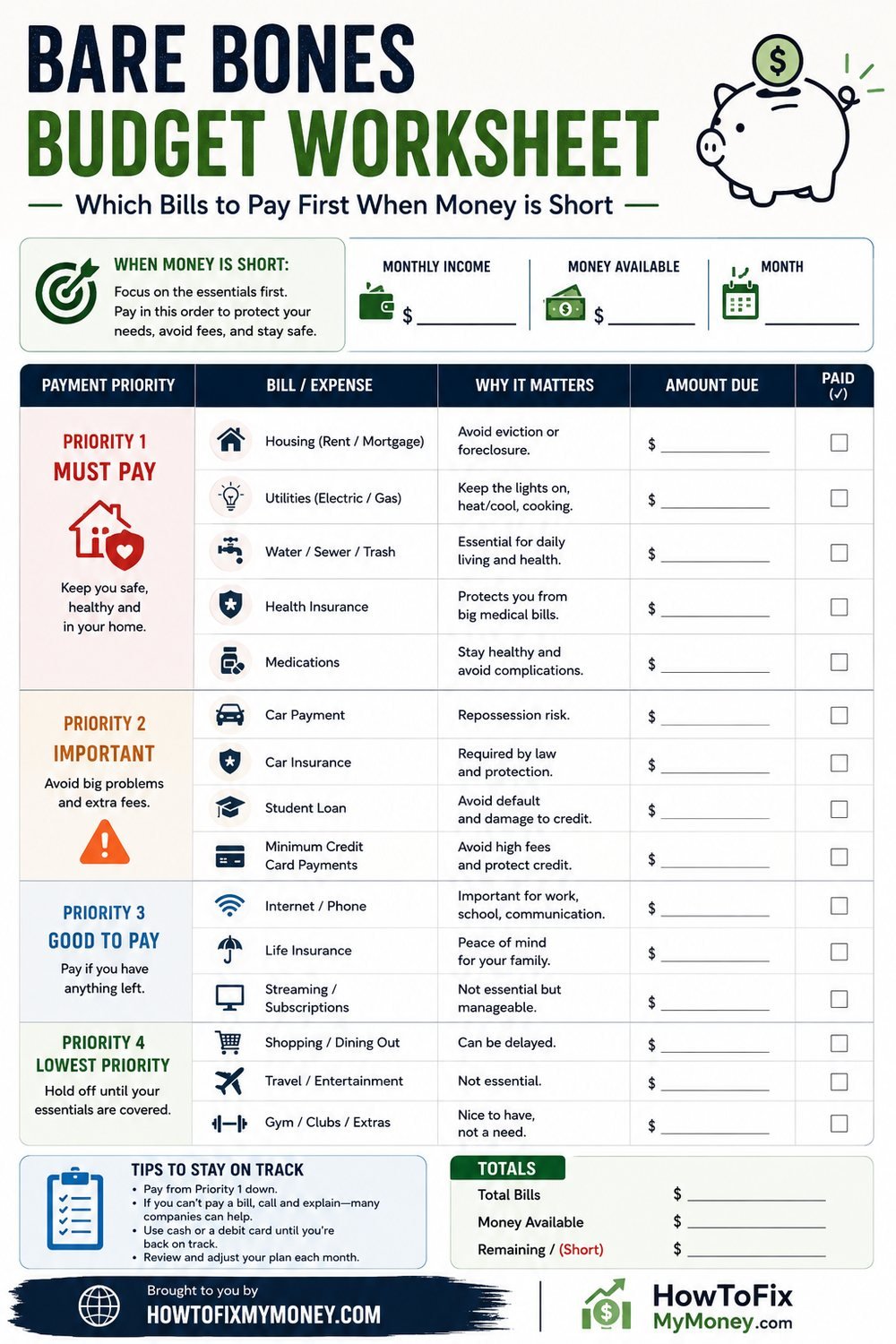
Here is what a bare bones month looks like for a household bringing in two thousand four hundred dollars.
| Expense | Amount | Notes |
|---|---|---|
| Rent | $1,100 | Group one, paid first, no exceptions |
| Power and water | $180 | Group one |
| Food | $320 | Cook at home, no delivery, no takeout |
| Transport to work | $160 | Fuel or transit pass only |
| Phone | $40 | Move to the cheapest plan that works |
| Minimum debt payments | $300 | Paid after the essentials |
| Buffer | $100 | For the thing that always goes wrong |
| Left over | $200 | Goes to whichever bill is furthest behind |
Notice two things. There is nothing in there for entertainment, subscriptions, or clothes. And there is still a buffer, because a bare bones budget with no buffer breaks the first time a tire goes flat.
This is temporary. You are not living like this forever. You are living like this for two or three months while you catch up.
Step Four: Call Your Creditors Before They Call You
This is the step almost everyone skips, and it is the one that changes the most. Companies have hardship programs they do not advertise. They will not offer them to you. You have to ask.
A call takes about ten minutes and sounds like this: you explain that you have had a drop in income, you say you want to stay current, and you ask what hardship options are available on the account.
What you might be offered depends on the type of bill.
- Utilities often have budget billing, which spreads your yearly cost evenly, or a payment arrangement that splits the arrears over several months.
- Credit card issuers may offer a reduced interest rate, a waived late fee, or a short-term hardship plan with lower payments.
- Landlords will often accept a written payment plan rather than start an eviction, because eviction costs them money too.
- Auto lenders sometimes allow a deferment, which moves one or two payments to the end of the loan.
Two rules for these calls. Never agree to a payment you cannot actually make, because breaking a hardship arrangement is worse than never having one. And always get the agreement in writing or by email before the next due date.
Step Five: Find Money You Are Not Currently Using
When you are behind, small amounts matter more than they normally would. Fifty dollars is the difference between a payment arrangement holding and breaking.
- Cancel every subscription for now. All of them. You can add back the ones you miss in three months.
- Check for unused direct debits. Old gym memberships and forgotten app subscriptions are extremely common.
- Lower your phone and internet plans. A single call often saves twenty to forty dollars a month.
- Check whether you are entitled to benefits or local assistance you are not claiming. Many people are not.
- Sell one thing you own and do not use. Not everything, just one thing, this week.
Step Six: Decide the Order You Will Catch Up In
Once you have stopped the bleeding and you have a small amount spare each month, you need a plan for the arrears. Take the bill you are furthest behind on within group one, and clear that first. Housing and power always come before anything else.
Once your essential bills are current, you can move on to a proper debt payoff plan. Our guide comparing the debt snowball and avalanche methods explains the two main options, and you can map out your own timeline with the free Debt Payoff Calculator.
What Not to Do When You Are Behind on Every Bill
- Do not take a payday loan. The rates are extreme and they turn a bad month into a bad year.
- Do not pay one card with another card. The balance moves, it does not shrink, and you usually add a fee.
- Do not ignore letters. Unopened mail does not stop anything happening, it just removes your chance to respond in time.
- Do not pay a company that promises to fix your credit for an upfront fee. Charging before delivering results is not allowed under federal rules.
- Do not drain a retirement account. The tax and penalties usually cost more than the debt you are clearing.
Where to Get Free Help
You do not have to pay anyone for good advice about this. Several free resources exist.
- The Consumer Financial Protection Bureau explains your rights and what collectors can and cannot do.
- The Federal Trade Commission has straightforward guidance on dealing with debt and spotting scams.
- USA.gov links to government help with debt and benefits you may qualify for.
Non-profit credit counseling agencies also offer free budget sessions. A legitimate one will never charge you before doing any work and will never promise to make your debt disappear.
Frequently Asked Questions
Which bill should I pay first when I cannot pay them all?
Housing first, then power and water, then food and transport to work. Those are the bills where being late costs you your home or your income. Credit cards and medical bills come lower down, because their consequences are financial rather than immediate.
Will skipping a credit card payment ruin my credit score?
One missed payment does damage your score, and it stays on your report for several years. But it is repairable over time. Losing your housing or your car is much harder to recover from, which is why those bills come first.
Should I use my emergency fund to catch up?
Yes, if you have one and you are behind on group one bills. That is exactly what it is for. Keep a small amount back rather than emptying it completely, so one surprise does not put you straight back where you started.
Can I negotiate with a company myself?
Yes. You do not need to pay anyone to do it for you. Call, explain your situation clearly, and ask what hardship options exist. Most large companies have them and most people never ask.
How long does it take to catch up on bills?
For most households it takes two to four months of a bare bones budget to get current, assuming income has stabilized. If the shortfall is caused by ongoing lower income rather than a one-off event, you may need a permanent change to the budget rather than a temporary one.
Is bankruptcy an option?
It is, in some situations, but it is a serious step with long-lasting consequences and it should never be a first move. Speak to a qualified professional before considering it, and try hardship arrangements and free credit counseling first.
Final Thoughts
Being behind on every bill feels like a personal failure, but it is usually just arithmetic. Income dropped, or costs rose, and the gap has to be closed somewhere.
Write the list. Sort the bills into the four groups. Pay group one first, ask for hardship help on the rest, and hold a bare bones budget for two or three months. That is the whole plan, and it works far more often than people expect.
When your essential bills are current again, come back and build a payoff plan with the Debt Payoff Calculator, or browse more guides in our Money Fixes section.